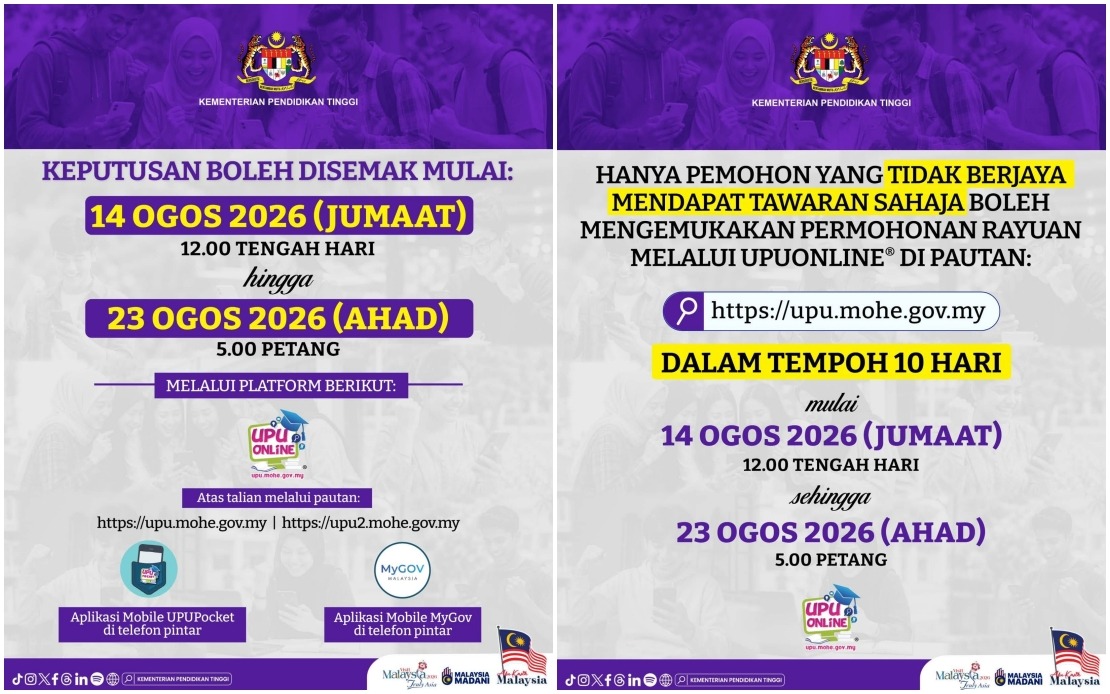
Hundreds of thousands of Malaysian secondary school leavers will discover their university placements on August 14, when the Ministry of Higher Education releases the outcomes of applications for the 2026/2027 academic intake through the centralised UPUOnline portal. The announcement marks a critical juncture in the higher education journey for students who have completed their STPM or equivalent qualifications and applied for admission to Malaysia's public universities.
Prospective undergraduates will be able to access their admission decisions starting from noon on August 14 through three digital channels: the official UPU website at https://upu.mohe.gov.my, the alternative UPU portal at https://upu2.mohe.gov.my, and through mobile applications including UPUPocket and Mobile MyGov. This multi-platform approach reflects the government's push to ensure accessibility for applicants across different technological preferences and connectivity situations. The results window remains open until 5 pm on August 23, providing a ten-day period for candidates to review their placement outcomes.
Following the release of initial results, the confirmation phase begins immediately on August 15, with candidates required to respond to their offers through individual university websites. This compressed timeline reflects the administrative urgency of finalising the student cohort before the academic year commences. Successful applicants must formally accept or decline their offers within the designated nine-day window, a process that allows universities to gauge acceptance rates and prepare for incoming cohorts. The Ministry of Higher Education has clarified that official offer letters will only be issued by universities after candidates confirm their willingness to accept the placement during this confirmation period.
For applicants who do not receive an initial offer, a formal appeals mechanism exists within the UPUOnline system. Students facing rejection can lodge appeals between August 14 and August 23, provided they submit their applications within the ten-day window. The appeals process operates under a specific criterion: unsuccessful candidates may only be reconsidered if vacancies emerge following the completion of new student registration at public universities. This approach ensures fairness by preventing the displacement of confirmed admissions while simultaneously giving rejected applicants a pathway to gainful reconsideration.
The Ministry has emphasised that placement offers for the 2026/2027 academic session are final and binding. Once a candidate accepts an offer, they cannot subsequently request transfers to alternative programmes or universities. This immutability in the offer decision underscores the finality of the UPU allocation process and encourages applicants to carefully consider their options before confirmation. Such restrictions exist partly to stabilise enrolment planning across public universities and partly to prevent logistical chaos that could arise from last-minute programme changes.
The timing of this announcement comes as Malaysia continues to grapple with the balance between demand for higher education and capacity constraints within the public university system. The STPM pathway remains one of the primary routes through which domestic students access public university places, alongside matriculation programmes and other pre-university qualifications. The August 14 release affects not only direct STPM graduates but also holders of equivalent qualifications, broadening the pool of applicants awaiting placement decisions.
For Malaysian families and students, the August 14 announcement carries substantial weight in terms of future career trajectories and socioeconomic mobility. Public university admissions determine which graduates emerge with state-subsidised degrees, a significant advantage given the cost differential with private institutions. The centralised nature of UPUOnline means that millions of families will simultaneously receive news of their children's placements, creating a defining moment in the annual education calendar comparable to national examination results announcements.
The provision of multiple access channels for results reflects lessons learned from previous application cycles where digital bottlenecks and server overloads hindered timely access. By offering both web-based and mobile application routes, the Ministry aims to distribute traffic and prevent the platform crashes that have historically frustrated applicants during high-volume result releases. The extended nine-day confirmation window also provides buffer time for technical issues and ensures that candidates with connectivity constraints can still engage with the system.
Universities themselves will be preparing extensively for the August 15 commencement of confirmation activities, as administrative staff manage acceptances, rejections, and subsequent appeals. The coordination required across Malaysia's network of public universities—processing potentially hundreds of thousands of individual responses—represents a significant operational undertaking. Universities must simultaneously prepare accommodation, course scheduling, and orientation activities for confirmed students while maintaining appeals systems for disappointed applicants.
For regional Southeast Asian observers, Malaysia's centralised UPUOnline system demonstrates a structured approach to managing mass higher education admissions. The system's emphasis on transparency, accessibility through multiple digital platforms, and formal appeals mechanisms reflects evolving best practices in education administration. The August 14 results release will serve as a test of system robustness and administrative efficiency as Malaysia scales its university admissions infrastructure to accommodate growing secondary school populations.

