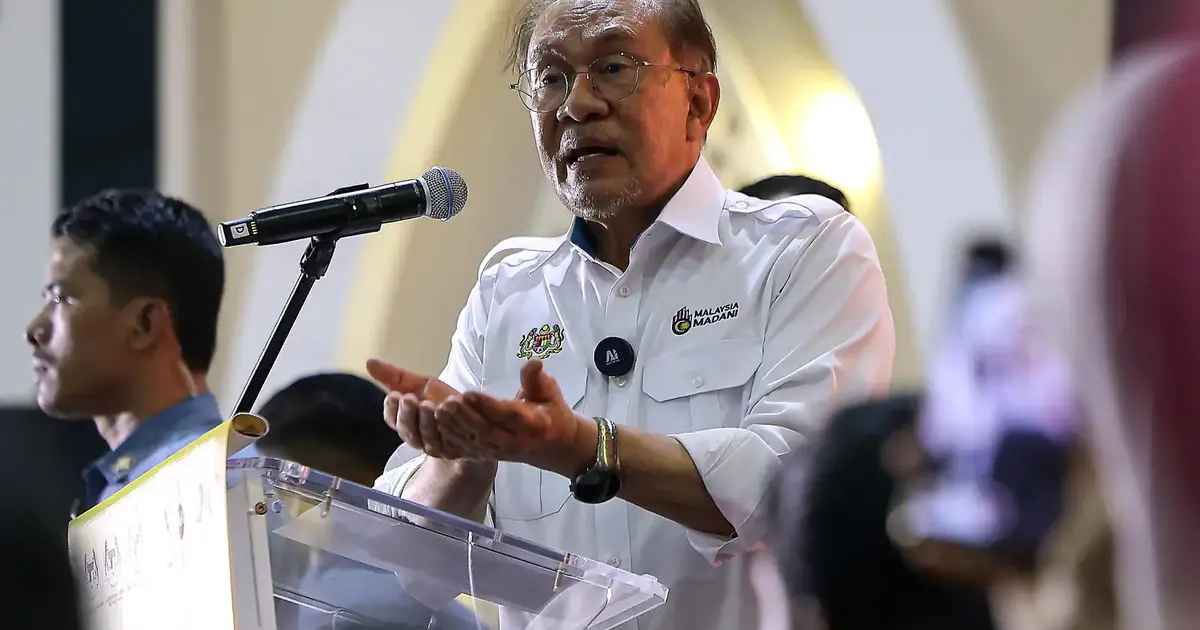
Prime Minister Anwar Ibrahim has pushed back against contentions that advocating for the rights of Malaysian Chinese and Indian communities necessarily erodes Islam's standing or the constitutionally entrenched position of the Malay-Muslim majority. His remarks strike at a persistent tension in Malaysian politics where defenders of minority interests often face accusations of undermining the foundational social contract enshrined in Article 153 of the Federal Constitution.
Anwar's position reflects a recalibration of how Malaysia's leadership frames the relationship between protecting vulnerable groups and preserving the constitutional settlement that has underpinned the nation's stability since independence. Rather than treating these commitments as opposing forces locked in zero-sum competition, the Prime Minister suggests they represent complementary pillars of inclusive governance that need not contradict one another.
The statement arrives at a time when Malaysian politics remains deeply segmented along ethno-religious lines, with periodic flare-ups over language rights, education policy, and representation in public institutions. Conservative voices—both Malay-Muslim and within other communities—often weaponise appeals to constitutional protections whenever discussions turn to addressing historical grievances or ensuring equitable treatment for minority populations. This rhetorical strategy has historically made it politically costly for mainstream leaders to champion minority causes without simultaneously reassuring the majority that such advocacy does not undermine established arrangements.
Understanding Malaysia's constitutional architecture proves essential for contextualising Anwar's remarks. Article 153 guarantees special rights for Malays and indigenous groups in Sabah and Sarawak, including preferences in the civil service, business licences, and higher education. These provisions were agreed upon during the transition to independence as part of a broader bargain in which the Malay and indigenous communities accepted citizenship for immigrant populations of Chinese and Indian descent. The bargain has always been delicate, and both sides have accused the other of reneging on implicit commitments.
Yet defenders of minority rights have long contended that Article 153 does not mandate discrimination or prevent the state from ensuring that Chinese and Indian Malaysians enjoy fundamental freedoms and equitable access to public services. Legal scholars and civil society organisations have frequently argued that upholding minority protections actually reinforces constitutional stability by reducing grievances and building confidence in the legal system across all communities. When citizens believe institutions treat them fairly regardless of ethnicity or religion, the social fabric strengthens rather than frays.
Anwar's framing also reflects the growing internationalisation of Malaysian governance concerns. As Malaysia increasingly integrates into global supply chains and competes for foreign direct investment, international investors and labour partners have raised questions about the country's record on minority rights, religious freedom, and ethnic relations. Multicultural competence—the ability to manage diverse populations equitably—has become a strategic asset in attracting talent and capital. A Prime Minister who can credibly argue that Malaysia successfully balances majority protections with minority safeguards enhances the nation's reputation internationally.
Within the ruling coalition, Anwar must navigate between Malay-Muslim-dominated parties dependent on preserving Article 153 and non-Malay partners—particularly the Democratic Action Party, which has consistently advocated for removing ethnicity-based provisions from law and policy. The PKR leader's attempt to position himself as capable of defending both sets of interests simultaneously reflects the intellectual difficulty of governing a society fractured by constitutional arrangements that privilege one ethnic group. Few leaders have successfully articulated a vision in which Muslim-Malay protections and minority rights reinforce rather than undermine each other.
The practical implications of Anwar's argument remain contested. Critics from Malay-Muslim organisations argue that erosion of Malay economic advantages through affirmative action programme relaxation, for instance, represents exactly the kind of constitutional compromise they fear. Meanwhile, minority rights advocates question whether symbolic commitments translate into substantive policy changes that benefit Chinese, Indian, or indigenous minority populations. The gap between rhetorical endorsement and implementation has historically plagued such initiatives in Malaysia.
Anwar's remarks also occur within a broader global conversation about majority-minority relations in plural democracies. Countries like India, Nigeria, and Indonesia have all grappled with similar tensions between constitutional protections for majorities and the imperatives of protecting vulnerable minorities. Malaysia's unique feature is that its constitutional settlement explicitly names and legally protects majority privileges in a way that democratic constitutions typically avoid, making the intellectual challenge of reconciling both sets of rights particularly acute.
Looking forward, the Prime Minister's position suggests that his administration intends to position itself as steward of both constitutional stability and incremental progress on minority rights rather than defender of zero-sum ethnic interests. Whether this middle path proves politically sustainable remains uncertain, particularly as electoral pressures push competing coalition partners toward maximalist positions. Nonetheless, Anwar's effort to decouple minority rights advocacy from constitutional revisionism may offer a template for other Malaysian leaders attempting to broaden their appeal across ethnic and religious divides without triggering backlash from those invested in existing arrangements.

