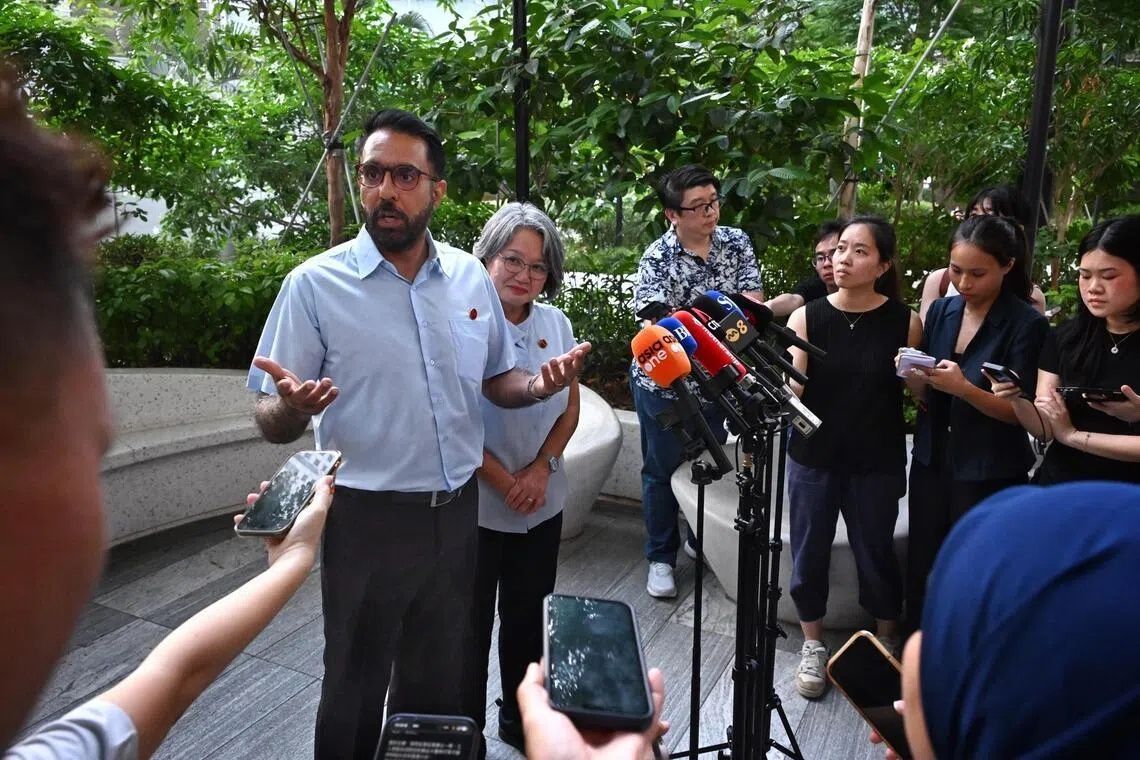
Pritam Singh's continued tenure as leader of Singapore's largest opposition party was confirmed on June 28 when party cadres voted to retain him, despite a concerted effort by unhappy members to force his resignation. The Workers' Party chief faced an internal challenge from a faction of 25 disgruntled party members who had formally petitioned for his removal, yet emerged from the proceedings with his authority substantially reinforced rather than diminished.
The mechanics of Singh's re-election reveal the depth of his support within the party hierarchy. Approximately 80 per cent of the inner circle—a body comprising slightly more than 100 senior party figures—voted to keep him in position during a secret ballot held at a special cadres conference. Gerald Giam, the Aljunied GRC MP who presided over the meeting, characterised the backing as exceeding a supermajority threshold, suggesting Singh retained the backing of most who participated. This decisive outcome followed a single round of voting in which cadres were afforded the opportunity to raise concerns and Singh delivered a comprehensive statement addressing their questions, according to Giam's account.
The timing and context of this internal contest underscore the substantial pressures that have beset Singapore's opposition politics in recent years. Singh's difficulties trace to the 2021 parliamentary scandal involving former Sengkang GRC MP Raeesah Khan, who fabricated allegations of sexual harassment and misled Parliament. Singh was subsequently found to have provided guidance that enabled Khan to perpetuate her falsehood for an extended period. This breach of parliamentary conduct standards resulted in his conviction for lying to a parliamentary committee, a judgment that survived High Court appeal in December 2025.
The legal consequences of Singh's entanglement with Khan's misconduct have been severe. Parliament's Committee of Privileges formally determined that Singh had contravened parliamentary norms through his actions, whilst the courts upheld criminal findings against him. Subsequently, Prime Minister Lawrence Wong moved to disqualify Singh from the role of Leader of the Opposition in January 2026, a position traditionally held by the head of the largest opposition party. Wong extended an invitation to the Workers' Party to nominate an alternative MP for the post, but the party declined, asserting that the role properly belongs to the leader of the opposition's largest parliamentary contingent.
The Workers' Party's steadfast backing of Singh despite these setbacks carries significant implications for Singapore's opposition landscape and the broader principles of internal party democracy. The petition submitted by 25 cadres in December 2025 had sought to trigger Singh's removal through three distinct mechanisms: compelling him to account for his conduct, demanding his resignation, and mandating a leadership vote. That the party membership ultimately rejected all three demands—with only a single round of voting required—suggests a clear consensus that Singh's continuation serves the party's interests more effectively than a transition to alternative leadership.
Former Workers' Party chief Low Thia Khiang's explicit endorsement on the morning of June 28 proved instrumental in consolidating Singh's position. Low's statement to media affirming continued support for Singh laid to rest months of speculation about whether the elder statesman might withdraw backing or signal openness to a successor. Low's intervention appeared calculated to prevent the dissident faction from identifying a credible challenger, effectively narrowing the internal contest to a binary choice: retain Singh or risk destabilisation through an untested alternative. The fact that no serious challenger emerged suggests Low's endorsement effectively closed off that avenue for the protest faction.
The Workers' Party subsequently proceeded with its biennial internal elections later on June 28, returning Sylvia Lim as chair—a position she has occupied continuously since 2003. The election of 12 central executive committee members followed, predominantly comprising incumbents from the previous CEC. Notably, four of these twelve positions went to members not currently serving as MPs: Low Thia Khiang, former Aljunied GRC MP Faisal Manap, long-serving CEC stalwart Tan Kong Soon, and senior counsel Harpreet Singh, who ran as part of the Workers' Party's Punggol GRC slate in the May 2025 general election.
Harpreet Singh's election to the central executive committee and his subsequent LinkedIn post characterising cadres' decision as deliberate rather than reflexive provides a revealing window into how party members have reconciled support for Singh with acknowledgment of his legal troubles. Singh contended that the vote reflected careful evaluation of Singh's track record rather than blind partisan loyalty. He specifically highlighted Singh's sustained service under intense political pressure and his measured leadership during a period when the Workers' Party achieved parliamentary milestones, whilst explicitly disclaiming any intention to minimise the court's judgment. This formulation allows party members to affirm their leader whilst simultaneously respecting legal outcomes—a delicate balancing act that Singh's supporters clearly felt necessary to articulate.
The party's earlier disciplinary process had already subjected Singh to formal accountability mechanisms. A panel comprising Sengkang GRC MPs Jamus Lim and He Ting Ru, along with former Hougang MP Png Eng Huat, conducted an investigation into Singh's conduct relating to Khan's parliamentary falsehoods. The panel determined that Singh had breached two articles of the Workers' Party Constitution through his actions. The central executive committee subsequently issued a formal letter of reprimand to Singh in response to these findings, preceding the June 28 special cadres conference by approximately two months.
For Malaysian and Southeast Asian observers, the Workers' Party's handling of internal dissent offers insights into how opposition parties in the region navigate leadership crises whilst maintaining institutional coherence. Many Southeast Asian opposition movements have fragmented under pressure from legal challenges, factional disputes, or demands for leadership change. The Workers' Party's decision to subject Singh to both rigorous internal investigation and a democratic confidence vote—whilst ultimately retaining him—demonstrates institutional mechanisms designed to balance accountability with continuity. This approach contrasts with opposition movements elsewhere in the region that have either capitulated entirely to government pressure or fractured irreparably under internal stress.
Singh's reinstatement as leader consolidates opposition party stability at a moment when Singapore's parliamentary landscape has undergone recent electoral change. The May 2025 general election saw the Workers' Party make gains, strengthening its position as Singapore's principal opposition voice. Singh's continued leadership now provides continuity for the party to develop policy platforms and consolidate its parliamentary presence. However, his removal from the formal Leader of the Opposition position—a role now technically vacant—creates an unusual constitutional arrangement whereby Singapore's opposition lacks a designated parliamentary counterweight to the government, a gap that may have longer-term implications for parliamentary discourse and accountability mechanisms.
The Workers' Party's internal proceedings reflected what Gerald Giam characterised as "robust and civil discussion," suggesting that intense disagreement need not produce acrimony or institutional fracture. The petition process allowed dissidents to formally register concerns, the special conference provided a forum for contentious issues to be aired, and the secret ballot ensured that the decisive vote occurred free from social pressure or public intimidation. This procedural integrity appears to have provided sufficient legitimacy to the outcome that even unsuccessful dissenters indicated acceptance of the democratic result. For opposition movements across Southeast Asia wrestling with internal crises and leadership disputes, the Workers' Party's procedural approach may offer a model for maintaining institutional cohesion whilst respecting both accountability and democratic choice.

