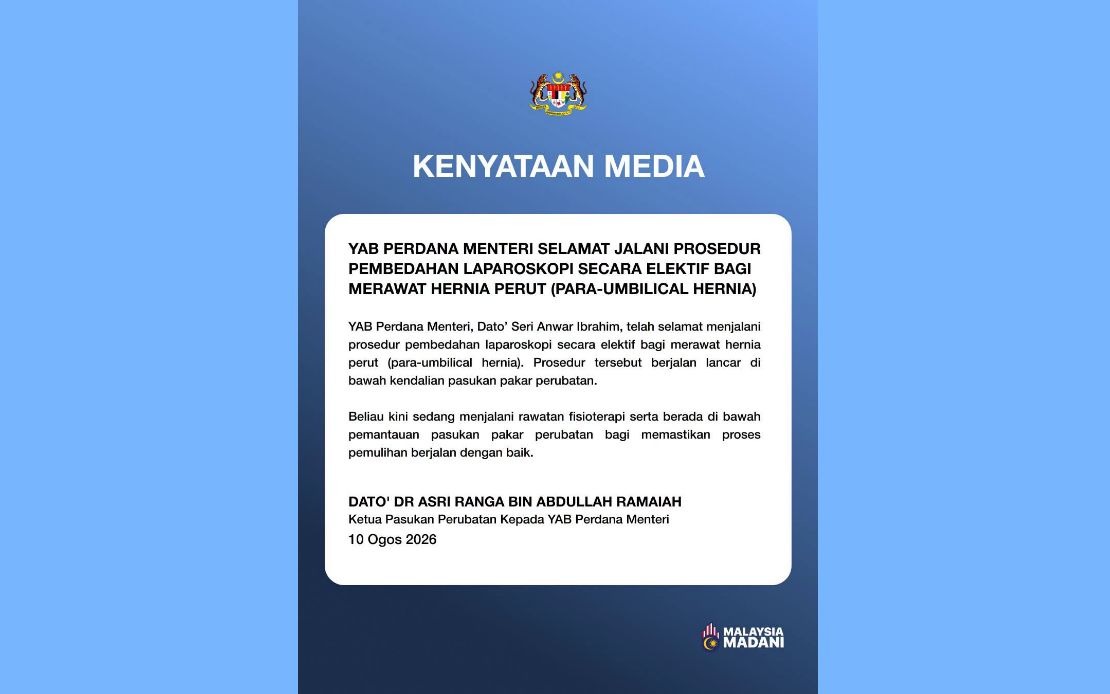
Prime Minister Datuk Seri Anwar Ibrahim has successfully completed an elective laparoscopic surgical procedure to address a para-umbilical abdominal hernia, according to an official statement released on Saturday. The minimally invasive operation, which represents a routine but necessary intervention for the country's leader, proceeded without complications under the care of an experienced surgical team. The timing of the procedure reflects a deliberate decision by the Prime Minister's office to address the condition during a planned medical schedule rather than allowing it to develop into a more pressing health matter.
Datak Dr Asri Ranga Abdullah Ramaiah, who heads the Prime Minister's medical team, confirmed that the laparoscopic approach—a technique that requires only small incisions and uses a camera to guide the surgeon—went smoothly. This minimally invasive method typically results in faster recovery times and reduced postoperative discomfort compared to traditional open surgery. The choice of this surgical technique underscores the medical team's commitment to ensuring the Prime Minister can return to full duties as quickly as possible, a consideration that takes on particular significance given Malaysia's ongoing domestic and regional responsibilities.
Following the completion of surgery, Anwar has transitioned into the recovery and rehabilitation phase of his treatment. He is currently engaged in physiotherapy sessions designed to restore muscle strength and mobility, procedures that are standard protocol following abdominal surgical intervention. The structured physiotherapy regimen aims to optimise his physical recovery and prepare him for a prompt return to the demanding schedule that accompanies the office of Prime Minister. This active approach to rehabilitation, rather than passive rest alone, typically accelerates the healing process and reduces the risk of complications.
The Prime Minister remains under continuous supervision by the team of medical specialists who performed the procedure. This level of monitoring reflects both standard medical best practice and the particular requirements associated with safeguarding the health of a serving head of government. The medical team has established protocols to track his vital signs, assess his pain management, and identify any potential post-operative concerns before they develop into significant issues. The close observation is particularly important during the immediate post-operative period, when the risk of complications such as infection or unexpected bleeding is highest.
According to Tunku Nashrul Abaidah, the Prime Minister's senior press secretary, Anwar is expected to remain under medical observation for approximately two days following the procedure. This observation period allows the medical team to monitor his initial recovery trajectory and ensure that he tolerates the post-operative period well. During this time, healthcare professionals will conduct various examinations and assessments to verify that the surgical site is healing appropriately and that no unforeseen complications have emerged. The two-day window represents a carefully calibrated timeframe based on contemporary surgical protocols and the particular demands of the Prime Minister's office.
The decision to undertake elective surgery carries implications for Malaysia's governance continuity during the recovery period. While the Prime Minister recovers, the machinery of government continues to function, with the cabinet and relevant ministers managing day-to-day affairs. This transition, while routine in many developed democracies, carries symbolic importance in the Malaysian political context, where questions of leadership succession and institutional stability frequently dominate public discourse. The transparent communication from the Prime Minister's office about the medical procedure demonstrates confidence in institutional stability and the robustness of Malaysia's administrative systems.
Abdominal hernias, particularly para-umbilical varieties that develop near the navel, are relatively common conditions that can develop due to factors including age, pregnancy, obesity, or increased abdominal pressure. While they do not always require immediate intervention, para-umbilical hernias can cause discomfort, restrict physical activity, and in rare cases lead to serious complications if the protruding tissue becomes incarcerated or strangled. The Prime Minister's decision to address this condition through elective surgery rather than managing it conservatively reflects a preventive approach to health maintenance, ensuring that potential complications do not interfere with his capacity to serve in his current role.
The laparoscopic technique chosen for this procedure represents the contemporary standard of care for many abdominal hernias in developed healthcare systems. The procedure involves inserting a thin camera and specialised surgical instruments through small incisions, allowing the surgeon to visualise the hernia site and perform the repair while minimising trauma to surrounding tissues. This approach offers several advantages, including reduced postoperative pain, shorter hospital stays, faster return to normal activities, and lower infection rates compared to open surgical repair. For someone in a leadership position requiring sustained energy and focus, these benefits translate into a more rapid return to full capacity.
The Prime Minister's medical team has issued a call for public prayers and good wishes during his recovery period. This cultural and religious acknowledgment reflects Malaysia's multiethnic society where such gestures carry broad resonance. The statement emphasises that the medical intervention is routine and that expectations for full recovery and swift resumption of duties are positive. The office has made clear that the health of the Prime Minister is a matter of national interest and that transparency regarding his medical status serves to reassure the public and maintain confidence in the continuity of governmental leadership.
Looking forward, the successful completion of this surgical procedure should allow Anwar Ibrahim to resume his full schedule of duties within a relatively short timeframe, pending satisfactory progress through the physiotherapy and recovery protocols. The transparent handling of this medical matter by the Prime Minister's office sets a precedent for open communication regarding the health status of Malaysia's senior leadership, potentially encouraging similar transparency in future instances. For the broader public, the successful completion of this routine yet necessary medical procedure demonstrates that Malaysia's medical infrastructure and expertise are capable of managing complex healthcare needs for the nation's senior figures.

