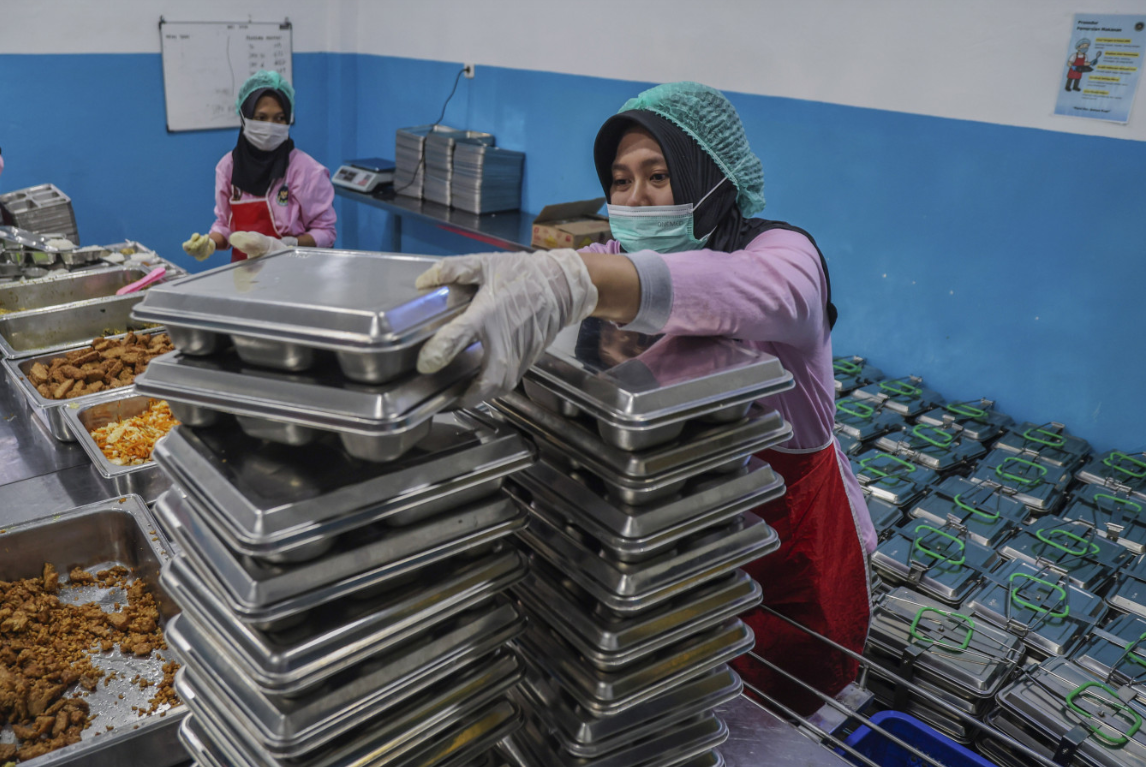
President Prabowo Subianto is undertaking a significant reassessment of two cornerstone social initiatives, signalling a willingness to recalibrate ambitious welfare policies that have become flashpoints of public controversy and political vulnerability. The Indonesian leader convened a four-hour closed-door session at the Palace on Wednesday with relevant cabinet ministers to examine implementation challenges surrounding the free nutritious meal programme and the Red and White cooperative scheme, both central to his government's agenda but increasingly beleaguered by operational difficulties and public scepticism.
The free meal initiative, budgeted at an enormous Rp 268 trillion—approximately US$19.5 billion—for 2026, represents one of the administration's most ambitious poverty-alleviation efforts, targeting roughly 83 million beneficiaries including schoolchildren and pregnant women. Despite its noble aim of combating malnutrition and childhood stunting, the programme has become a credibility test for Prabowo's presidency. It has faced withering criticism on multiple fronts: mounting street protests last month demanding temporary suspension, intense scrutiny over its astronomical fiscal burden, documented food poisoning incidents, and an ongoing corruption investigation involving senior figures from the National Police and Indonesian Military (TNI). For a government seeking to establish fiscal discipline and social legitimacy simultaneously, these problems represent serious political headwinds.
Following the Palace meeting, Agustina Arumsari, deputy chief of the National Nutrition Agency (BGN), disclosed that Prabowo has ordered a meticulous, deliberative examination of how the free meals initiative operates within educational institutions. The agency faces a one-month deadline to complete this comprehensive review. The President's directive underscores his insistence that policy implementation proceed with careful deliberation rather than speed, a notable shift in messaging for a leader who has championed rapid, decisive action on flagship programmes.
The proposed review will concentrate on refining beneficiary eligibility criteria, with the government exploring whether higher-income households should be excluded from the scheme. This targeting approach raises intricate practical questions, particularly regarding implementation in educationally mixed socioeconomic settings. Agustina highlighted the government's sensitivity to a potential psychological and social cost: avoiding scenarios where some classmates receive meals while others do not, recognising that such visible disparities could generate classroom tensions and stigmatisation. This consideration reveals sophisticated thinking about implementation challenges beyond mere budgetary concerns, acknowledging that blanket programmes and means-tested alternatives each carry distinct pedagogical and social implications.
Beyond eligibility restructuring, officials are exploring alternative delivery mechanisms, potentially leveraging existing school canteens rather than exclusively relying on the current dedicated free meal kitchens. Such a pivot would represent a substantial operational redesign, moving away from a centralised, uniform distribution model toward more decentralised, contextualised approaches. The shift reflects learning from implementation difficulties and signals openness to pragmatic adjustments without abandoning the fundamental programme objective.
The governmental reassessment points toward a broader strategic pivot: narrowing beneficiary populations toward the most economically vulnerable segments and adopting less centralised operational structures. For Malaysian policymakers monitoring Indonesia's social programme developments, this course correction offers instructive lessons. Large-scale, universalist welfare initiatives, however well-intentioned, encounter substantial implementation friction when fiscal resources are stretched thin, administrative capacity is uneven across regions, and political management becomes complex. Indonesia's experience underscores the value of rigorous piloting, graduated rollouts, and ongoing monitoring systems before launching programmes affecting tens of millions.
Parallel to the free meal review, Coordinating Food Minister Zulhas Hasan announced an expanded mandate for Red and White cooperatives, positioning them as government conduits for distributing diverse assistance programmes, subsidised goods, and social aid. The cooperatives will additionally function as market stabilisation mechanisms, purchasing agricultural commodities—particularly rice and corn—when prices fall beneath government thresholds, thereby supporting farmer incomes at officially determined levels. This expanded role repositions the cooperative framework as a multi-functional rural development and price support instrument.
However, the Red and White cooperative programme itself faces serious reputational damage stemming from a controversial mandatory military-style training regime for cooperative managers that resulted in at least four deaths. This tragic outcome has intensified governmental pressure to recalibrate the programme's implementation modalities. The deaths undermine programme legitimacy and raise acute questions about the appropriateness of militaristic training protocols for civilian economic managers. For a government seeking to balance rural economic development with public safety concerns, these fatalities represent a significant governance failure requiring meaningful institutional adjustment.
The confluence of challenges facing both flagship programmes reflects broader implementation difficulties affecting Indonesian governance. Ambitious social policy initiatives, when launched rapidly and at enormous scale, frequently encounter unforeseen logistical, financial, and administrative obstacles. Corruption investigations, food safety incidents, and training-related casualties indicate systemic supervision gaps and accountability weaknesses requiring institutional strengthening. For Indonesia's social programmes to succeed, particularly those targeting vulnerable populations, rigorous quality assurance, transparent monitoring, and responsive course corrections become non-negotiable.
For Southeast Asian observers, particularly Malaysian policymakers designing welfare expansions or rural development initiatives, Indonesia's experience offers cautionary and instructive insights. The region's development challenges demand ambitious social programmes, yet implementation excellence cannot be sacrificed for speed. Prabowo's willingness to order comprehensive reviews, while politically costly in the short term, demonstrates recognition that sustainable development requires adaptive management. The question facing his administration now involves whether these reassessments produce genuinely improved programmes or merely serve as temporary political circuit-breakers before attempting similar large-scale implementations with somewhat modified parameters.
As Indonesia navigates these programme adjustments, the international development community will monitor whether the administration successfully learns from implementation failures and implements meaningful reforms. The free meal and cooperative initiatives remain fundamentally important for Indonesia's rural development and nutritional security objectives. Their eventual success or failure will significantly shape regional perceptions of Indonesia's governance capacity and social policy effectiveness during the coming years.

