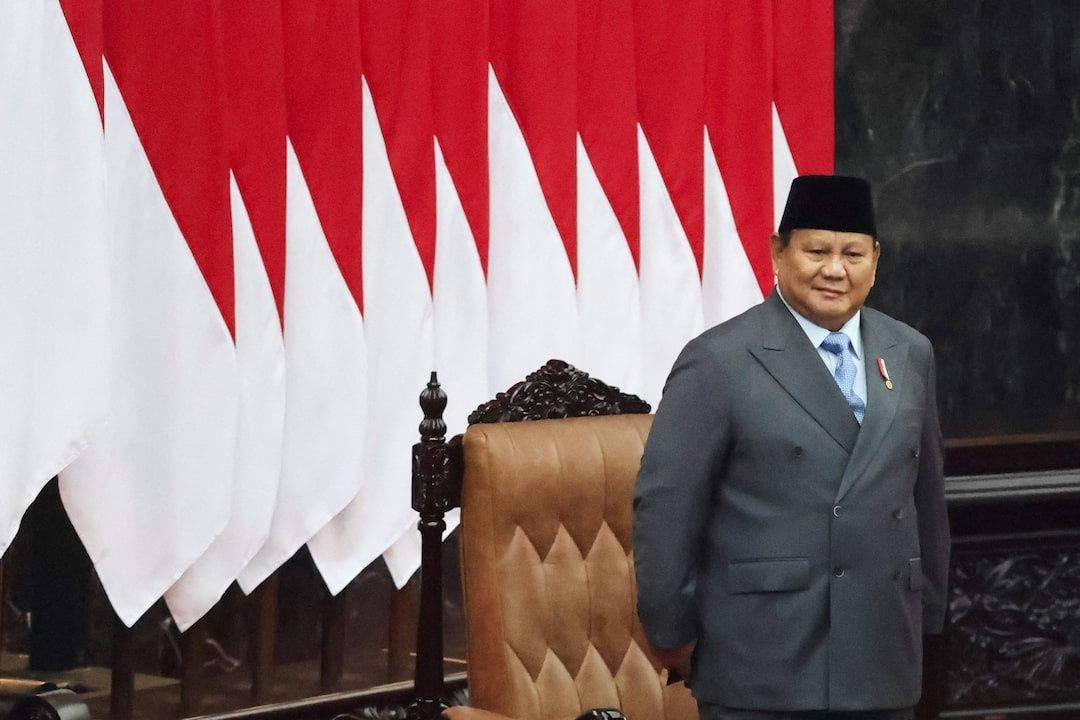
Indonesian President Prabowo Subianto faces one of the most consequential economic presentations of his presidency on Friday when he unveils the 2027 budget to parliament. The unveiling arrives at a precarious moment, with the former military commander's approval ratings having collapsed by nearly 30 percentage points over eight months, falling to just 51% according to recent polling. The deterioration reflects widespread public frustration with slowing economic conditions and perceived failures in law enforcement, creating political headwinds as he attempts to restore confidence in his administration's stewardship of Southeast Asia's largest economy.
Since taking office in October 2024 following an electoral landslide, Prabowo has confronted a parade of economic disappointments that have undermined the ambitious platform upon which he campaigned. The president swept into power promising to accelerate growth from the current 5% annual rate to an aggressive 8%, whilst simultaneously implementing a sweeping free meals programme for millions of schoolchildren and launching an anti-corruption crusade. Yet the first nine months have delivered the opposite trajectory. The Indonesian rupiah has weakened considerably against the United States dollar, stock market performance has disappointed foreign and domestic investors alike, and mounting concerns about government spending discipline have eroded confidence in macroeconomic management.
The flagship meal subsidy programme, which was supposed to be a signature achievement demonstrating the government's commitment to social welfare, has instead become a cautionary tale of implementation challenges. Budget constraints have forced painful cutbacks to the initiative, whilst simultaneous allegations of mismanagement and waste have provided ammunition to critics questioning whether the administration can effectively execute even its most central policy priorities. These stumbles have compounded doubts about Prabowo's broader economic vision and his ability to translate electoral popularity into tangible results for ordinary Indonesians.
Economists and market analysts view the budget presentation as a crucial credibility test for investor confidence. Irman Faiz, an economist at Bank Danamon, underscores that this budget cycle represents perhaps the most important evaluation of the administration's fiscal competence in years, particularly given the market's accumulated frustration with unexpected policy shifts. The global investment community's patience for economic surprises has worn decidedly thin, and Friday's presentation will largely determine whether major institutional investors maintain their exposure to Indonesian assets or begin withdrawing capital.
Indonesia's fiscal position has become increasingly constrained, with the government operating near constitutional boundaries. The fiscal deficit is currently tracking at approximately 2.8% of gross domestic product for 2025, and officials expect it to approach or reach the 3% constitutional ceiling within months. This leaves minimal room for major new spending initiatives, forcing difficult choices between funding social programmes, infrastructure investment, and debt servicing. The budget document will reveal whether Prabowo intends to maintain spending discipline or push against these fiscal constraints, a decision with significant implications for inflation, exchange rates, and borrowing costs throughout the region.
A major source of investor uncertainty surrounds the president's commodity export strategy, which has become increasingly controversial since he first announced it during a May parliamentary address. Prabowo surprised markets by unveiling plans to consolidate all critical natural resources exports under a new state-owned enterprise called Danantara Sumberdaya Indonesia. The announcement sent shockwaves through international commodities markets, as traders and multinational companies immediately began assessing how such centralised control might disrupt supply chains and affect profitability. Palm oil exporters, which form a crucial pillar of Indonesia's export earnings, appeared particularly vulnerable to potential restrictions.
In the months since the original announcement, administration officials have repeatedly walked back the boldest aspects of the proposal, suggesting the new entity will primarily supervise rather than directly control commodity flows. Yet this clarification has only deepened confusion rather than resolving it. Yose Rizal Damuri, executive director of the Centre for Strategic and International Studies, notes that investors remain uncertain about Danantara Sumberdaya Indonesia's precise operational scope and authority. Traders and multinational corporations cannot effectively plan investment and logistics strategies when fundamental questions about regulatory structure remain unanswered. Friday's budget address offers Prabowo an opportunity to definitively clarify the entity's role, an outcome that commodity markets are actively anticipating.
The palm oil industry, which generates substantial foreign exchange earnings for Indonesia and represents a critical source of government revenue, has particular reason to monitor the president's remarks. Analysts at global agricultural trading houses confirm that export policy clarity regarding palm oil remains a priority concern for the sector. Indonesia produces roughly 60% of the world's palm oil, making any policy changes with potential to disrupt supply chains or increase compliance burdens a matter of direct interest to global food and energy industries. Confusion or further unexpected policy shifts could prompt some producers to relocate operations or shift investments to rival producing nations.
Arya Fernandes, head of politics and social change at the Centre for Strategic and International Studies, observes that Prabowo must address multiple, interconnected anxieties that have accumulated among voters and investors. Economic deterioration forms the foundation of public dissatisfaction, yet the president's priority programmes—particularly the free meals scheme and the commodity export reorganisation—have themselves become sources of doubt rather than confidence. The challenge confronting Prabowo is extraordinary: he must simultaneously convince global investors that the government maintains fiscal discipline and strategic consistency whilst persuading domestic voters that his administration is delivering on its core promises. Under current economic conditions, achieving both outcomes represents a formidable task requiring careful communication and credible commitments.
The 2027 budget presentation therefore carries significance far beyond routine fiscal planning. It represents a pivotal moment in Prabowo's presidency and will likely determine whether his administration can arrest declining approval ratings and restore international investor confidence. The document will communicate whether the government intends to pursue orthodox macroeconomic policies or continue with ambitious but potentially destabilising initiatives. For Malaysia and other Southeast Asian economies, Indonesia's economic trajectory carries regional implications, particularly regarding currency values, trade flows, and regional growth dynamics that increasingly interconnect the region's economies.

