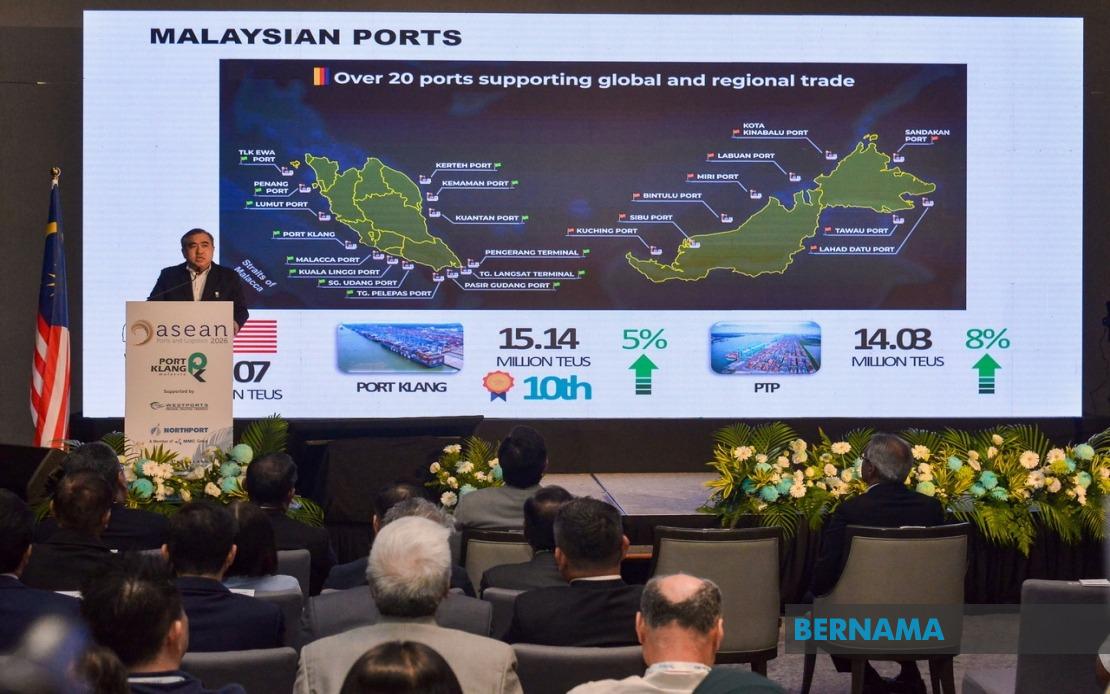
Transport Minister Anthony Loke has set his sights on transforming Malaysia into a dominant force in Southeast Asian maritime commerce through the development of Port Klang's Third Terminal on Carey Island. Speaking at the ASEAN Ports and Logistics Conference and Exhibition in Kuala Lumpur, Loke outlined an ambitious phased development strategy spanning nearly two decades, positioning the undertaking as essential for maintaining Malaysia's competitive edge in global shipping over the next 20 to 30 years.
The scale of the ambition becomes clearer when examining current capacity disparities. Port Klang's existing infrastructure can process approximately 20 million twenty-foot equivalent units annually, placing it significantly behind Singapore's Tuas Port, which boasts a capacity three times greater at 60 million TEUs yearly. This disparity underscores Malaysia's pressing need for infrastructure expansion if the nation aspires to capture greater market share in transhipment and container handling services that drive regional economic activity.
Loke's rhetoric framed the Carey Island project not merely as commercial expansion but as a strategic necessity for preserving Malaysia's position in an increasingly competitive maritime landscape. By substantially enlarging Port Klang's throughput capacity, the terminal would enable the country to process far greater cargo volumes, positioning Malaysian ports as increasingly attractive alternatives to established regional competitors. The minister emphasized that without such infrastructure investment, Malaysia risks ceding influence in logistics networks that channel hundreds of billions in trade across Southeast Asian waters annually.
The project has traversed significant groundwork before reaching this announcement stage. A feasibility study initiated in 2018 has been completed, and the Cabinet granted in-principle approval for proceeding under a public-private partnership arrangement. This PPP structure suggests the government recognizes the project's scale exceeds conventional public funding mechanisms, requiring private sector expertise and capital injection alongside government stewardship. Such arrangements have become increasingly common for major port developments across Asia, allowing risk-sharing between state entities and commercial operators.
However, tangible progress remains contingent upon resolving administrative hurdles. Loke acknowledged that land-related negotiations with the Selangor state government currently prevent full project initiation. These discussions likely involve complex questions of land acquisition, environmental considerations, and jurisdictional coordination between federal and state authorities—challenges that frequently delay major infrastructure projects throughout Malaysia. The minister indicated that once these negotiations conclude successfully, development could commence relatively swiftly, suggesting bureaucratic rather than fundamental planning obstacles remain.
Beyond capacity expansion, Loke highlighted how Malaysia's geographic positioning has unexpectedly strengthened its competitive advantages amid broader geopolitical instability. Regional tensions in West Asia have prompted shipping companies and logistics operators to reassess maritime routes, with many redirecting cargo toward ports perceived as safer from conflict-related disruptions. Port Klang and Port Tanjung Pelepas have both experienced growing cargo volumes in early 2024, suggesting that heightened geopolitical uncertainty is paradoxically creating commercial opportunities for Malaysian maritime infrastructure.
This dynamic reflects broader patterns in global trade: when security concerns affect traditional shipping corridors, operators seek alternative routes through politically stable regions. Malaysia's geographic location athwart major Indian Ocean shipping lanes, combined with its domestic political stability and strong maritime governance, positions it as an increasingly attractive transshipment hub. Companies diverting cargo away from Middle Eastern choke points find Malaysian ports offer both operational efficiency and reduced exposure to geopolitical risks.
The implications extend beyond Port Klang's operational metrics. Enhanced container-handling capacity would strengthen Malaysia's position within ASEAN's logistics ecosystem, potentially attracting regional distribution networks and supporting economies throughout Southeast Asia. Neighboring countries benefit when major transhipment hubs expand, as increased capacity generally reduces shipping costs and improves service reliability across the region. Malaysia's infrastructure development thus carries positive externalities for ASEAN members engaged in cross-border commerce.
Loke used the ASEAN conference platform to advocate for collective maritime stewardship, urging member states to safeguard principles of neutrality and security throughout the Strait of Melaka. This diplomatic overture acknowledges that individual port development must occur within broader frameworks ensuring freedom of navigation and regional stability. The Strait remains among the world's most critical maritime chokepoints, with approximately one-third of global maritime trade transiting its waters. Regional powers maintaining shared commitments to neutrality and freedom of passage create conditions enabling commerce to flourish.
The Port Klang Third Terminal project represents Malaysia's bet that sustained infrastructure investment can overcome historical competitive disadvantages against established regional giants. While Singapore's Tuas Port's superior capacity reflects decades of cumulative development and accumulated expertise, the Malaysian government evidently believes that modern construction techniques and phased implementation can compress development timelines. Whether this optimism proves warranted will depend on execution capabilities, private sector partnership effectiveness, and sustained political commitment across multiple electoral cycles.
For Malaysian stakeholders, the project's success carries implications extending far beyond maritime commerce. Enhanced port capacity supports manufacturing competitiveness by reducing logistics costs, strengthens Malaysia's position in regional supply chains, and generates employment across port operations, warehousing, and ancillary services. The two-decade development timeline means that today's policy decisions will shape Malaysia's competitive position well into the 2040s, underscoring the strategic importance Loke and his government attach to this megaproject.
The coming months will prove pivotal as administrators navigate Selangor state negotiations and refine partnership frameworks with private operators. Success in resolving land-related issues would clear the path for one of Southeast Asia's most ambitious maritime infrastructure undertakings—a project with potential to reshape regional trade patterns and cement Malaysia's standing as a maritime power.

