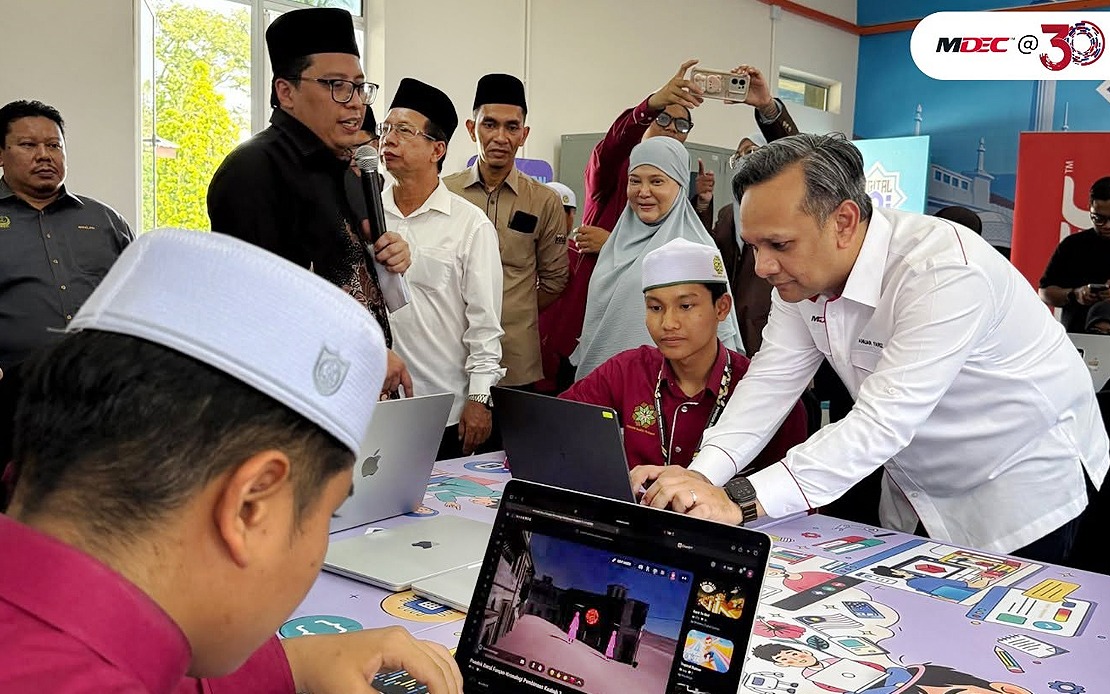
Malaysia's push towards becoming an artificial intelligence-driven economy received a significant boost in Ipoh this week when the Malaysia Digital Economy Corporation handed over a state-of-the-art Digital Maker Hub to Pondok Darul Furqan in Tambun. The initiative marks a deliberate effort to democratize access to emerging technologies within an educational segment that has traditionally remained on the periphery of digital transformation efforts.
The Digital Maker Hub represents more than a collection of hardware and software tools. It functions as an integrated learning environment designed to bridge the gap between theoretical knowledge and practical application in digital disciplines. The facility is outfitted with laptops, high-speed internet infrastructure, interactive smartboards, robotics kits, and microcontroller equipment—all calibrated to enable hands-on exploration of technologies that will define careers across the next decade. By situating these resources within an Islamic educational institution, the programme acknowledges that digital capability development cannot remain exclusive to conventional secular institutions if Malaysia is to build a truly comprehensive talent pipeline.
MDEC chief executive officer Anuar Fariz Fadzil framed the initiative within Malaysia's broader economic transformation ambitions. He emphasized that the nation's aspiration to achieve AI Nation status by 2030 depends fundamentally on expanding technological literacy across all demographic and institutional segments. This represents a strategic recognition that silicon valley-style innovation cannot materialise without building foundational digital competence at the grassroots level, particularly in communities that serve significant student populations. Islamic education institutions enrol tens of thousands of Malaysian students annually, and their traditional focus on religious and moral education has sometimes created a perceived distance from STEM and digital disciplines.
The Digital Maker Hub initiative operates under the broader framework of the Islamic Education Institution Digital Transformation Programme, formally designated as Digital IPI. This programme emerged through collaboration between MDEC and the Department of Islamic Development Malaysia, representing institutional alignment at the highest levels of government planning. The partnership underscores recognition that digital transformation cannot be imposed externally but must be organically integrated into existing educational ecosystems with cultural sensitivity and institutional buy-in.
The immediate engagement at Pondok Darul Furqan demonstrated the programme's pedagogical approach. Thirty students and five educators participated in the MetaSkool Metaverse Programme, a two-day immersive experience that introduced metaverse technology through experiential learning rather than lecture-based instruction. This methodology reflects evolving international best practices in technology education, where young people learn most effectively through interactive discovery and creative application rather than passive absorption of technical information. The emphasis on metaverse technology is particularly notable given that this emerging domain remains nascent even in developed economies, positioning Malaysian students from Islamic institutions to develop expertise in genuinely cutting-edge technological territory.
The rollout strategy demonstrates a measured, phased approach to implementation. Beyond Pondok Darul Furqan, four additional Islamic education institutions across Kedah, Kelantan, Negeri Sembilan, Pahang, and Penang will receive identical Digital Maker Hubs during the pilot phase. This geographical distribution across multiple states ensures regional accessibility and allows for iterative refinement of the programme based on diverse institutional contexts and student demographics. The expansion beyond the initial site signals confidence in the model's viability while maintaining quality control through deliberate limitation of pilot scope.
Prime Minister Datuk Seri Anwar Ibrahim's formal launch of Digital IPI in March provided high-level political endorsement that has translated into resource allocation and institutional commitment. The programme anticipates reaching more than 3,000 students and 50 teachers through structured training modules encompassing digital literacy foundations, artificial intelligence principles, digital creativity methodologies, immersive technology applications, and digital content creation workflows. This scale of ambition, while significant for a pilot initiative, represents only a fraction of Malaysia's total Islamic education enrollment, suggesting substantial scope for expansion if the pilot phase demonstrates positive outcomes.
The curriculum integration approach is notably holistic. Rather than treating technology as a parallel subject disconnected from religious and moral education, Digital IPI seeks to weave technological literacy into existing pedagogical frameworks. This integration philosophy acknowledges that students in Islamic institutions are simultaneously developing religious identity, moral consciousness, and practical skills. By demonstrating how digital tools can be deployed with integrity, trustworthiness, and ethical awareness, the programme positions technology not as value-neutral infrastructure but as a domain where Islamic principles can be practically expressed and reinforced.
For Malaysia's broader digital economy aspirations, the significance extends beyond immediate participant benefits. Islamic education institutions form part of a substantial educational ecosystem that has historically operated somewhat separately from the digital economy narrative. By deliberately incorporating these institutions into transformation initiatives, Malaysian policymakers signal that inclusive development means reaching populations and educational traditions that might otherwise remain marginal to technology adoption stories. This approach builds social cohesion around shared technological advancement rather than creating a bifurcated system where some communities embrace digital futures while others remain excluded.
The initiative also carries implications for regional talent development. Southeast Asia increasingly competes globally for digital expertise, and Malaysia's strategic positioning depends partly on maximizing human capital across all available populations. By developing digital capabilities within Islamic educational networks, Malaysia expands its talent pool in precisely those domains—AI, digital creativity, immersive technologies—where regional competitive advantage remains contestable. Students emerging from this programme with robust digital foundations will have pathway options that previously seemed narrower.
From an institutional perspective, the Digital Maker Hub model offers replicability potential. Other religious educational traditions, vocational institutions, and community learning centers might adopt similar frameworks for integrating emerging technologies into specialized educational missions. The MDEC-JAKIM partnership demonstrates how government entities with distinct mandates can align behind common digital transformation objectives, a collaborative model that could inform broader institutional coordination on technology adoption across government.
Looking forward, the success metrics for Digital IPI will extend beyond simple equipment deployment or participant numbers. Meaningful evaluation will track whether participating students pursue further technology education, whether teachers successfully integrate digital tools into religious education delivery, and whether institutions sustain technological engagement beyond initial MDEC support. The true measure will be whether Islamic education institutions become recognized as sites of genuine technological innovation and competence rather than peripheral participants in Malaysia's digital economy story.

