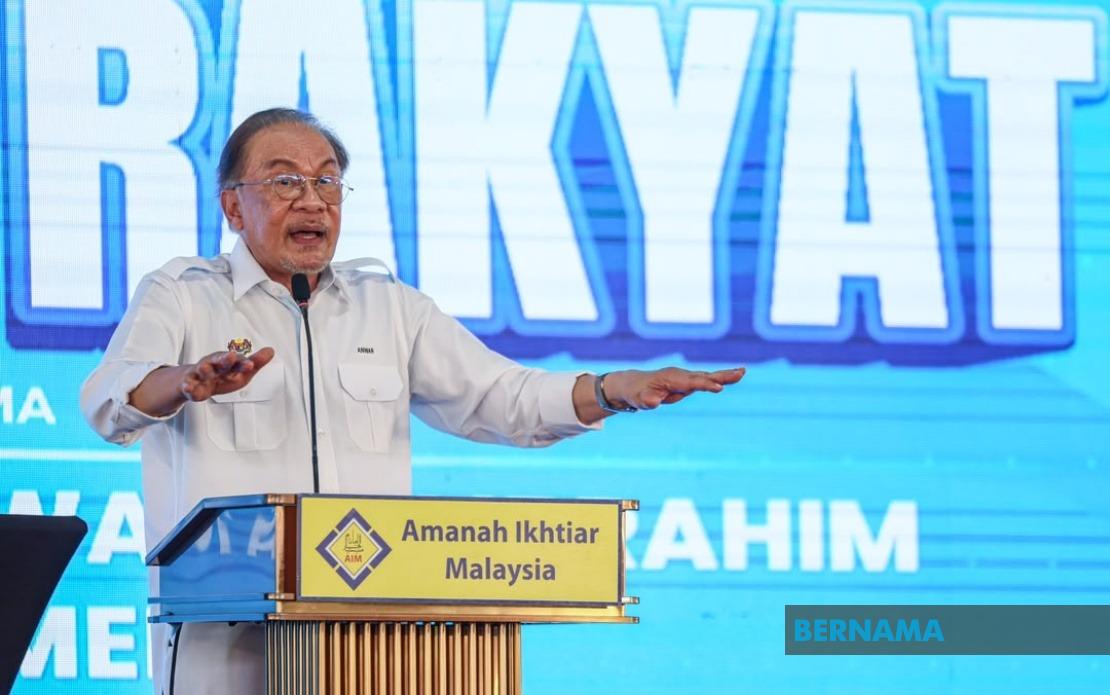
Prime Minister Datuk Seri Anwar Ibrahim has attributed the increasingly coordinated opposition against his administration to its resolute anti-corruption agenda, contending that political rivals view the government's integrity-focused policies as a direct threat to their interests. Speaking at a Pakatan Harapan campaign event in Senggarang during the Johor state election campaign, the Prime Minister and PH chairman suggested that parties uncomfortable with the MADANI Government's zero-tolerance stance toward public fund misappropriation and official misconduct have forged an alliance to undermine his leadership. This characterization of opposition coordination around anti-corruption as a central political dividing line underscores how governance accountability has become a defining feature of Malaysia's current political contest.
The Prime Minister emphasized that his government's guiding philosophy remains unambiguous: elected officials must not leverage their positions to acquire real estate, secure business contracts, obtain corporate shareholdings, or accumulate private wealth through state resources. Anwar highlighted his own record as evidence of this principle, noting that despite numerous visits to Johor during his tenure, he has not acquired land, pursued projects, or obtained equity stakes in the state. This personal example served as a broader call for institutional culture change, with Anwar urging elected representatives across all levels to embrace similar standards of conduct. The emphasis on personal financial abstinence as a leadership benchmark reflects efforts to reset public expectations about official ethics following years of high-profile corruption scandals that have damaged public trust in institutions.
For Malaysian voters, particularly those in Johor, Anwar's framing carries significant implications for evaluating governance quality beyond rhetoric. The assertion that political alignment between federal and state governments facilitates development delivery speaks to structural efficiency gains from unified administration, yet Anwar's own acknowledgment that despite billions in development spending, fundamental issues remain unresolved suggests that funding levels alone do not guarantee equitable outcomes. The persistence of unaffordable housing, inadequate infrastructure, and insufficient social support despite substantial investment points to potential governance or prioritization gaps that merit scrutiny from both voters and watchdog organizations. Anwar's complaint that wealth concentration rather than broad-based prosperity characterizes Johor's development trajectory indicates awareness that development metrics and lived experience may diverge significantly.
The Prime Minister's robust defense of the Pakatan Harapan coalition's partnership with the Democratic Action Party addresses a persistent concern among certain constituencies about potential ideological conflicts. Anwar's assertion that DAP ministers have not once obstructed Malay-focused or Islam-related programmes during his three-and-a-half year tenure invites independent verification of cabinet voting records and policy implementation. For Malaysian observers assessing coalition stability and programmatic coherence, such claims warrant careful examination against documented policy outcomes. The defensive tone suggests that skepticism about multi-ethnic coalition governance remains a potent political vulnerability, implying that substantial portions of the electorate harbor concerns about DAP's actual influence over religious and communal matters despite Anwar's reassurances.
The Johor state election itself represents a critical test of whether anti-corruption messaging translates into electoral support at the state level. With 172 candidates contesting 56 seats, and voting scheduled for July 11, the contest reflects broader national political realignment. For Pakatan Harapan, securing state-level control in Johor would validate the anti-corruption platform as electorally viable and provide operational control over resource distribution in Malaysia's second most populous state. Conversely, poor performance might suggest that voters weigh additional factors—including economic management, communal sensitivities, and local grievances—alongside corruption concerns when making electoral choices.
Anwar's observation about the extraordinary enthusiasm of Senggarang supporters, who remained engaged despite severe heat, suggests genuine grassroots mobilization rather than manufactured turnout. This organic energy may indicate authentic voter interest in regime change or conversely, represent PH's traditional support base rather than evidence of broader demographic expansion. The distinction matters substantially for understanding whether Anwar's anti-corruption message genuinely attracts swing voters or primarily energizes existing coalition supporters. Johor's historical electoral volatility means that even modest shifts in voter preferences can dramatically alter seat distributions.
The broader regional context for Malaysia's anti-corruption positioning should not be overlooked. Southeast Asian democracies increasingly face pressure to demonstrate governance competence amid rising public skepticism of institutional integrity. Thailand, the Philippines, and Indonesia have all experienced major political disruptions partly attributed to perceived corruption and elite capture. Malaysia's positioning as a functioning multi-ethnic democracy with competitive elections grants particular importance to demonstrable anti-corruption progress, which serves as a comparative governance advantage within the region. If Anwar's administration successfully prosecutes high-profile corruption cases and maintains tangible institutional reforms, it strengthens Malaysia's regional standing and provides a governance model alternative to more authoritarian approaches elsewhere in Southeast Asia.
For international investors and development partners, anti-corruption credibility carries economic significance beyond moral considerations. Jurisdictions perceived as having reliable rule of law, transparent procurement processes, and genuine consequences for official misconduct attract higher quality investment and command lower borrowing costs. Conversely, perceived corruption risks trigger capital flight and reduce competitiveness. Anwar's emphasis on institutional reform and personal exemplification suggests awareness that Malaysia's economic competitiveness depends partly on demonstrable governance improvements. However, the gap between stated principles and institutional capacity to investigate, prosecute, and punish corruption requires sustained attention and independent oversight to maintain credibility.
The timing of Anwar's anti-corruption rhetoric during the Johor campaign reflects strategic prioritization of governance issues as differentiation from opposition parties. This emphasis may indicate either confidence in public appetite for integrity-focused leadership or concern that economic performance during the MADANI Government's early tenure has disappointed enough voters to require compensating with alternative value propositions. The fact that governance and corruption remain central campaign themes across major parties suggests broad public concern about institutional trustworthiness, even if voters may prioritize immediate economic welfare in actual voting decisions. Understanding whether anti-corruption momentum sustains beyond campaign rhetoric into institutional practice will substantially shape Malaysia's governance trajectory and regional standing over the next decade.

