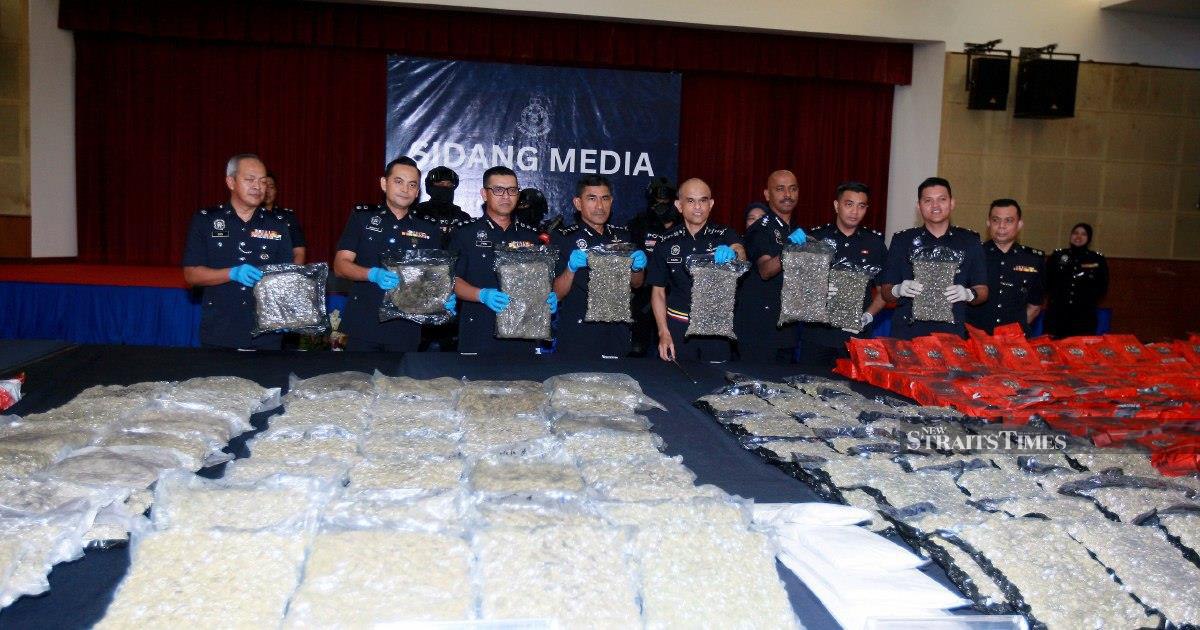
Police in Selangor have struck a significant blow against organised drug trafficking networks, disrupting six independent smuggling operations and confiscating roughly 600 kilograms of illicit substances in concurrent raids. The seizures, valued at RM37.5 million, represent one of the state's more substantial anti-narcotics enforcement efforts in recent months, reflecting intensified efforts by enforcement authorities to combat the flow of drugs through Malaysia's most economically developed state.
The coordinated operations resulted in the arrest of twelve individuals across multiple locations, though police have not yet disclosed the full details of the suspects' identities or their alleged roles within the trafficking hierarchy. These simultaneous strikes across Selangor demonstrate the capacity of law enforcement to execute strategic, multi-pronged operations rather than reactive single-site raids, suggesting an intelligence-led approach to dismantling organised drug distribution networks that operate across the state.
The scale of the confiscation underscores the persistent challenge posed by drug trafficking throughout the Klang Valley and surrounding areas. Despite sustained enforcement efforts, criminal syndicates continue to move significant quantities of narcotics through Selangor, taking advantage of the state's extensive road networks, multiple ports of entry, and dense population centres that can obscure smuggling operations. The variety of drugs seized suggests trafficking organisations are diversifying their product offerings, likely responding to fluctuating street demand and law enforcement pressure on specific substances.
Selangor's position as Malaysia's most populated state and its proximity to international trafficking corridors make it an attractive hub for narcotics distribution. Criminal networks exploit the state's position between Kuala Lumpur and major highways leading to other regions, using it as a transhipment point for drugs destined for domestic consumption and, in some cases, export to neighbouring countries. The presence of international ports and airports within Selangor's jurisdiction further complicates enforcement efforts, as traffickers utilise multiple entry points and concealment methods to circumvent customs and police detection.
The financial scale of this haul—valued at RM37.5 million on the street market—illustrates the lucrative nature of drug trafficking and the substantial resources that organised crime groups dedicate to their operations. These proceeds typically fund further criminal activities, including money laundering operations, acquisition of firearms, and corruption of officials. The seizure represents significant degradation of criminal profit, though law enforcement agencies acknowledge that disrupting supply chains remains an ongoing challenge requiring sustained investment and intelligence-gathering capabilities.
The arrest of twelve individuals opens new avenues for investigation into the broader structure of trafficking organisations. Police typically interrogate detained suspects to identify suppliers, distributors, financiers, and street-level operatives, potentially enabling authorities to unravel multiple layers of criminal networks. Successful prosecutions flowing from these arrests could yield lengthy prison sentences under Malaysia's stringent drug laws, which impose substantial penalties for trafficking offences involving large quantities of controlled substances.
Selangor authorities have increasingly emphasised the importance of intelligence-led policing to identify and disrupt trafficking networks before drugs reach end consumers. The simultaneous nature of these raids suggests coordination between different police units and federal agencies, reflecting broader national strategies to combat organised drug crime. The approach contrasts with purely reactive policing and instead focuses on proactive identification of trafficking routes, warehousing facilities, and distribution points based on surveillance and informant intelligence.
The seizure also highlights the transnational dimensions of Malaysia's drug problem. Many of the substances entering the country originate from source regions in Asia, particularly the Golden Triangle and pharmaceutical diversion schemes. Criminal organisations utilise both traditional smuggling methods—concealment in vehicle compartments and shipping containers—and increasingly sophisticated approaches involving drones, maritime vessels, and corruption of port officials. The diversity of drugs seized in these raids likely reflects multiple trafficking sources and routes.
For Malaysian communities, particularly in Selangor, such enforcement actions provide temporary respite from street-level drug availability, though experts note that supply-side interventions alone cannot address demand-driven drug markets. Comprehensive anti-drug strategies require parallel investment in rehabilitation facilities, community education, and economic opportunities for vulnerable populations susceptible to drug involvement. Police operations remain essential but represent only one component of broader public health and crime prevention frameworks.
The success of these raids will be judged not merely by the quantity seized and arrests made, but by whether they generate intelligence enabling longer-term dismantling of trafficking infrastructure. If the seized drugs and detained suspects connect to a single major organisation, this operation could represent a strategic victory against organised crime. Conversely, if they involve multiple independent cells, the impact on overall drug supply may prove limited, requiring police to maintain sustained enforcement pressure across Selangor's diverse urban and suburban landscapes.

