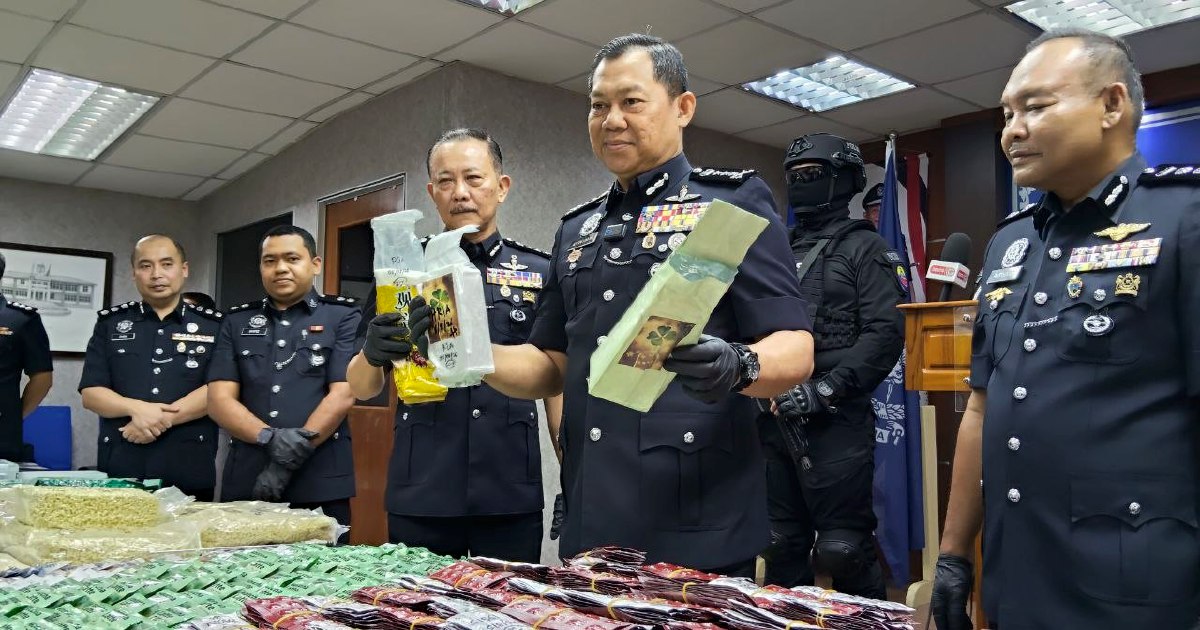
Johor Baru law enforcement has scored a significant victory in the ongoing battle against drug trafficking, breaking up what authorities believe was an organised distribution operation. The bust came after officers raided an apartment located on Persiaran Senibong in Masai, where they discovered an extensive cache of various narcotics totalling 96.76kg. The drugs seized were valued at approximately RM8.49 million, representing one of the larger hauls in the state's recent enforcement history. Two suspects have been taken into custody as investigations continue into the scope and reach of the syndicate.
The apartment itself had been deliberately leased as a storage facility for the illicit operation, according to police findings. This tactical use of residential premises reflects an evolution in drug trafficking methodology, where syndicates increasingly rely on nondescript urban locations to move their merchandise away from traditional street-level distribution points. The strategy creates additional layers of operational security, making it harder for authorities to track supply chains and identify the broader network of distributors and end-users. The deliberate compartmentalisation of storage, distribution, and retail activities is a hallmark of sophisticated criminal enterprise in the narcotics trade.
The recovery of such a substantial quantity of drugs in a single location underscores the significant volume of narcotics flowing through Malaysia's illicit supply networks. Masai's strategic location in the southern reaches of Johor, close to Singapore's border, has historically made it a transit point and distribution hub for drug trafficking operations. The proximity to international borders, coupled with established smuggling routes and organised crime networks that operate across the Strait, creates persistent challenges for law enforcement. Criminal syndicates exploit these geographical advantages to maintain steady supplies of contraband heading to local markets and potentially onwards to other regional centres.
The arrest of two individuals marks the beginning of what will likely be an extended investigation into the full scope of the operation. Authorities will be examining the supply chains that provisioned the apartment, the distribution networks that moved drugs from this location, and the financial mechanisms that sustained the enterprise. Intelligence gathered from the seized premises—communications devices, financial records, and logistical documentation—will provide investigators with crucial leads to identify other members of the syndicate and potentially disrupt larger trafficking networks operating throughout the peninsula and beyond.
For Malaysian drug enforcement agencies, such operations serve dual purposes beyond simply removing contraband from circulation. They generate actionable intelligence that helps authorities map the structure and connections of organised crime groups, revealing vulnerabilities that can be exploited in subsequent enforcement actions. The seizure and arrests also send a deterrent message to other syndicate members and aspiring traffickers regarding the risks and consequences of involvement in large-scale drug distribution. However, enforcement experts acknowledge that supply-side interventions alone cannot stem the flow of narcotics without complementary demand reduction and rehabilitation efforts.
The value of the seized drugs—RM8.49 million—represents the street-level retail equivalent, illustrating the enormous financial incentives that drive trafficking operations. For criminal organisations, the profit margins in drug trafficking remain extraordinarily attractive despite heightened enforcement pressure and lengthy prison sentences for major traffickers. The financial resources accumulated through such operations often extend beyond direct drug sales into money laundering schemes, property acquisition, and investment in legitimate businesses that provide cover and facilitate further criminal activity. This convergence of drug trafficking with broader organised crime presents a complex enforcement challenge that requires coordinated action across multiple government agencies.
Johor's ongoing struggles with drug trafficking reflect broader Southeast Asian trends. The region remains a critical transshipment point for narcotics originating from the Golden Triangle and destined for Australian and Asian markets. Domestic consumption within Malaysia itself has grown substantially over the past decade, expanding the profit potential for both international trafficking organisations and locally-based syndicates. The availability of synthetic drugs, particularly methamphetamine and fentanyl analogues, has added new dimensions to enforcement efforts, as these substances are often manufactured regionally rather than imported across international borders.
The Persiaran Senibong operation also highlights the vulnerability of Malaysia's residential real estate market to exploitation by criminal enterprises. Property rental networks, often fragmented across multiple agents and managed by absentee landlords, can be manipulated by traffickers seeking discreet locations. Strengthening verification procedures for residential leasing, enhancing communication between property management and law enforcement, and implementing technological monitoring systems in high-risk areas could create additional friction for criminals attempting to establish distribution bases. Such complementary approaches work in tandem with enforcement operations to reduce the operational space available to trafficking syndicates.
Looking ahead, the outcomes of charges and trials stemming from this arrest will likely influence sentencing considerations and prosecutorial strategies in future major drug cases. Malaysian courts have demonstrated increasing willingness to impose lengthy prison sentences on major traffickers and high-level syndicate members, recognising that distribution-level operators occupy a critical position in the drug supply chain. Convictions in cases of this magnitude can reshape criminal enterprises' cost-benefit calculations and potentially deter participation in large-scale operations. However, sustained pressure requires consistent enforcement action, adequate investigative resources, and judicial capacity to process an growing docket of complex narcotics cases.
The successful operation also demonstrates the capacity of Johor police to execute sophisticated enforcement actions targeting organised criminal activity. Intelligence gathering, surveillance, and coordinated tactical execution resulted in the disruption of an active distribution network and the recovery of a significant drug cache. Building on such successes and maintaining operational momentum remains essential as law enforcement agencies across Malaysia confront an evolving landscape of narcotics trafficking that increasingly blurs the lines between domestic and international organised crime.

