Poland is poised to become a pioneer in recognizing the therapeutic bond between dying patients and their companion animals. Proposed legislation now before parliament would guarantee terminally ill individuals the legal right to receive visits from their pets while in hospice and palliative care wards—a measure that advocates say addresses a critical gap in end-of-life care and the growing isolation experienced by the critically ill across the country.
The initiative emerged from the deeply personal experience of Ewa Lutka-Krawczyk, a 70-year-old gallbladder cancer patient currently receiving palliative care at a Warsaw hospital. Upon learning of her terminal diagnosis, Lutka-Krawczyk's primary concern was not for herself but for Gaja, a shelter dog she had rescued three years earlier and to whom she had become profoundly attached. She pleaded with her physicians to assure her that she would survive long enough to spare Gaja the trauma of separation. Back home with her husband, the dog has scarcely eaten since her hospitalization, sensing the absence of her lifelong companion. Yet this story of separation has catalyzed broader recognition that such painful disconnections need not be inevitable.
Dr. Tomasz Dzierzanowski, director of the Palliative Medicine Clinic at the Medical University of Warsaw and Lutka-Krawczyk's treating physician, has emerged as the legislative effort's principal architect. Dzierzanowski introduced the proposal through a member of Prime Minister Donald Tusk's centrist coalition, positioning pet visitation rights within a larger framework addressing what he characterizes as society's epidemic of emotional abandonment during humanity's most vulnerable moments. The physician's motivation crystallized during an encounter with Waldemar, a cancer patient consumed with anxiety about his two cats' welfare. When Dzierzanowski arranged for the animals to be brought into the ward, witnessing the patient's tears of joy and the profound emotional response from both the cats and watching staff members convinced him that legislation was imperative.
The psychological and spiritual dimensions of this initiative extend beyond simple companionship. Dzierzanowski identifies a troubling pattern among his patients: older individuals who have outlived their friends and peers find themselves navigating terminal illness in profound isolation, while younger patients lack the deep social bonds that previous generations naturally cultivated. The modern digital age, he suggests, has paradoxically increased human isolation even as it promises connection through screens and virtual networks. In such contexts, the presence of a trusted animal—a creature that does not leave, does not age away, and understands only unconditional attachment—offers palliative benefits beyond what conventional medical interventions can provide.
While hospice visits by companion animals occur in scattered locations across Poland, no universal legal framework currently protects patients' rights to such contact. Katarzyna Piekarska, the lawmaker steering the legislation through parliament's health committee, emphasizes that animals informally visit hospitals throughout the country already; the measure seeks to formalize and standardize what is currently haphazard practice. This gap in regulation creates uncertainty for both patients and healthcare administrators, leaving the granting of pet visits dependent on individual institutional discretion rather than guaranteed rights.
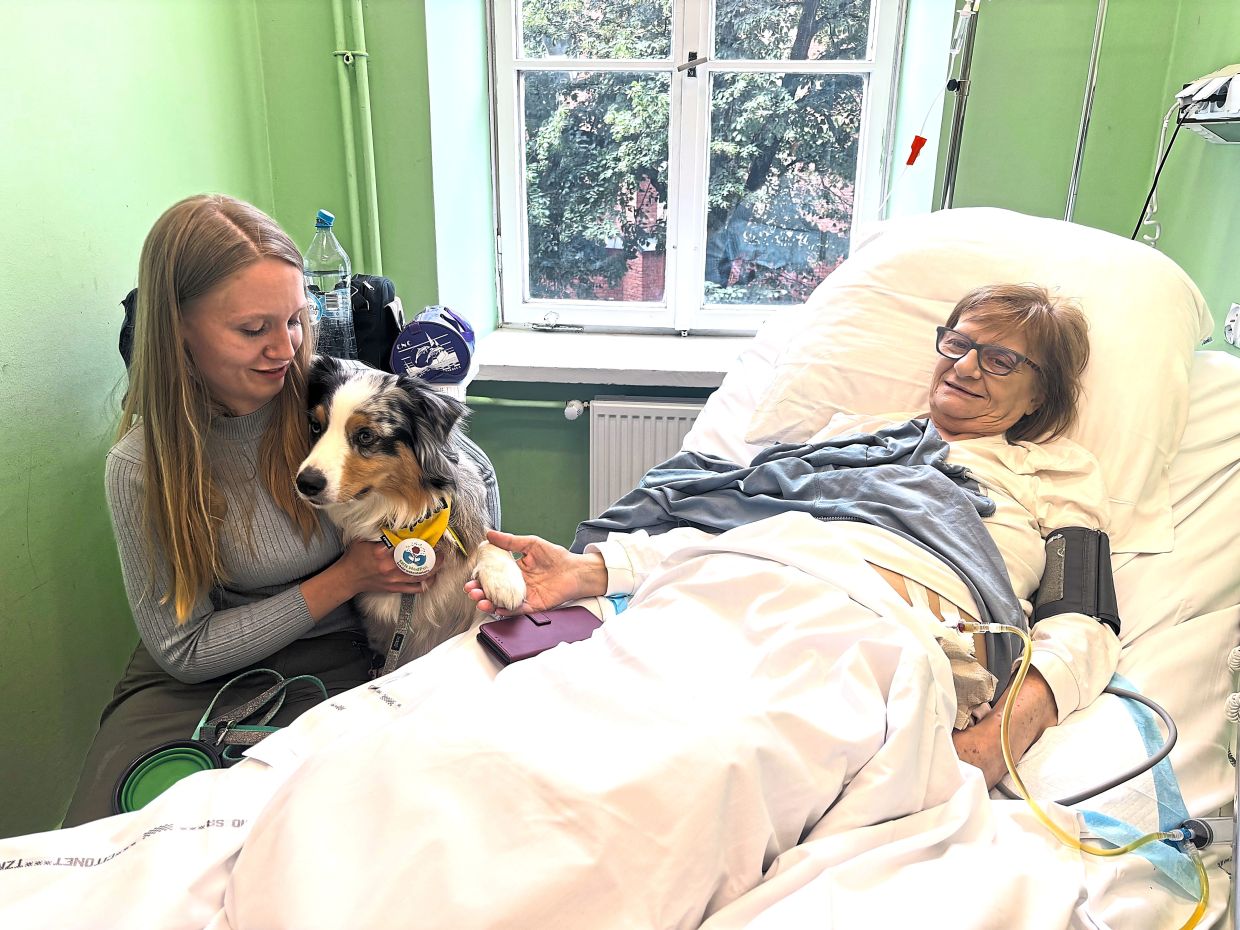
Dzierzanowski's palliative care unit has pioneered an approach that distinguishes between personal pet visits and formalized therapy dog programs, both of which he accommodates when medical conditions permit. During recent rounds, Kluska, an Australian shepherd whose name translates as "dumpling," moved through patient rooms with her handler, Malgorzata Brzozowska, a medical student. Kluska's presence prompted even severely ill patients to muster smiles and energy: Lutka-Krawczyk reached out to hold the dog's paw, while Wojciech Zelik, a 58-year-old tumor patient, rose from his bed to admire the animal and stroke her coat as Brzozowska demonstrated the dog's trained tricks.
Yet the therapeutic impact reverberates well beyond patients themselves. Hospital staff members—nurses, cooks, and other caregivers who navigate the emotional labour of tending to the dying—visibly brightened during Kluska's visits, crouching down to pet the dog and share moments of levity and tactile warmth. A cook offered the dog slices of ham, small acts of nurturing that provide psychological respite from the demands of their work. Brzozowska notes that the benefits multiply when patients reconnect with their own animals rather than interacting with therapy dogs alone; the reunion calms not only the patients but their families and, perhaps most poignantly, the animals themselves.
Animal behavior research supports an observation Brzozowska articulates with particular insight: when a dog reunites with its absent owner in a hospice setting, the animal's reduced anxiety appears to reflect a deeper understanding—an intuitive knowledge that the human who has vanished did not abandon the relationship but rather disappeared into an incomprehensible place. The animal's peace upon reunion suggests recognition and resolution of that mystery. This perspective invites reflection on what dying patients themselves experience when separated from beloved animals by institutional policy rather than intentional choice.
The Polish legislation arrives at a moment when palliative care philosophy increasingly acknowledges that terminal illness is not merely a medical event but an existential and relational one. International best practices in hospice care emphasize the patient's autonomy, dignity, and psychological comfort during life's final chapter. Where a person has structured a meaningful life around an animal companion, severing that bond at the end of life contradicts fundamental principles of palliative care. The proposed law recognizes that comfort and meaning are inseparable—that a dying person's wellbeing encompasses not only symptom management but the preservation of connections that have sustained them.
For Lutka-Krawczyk, news of the proposed legislation and her immediate eligibility for Gaja's visits brought visible relief. She can now anticipate a reunion with the creature whose presence has shaped her daily existence for three years. For the broader population of Polish patients facing terminal illness, the legislation represents something more: an institutional acknowledgment that isolation at life's end is not inevitable, that love between human and animal possesses therapeutic legitimacy worthy of legal protection, and that palliative care encompasses the whole person—including their bonds with other creatures who depend upon and cherish them.

