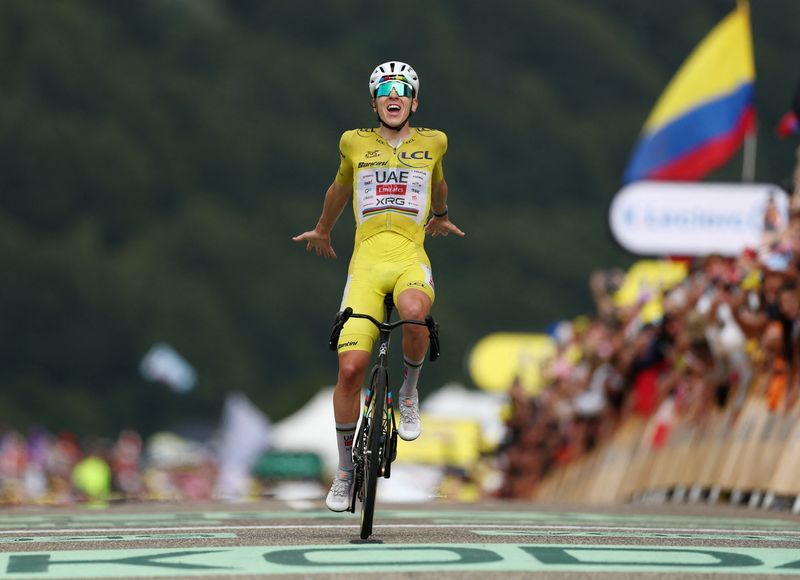
The 2024 Tour de France continued its mountainous onslaught on Saturday as Tadej Pogacar demonstrated the form that has made him the dominant force in professional cycling this season. The four-time champion executed a perfectly timed surge on the steepest gradients of the Col du Haag, breaking away decisively in the final kilometres to secure his fourth stage victory of the race. This triumph further consolidated Pogacar's grip on the yellow jersey, extending his advantage over second-placed Jonas Vingegaard to four minutes and 30 seconds, putting him in an increasingly commanding position in his quest for a third consecutive Tour title.
The 155.3-kilometre stage from Mulhouse to Le Markstein Fellering presented a relentless examination of climbing prowess, with three category one ascents and treacherous conditions that would test even the most experienced mountain riders. Early rainfall created technical hazards on the descents, particularly along the Col du Page, where slippery surfaces demanded careful navigation from the peloton. These challenging weather patterns and route characteristics set the stage for a day of aggressive racing that would ultimately showcase the Slovenian's superior fitness and tactical acumen.
French climber Valentin Paret-Peintre of Soudal Quick-Step initiated an aggressive early breakaway, reaching the Grand Ballon summit ahead of Richard Carapaz to earn the mountain points while receiving encouragement from the partisan home crowd. The move eventually swelled to include six riders, who managed to establish a commanding advantage of nearly three minutes over the main field as they approached the Ballon d'Alsace ascent. However, Carapaz and his EF Education–EasyPost teammate Ben Healy momentarily lost their way at the base of this climb, requiring a brief correction before they regained contact with the leaders ahead of the pursuing peloton.
The dynamics shifted dramatically as Pogacar's UAE Team Emirates-XRG domestiques began applying relentless pressure on the final major climb, methodically reeling in the breakaway group and eroding their advantage from three minutes to just 80 seconds. Carapaz mounted an early attack on the brutal 11.2-kilometre Col du Haag ascent, with Norwegian Tobias Johannessen following closely in pursuit, briefly threatening to seize control. This aggressive move, however, could not withstand the systematic chase orchestrated by Pogacar's support team, which ensured their leader would soon be in contention as the road steepened.
When the gradient ramped up to a gruelling 16 percent in the final two kilometres, Pogacar executed his decisive move with clinical precision. His acceleration immediately created significant separation from his remaining rivals, and he crested the summit with a 30-second cushion already established. The Slovenian maintained his rhythm through the concluding five kilometres of descent and flat terrain leading to the finish line, crossing the tape with a commanding 38-second margin over UAE Team Emirates-XRG teammate Isaac del Toro, who claimed second place.
Del Toro's runner-up finish proved significant for the overall standings, allowing the Spaniard to leapfrog past Alejandro Ayuso and claim fourth position in the general classification. Paul Seixas, competing as the local favourite in this eastern French region, secured third place on the day, while Vingegaard's fourth-place finish was indicative of a rider unable to match Pogacar's devastating acceleration. The performance gap between the race leader and his closest challenger continues to widen, presenting an increasingly steep mountain for any rival to overcome.
Pogacar's assessment of his performance revealed the clinical execution that has characterised his campaign throughout the three-week event. In his post-stage comments, he emphasised that his team had methodically targeted this particular stage from the outset, recognising the unique characteristics of the mountainous terrain between Mulhouse and the Vosges peaks. His intimate knowledge of these climbs, honed through previous racing in the region, clearly provided a decisive advantage when the decisive moment arrived. The champion's recognition of the stage's qualities and his team's ability to position him perfectly for the climactic attack showcased the integrated approach required for success at cycling's most prestigious competition.
Looking ahead to the following day's racing, Pogacar acknowledged that Sunday's 14th stage from Champagnole to Plateau de Solaison would present a distinct challenge, featuring another relentless mountain profile that could test even his formidable capabilities. Despite this cautious assessment, his demeanour suggested complete confidence in his ability to manage the additional demands, with the rider indicating his team remained fully prepared to defend their position and respond to any tactical movements from the opposing camps. This measured optimism reflected the psychological advantage that comes with a substantial time buffer in a Grand Tour.
For Malaysian and Southeast Asian cycling enthusiasts following the race, Pogacar's performance offers a masterclass in mountain riding discipline and tactical awareness. His methodical approach to stage racing, combined with the support structure provided by his world-class team, demonstrates why professional cycling remains a sport where individual brilliance must be paired with collective effort. As the Tour enters its final mountain stages, the question no longer centres on whether Pogacar will win, but rather by what margin he will eventually claim his third consecutive title.

