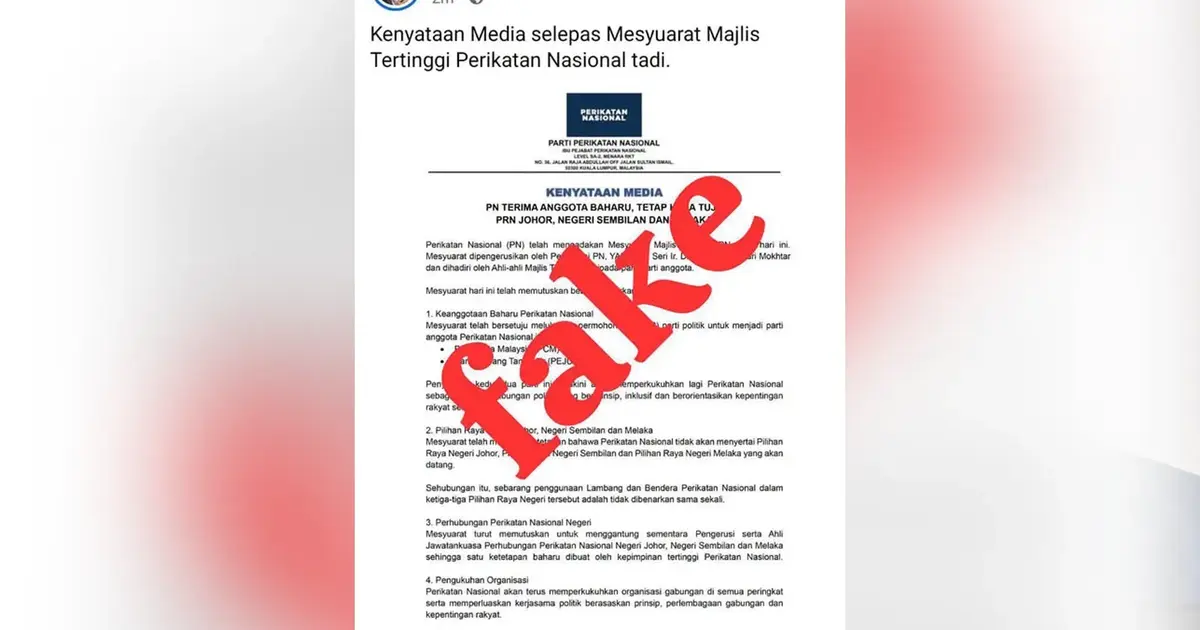
Perikatan Nasional has moved swiftly to repudiate allegations that it plans to abstain from participating in three state elections, characterising the circulating statement as completely false and misleading. The coalition, which represents a significant opposition bloc in Malaysian politics, released a firm rebuttal to counteract what it described as inaccurate claims that have begun circulating in public discourse.
The emergence of such claims reflects the increasingly fraught political environment surrounding Malaysia's state-level electoral contests. State elections serve as crucial testing grounds for political coalitions, often providing indicators of their strength ahead of federal parliamentary polls. For PN, which has built momentum in recent years and governs several states, participation in all available elections carries considerable strategic importance. Any suggestion of a pullback from electoral contests could significantly undermine the coalition's political standing and its efforts to expand or consolidate its influence across the federation.
The timing of the false statement warrants particular scrutiny. Electoral campaigns and inter-election periods frequently see the circulation of rumours and misleading information designed to sow confusion among voters and weaken political opponents. Such tactics, whether deliberately orchestrated or opportunistically amplified, can distort public understanding of coalition strategies and intentions. The rapid denial from PN indicates the coalition recognised the potential damage such misinformation could inflict if left unchallenged.
For Malaysian voters and political observers, the incident underscores the importance of verifying political claims through authoritative sources rather than accepting circulating statements at face value. In an era of digital communication, false narratives can spread quickly across social media platforms and informal networks, potentially influencing public perception and electoral behaviour. The proliferation of such misinformation poses challenges not only to the political parties involved but to the broader integrity of Malaysia's democratic processes.
PN's composition as a multi-party coalition adds another dimension to understanding why such claims would prompt immediate clarification. The coalition comprises diverse political entities with varying regional strongholds and electoral interests. Coordinating electoral participation across multiple state contests requires alignment among these constituent parties. A withdrawal from any significant state election would necessitate explanation and agreement among coalition partners, making any such decision visible rather than something that could be executed through false external claims.
The three state elections referenced in the false statement hold particular strategic significance within Malaysia's electoral map. Different states present distinct political environments, demographic compositions, and competitive dynamics. Some represent heartland territories for PN or its constituent parties, while others represent opportunities for electoral expansion. Abandoning contests in any of these states would require substantive strategic rationale, not merely false public messaging.
Regional implications extend beyond Malaysian borders. Malaysia's political developments, particularly involving major coalitions like PN, receive attention from neighbouring countries and international observers monitoring Southeast Asian democratic trends. Concerns about the integrity of Malaysia's electoral processes, whether rooted in misinformation or genuine democratic challenges, can influence regional perceptions of institutional stability and democratic health in the country.
The experience also highlights the vulnerability of political discourse to deliberate manipulation. Whether such false statements originate from political opponents, mischievous actors, or are simply products of rumour mills remains unclear. However, the readiness with which such claims gain circulation suggests an environment where political credibility remains contested and subject to challenge through various information channels. Political parties must now invest considerable effort in addressing false claims alongside pursuing substantive campaigning.
For voters contemplating state election choices, the incident serves as a reminder to seek authoritative confirmation of coalition positions and electoral intentions. Official statements from party headquarters, public announcements by recognised party leadership, and reporting from established news organisations provide more reliable sources than informal claims that circulate without clear attribution. The responsibility for media literacy in contemporary Malaysian politics increasingly falls upon individual voters.
Moving forward, PN faces the challenge of translating its categorical denial into sustained electoral engagement. The coalition's commitment to participating fully in the three state elections now rests upon its demonstrated capacity to mount competitive campaigns and mobilise its electoral base effectively. Backing its denial with concrete campaign activity will prove far more persuasive than statements alone, particularly among voters exposed to competing narratives and claims in Malaysia's complex political marketplace.