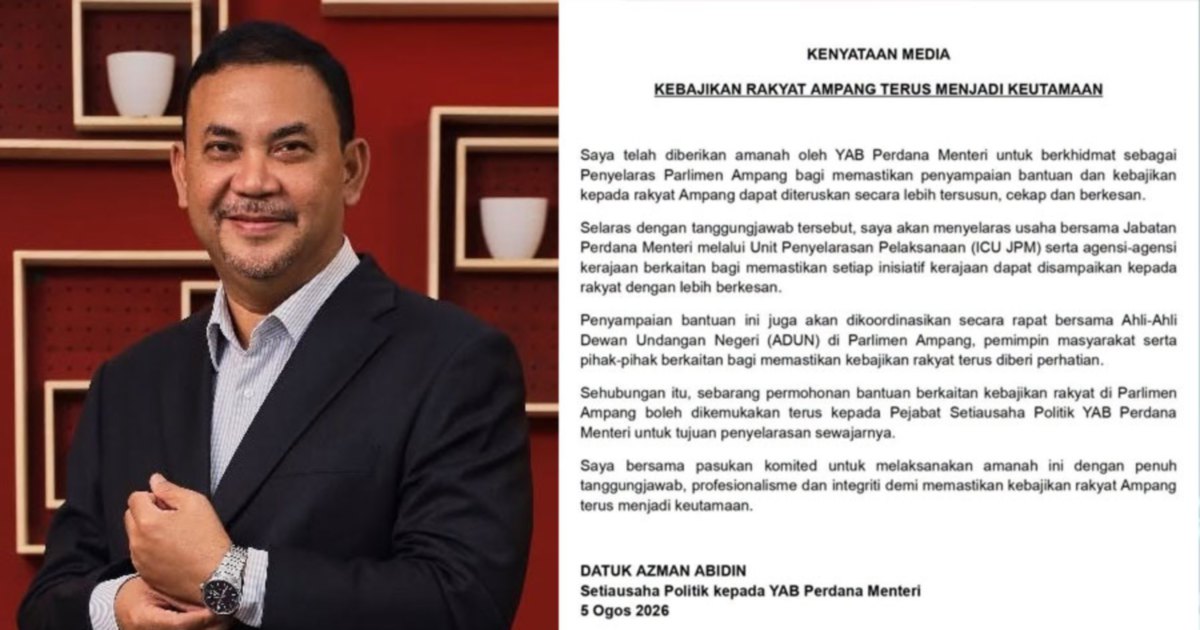
A senior political aide working directly under Prime Minister Datuk Seri Anwar Ibrahim has taken on the role of parliamentary coordinator for the Ampang constituency. The appointment comes as a consequence of the suspension imposed on PKR member Rodziah Ismail, who has been barred from accessing the MyKhas system that manages the distribution of constituency development allocations to lawmakers. This move reflects ongoing shifts within the ruling coalition's administrative structures and highlights the mechanisms through which federal-level political offices exercise oversight on parliamentary representation at the constituency level.
The MyKhas system represents a centralised digital platform administered by the federal government through which elected representatives receive and deploy funds designated for local constituency development projects. By controlling access to this system, the central authority maintains significant leverage over how individual MPs distribute resources to their constituents and can effectively suspend a lawmaker's ability to spend without explicitly removing them from office. The suspension of Rodziah Ismail's credentials within this system indicates that the decision was taken at a level above ordinary party management, suggesting involvement from senior government structures.
Rodziah Ismail represents Ampang, an established parliamentary constituency in the Klang Valley region that encompasses parts of Kuala Lumpur and Selangor. As a PKR member, she formed part of the ruling coalition that came to power following the 2022 general election. However, her suspension from fund access suggests friction between her and either her party leadership or the federal government authorities who oversee the allocation system. The transfer of her coordinator responsibilities to a staffer within the Prime Minister's own political office represents a significant assertion of central control over local parliamentary affairs.
The appointment of a PM's political secretary to this position is operationally significant because it places someone with direct access to the highest levels of executive authority into day-to-day management of constituency business. Political secretaries typically handle sensitive matters and maintain lines of communication with senior ministers and the PM's office itself. By elevating this role beyond the usual committee or assistant secretary level, the administration has inserted itself directly into local parliamentary coordination, a move that typically occurs when there are concerns about loyalty, accountability or performance at the constituency level.
This situation reflects broader tensions within Malaysia's political landscape regarding centralisation of power and resource distribution. The coalition government has shown increasing willingness to use administrative mechanisms to enforce discipline across its parliamentary members. Whereas previous governments might have relied on party structures to manage internal conflicts, the current administration appears more inclined to deploy federal administrative tools—such as suspending system access—as instruments of political control. For constituents in Ampang, this means that critical development funding decisions may now pass through an official more attuned to federal political considerations than to purely local priorities.
The timing and nature of Rodziah Ismail's suspension raise questions about the stability of the ruling coalition and the mechanisms that keep its diverse membership aligned. PKR itself has experienced internal tensions following shifts in party leadership and governance structures in recent years. The suspension of one of its MPs from fund access without reported prior party announcement suggests that such decisions may be taken at government level rather than through party channels, indicating possible coordination challenges between party and state structures or divergent interests between different arms of the ruling coalition.
For Malaysian constituencies and the broader system of local governance, such developments carry practical implications. Constituents seeking to access development projects, infrastructure improvements, or community facilities typically rely on their elected representative to champion their cause and secure funding through allocation systems. When an MP loses access to such systems, the mechanism through which their voice reaches federal resources effectively becomes muted. The insertion of a PM's office staffer into this role transforms the nature of constituency representation from responsive local advocacy into something more closely resembling federal administration of local affairs.
The MyKhas system itself reflects the digital transformation of government administration and demonstrates how technology can serve as an enforcement mechanism for political control. By design or evolution, the system allows for suspension of access without complex bureaucratic procedures, enabling rapid response to political developments. This capability has apparently been deployed in Rodziah Ismail's case, raising questions about the criteria used for such suspension and the appeal mechanisms available to affected MPs. The lack of public explanation for the suspension suggests that such administrative actions may occur within executive discretion without full transparency requirements.
Within the Klang Valley region, which encompasses multiple parliamentary constituencies and is considered economically significant, questions may arise about how this management change affects broader coordination and development planning. Ampang's location within or adjacent to the federal territories means it sits at the intersection of multiple governance jurisdictions. The insertion of federal-level political staff into its parliamentary coordination could either streamline decision-making across these jurisdictional boundaries or create additional layers of bureaucratic complexity depending on how the coordination role is exercised.
The appointment also merits attention from the perspective of gender representation and internal party dynamics within PKR. Rodziah Ismail's suspension represents a notable restriction on a female MP's authority and influence, raising questions about whether such measures are applied consistently across the coalition or whether certain categories of representatives face different treatment. The party's response to this situation may signal its stance on protecting its members' parliamentary prerogatives against potential overreach by federal administrative structures. For those monitoring governance reform and democratic accountability in Malaysia, how PKR navigates this situation will provide insight into the relative power dynamics between party structures and the federal executive.
Moving forward, this appointment and the circumstances surrounding it warrant close observation as indicators of governance trends in Malaysia. Whether this represents a temporary administrative adjustment or signals a broader pattern of centralised control over parliamentary resources and representation will have significant implications for local governance, parliamentary effectiveness, and the functioning of Malaysia's federal system. The situation also raises questions for other MPs and constituencies about the stability of their own fund access and the degree to which central political considerations may override local parliamentary priorities.

