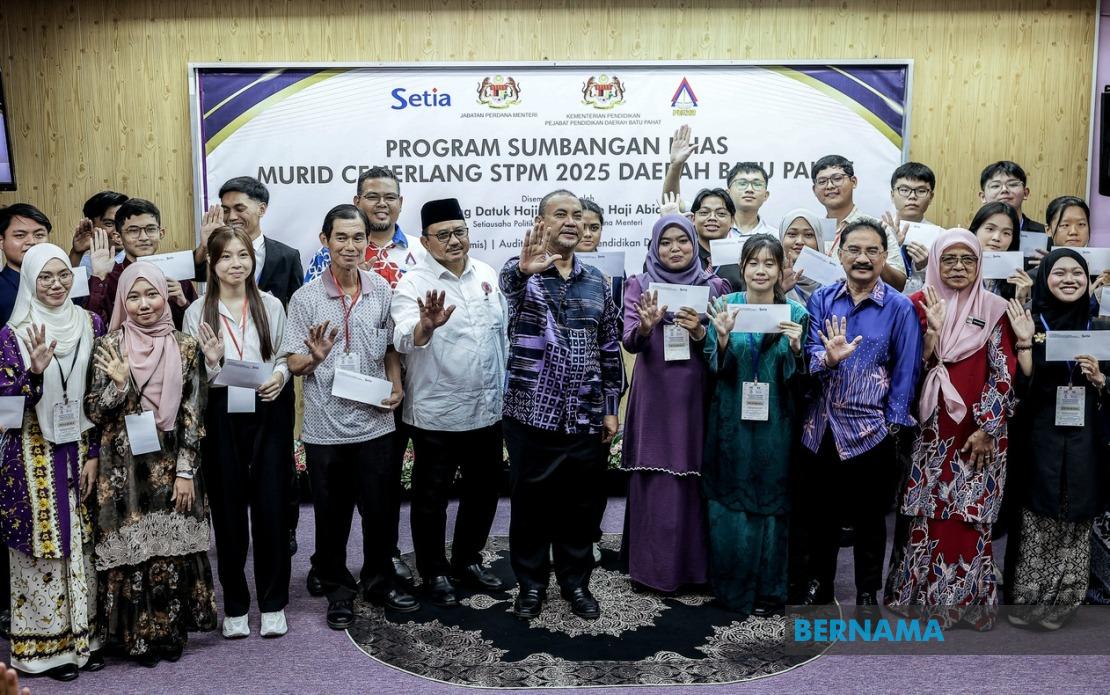
The Prime Minister's Office has distributed special financial contributions to 214 high-performing Form Six students in the Batu Pahat district, marking a coordinated effort to recognise academic achievement and support the nation's brightest young minds as they transition into higher education. The awards ceremony, held at the Batu Pahat District Education Office, acknowledged students from 16 secondary schools within the district who have demonstrated exceptional results in the 2025 Sijil Tinggi Persekolahan Malaysia examination.
Datuk Azman Abidin, the Political Secretary to the Prime Minister, explained that this initiative serves a dual purpose within the government's broader education strategy. Beyond recognising the tangible accomplishments of these students, the contribution programme aims to reinforce the importance of maintaining academic standards and inspiring other pupils to strive for similar excellence. Azman emphasised that the awards represent more than ceremonial acknowledgement—they constitute a concrete investment in the future generation's educational trajectory.
The scheme's expansion potential offers a glimpse into how the government intends to scale successful education initiatives. While current funding constraints have limited the programme to Batu Pahat, officials have indicated that the reach could expand to additional districts and regions, provided budgetary allocations permit such growth. This suggests that the government views targeted financial incentives as an effective policy tool for motivating student performance across the nation.
The contributions themselves carry symbolic weight within Malaysia's education system, where Form Six performance significantly influences university admission prospects and scholarship eligibility. By distributing these awards, the government signals its commitment to bridging the gap between recognition and tangible support—a particularly important gesture for students whose families may lack the financial resources to adequately prepare for university entrance or initial enrolment costs.
Among the recipients was 20-year-old Afida Auni Airulnizam, a former student of SMK Tun Sardon in Rengit, who described the contribution as both validation of her academic efforts and encouragement to pursue her tertiary ambitions. Her aspiration to study sports science represents the diversification of career interests among Malaysian Form Six graduates, reflecting broader shifts in student aspirations beyond traditional fields. Inspired by her older brother's university experience, Afida views the award as affirmation that her educational journey deserves investment and support.
The financial assistance takes on particular significance for students from modest economic backgrounds, where the costs associated with university preparation—from application fees to entrance examination preparation—can present genuine hardship. Muhd Ammar Firdaus Mohd Fadzil, 20, a former SMK Tun Ismail student, highlighted this reality, noting that the contribution meaningfully reduces the financial obstacles that often accompany the transition from secondary to tertiary education. For families managing multiple educational expenses, such targeted assistance can prove decisive in enabling qualified students to pursue their chosen paths.
The geographical concentration of this initiative in Batu Pahat, while limited in immediate scope, carries implications for how the government intends to implement meritocratic education policies throughout Malaysia. By beginning with a specific district and demonstrating results, officials can establish both the operational framework and cost-benefit analysis necessary for nationwide expansion. This methodical approach suggests a data-driven strategy rather than ad hoc distribution of educational incentives.
For Malaysian secondary schools competing for recognition through student achievement, such initiatives create additional motivation beyond the inherent value of academic excellence. When high performers receive visible government acknowledgement and tangible support, schools benefit from enhanced reputational standing and student recruitment, particularly among ambitious families seeking institutions with proven track records. This creates a virtuous cycle where excellence is both celebrated and rewarded, potentially strengthening educational standards across participating schools.
The timing of these awards—shortly after Form Six examination results are announced—aligns them with a crucial moment in students' lives when confidence and momentum matter significantly for subsequent university applications and enrolment decisions. By intervening at this juncture, the government optimises the motivational impact of its support. Students receiving recognition when their achievement is most recent and emotionally resonant are more likely to channel that affirmation into sustained academic commitment throughout their tertiary studies.
Looking forward, the programme's sustainability depends on several factors, including consistent government budgeting and ongoing identification of deserving recipients. Datuk Azman's statement that expansion depends on available funding underscores a pragmatic acknowledgement of Malaysia's fiscal constraints and competing budgetary priorities. However, the initiative's initial success in Batu Pahat provides a foundation for advocating expanded allocations, particularly as education remains a politically salient policy area with broad public support across Malaysian demographics.
The recognition ceremony itself serves broader national messaging purposes, reinforcing the government's professed commitment to education excellence at a moment when Malaysian schools face various pressures—from international competition to resource constraints to pandemic-related learning disruptions. By publicly celebrating Form Six achievements and providing material support, officials project an image of government investment in youth development, potentially influencing public perception of educational policy effectiveness and government responsiveness to student needs.

