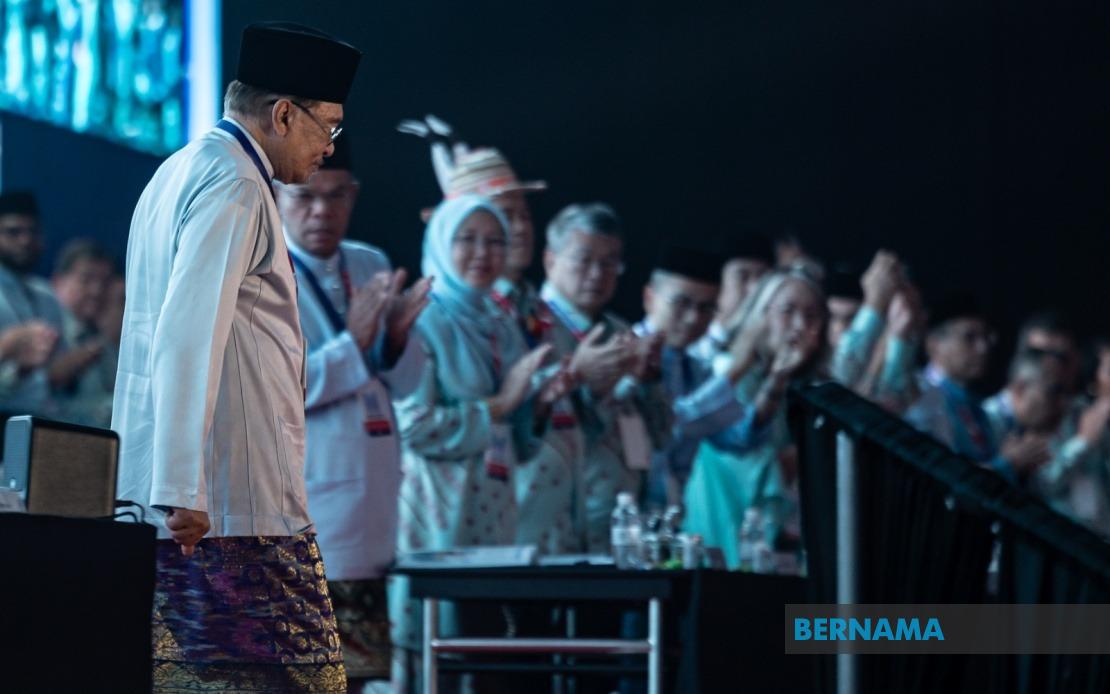
Prime Minister Datuk Seri Anwar Ibrahim has firmly rejected contentions from various quarters that the MADANI Government discriminates against particular states in its resource distribution. Speaking at the 2026 PKR National Congress held at the Melaka International Trade Centre in Ayer Keroh on Thursday, Anwar stressed that funding disparities between states reflect divergent developmental priorities rather than political bias or neglect. The Prime Minister's remarks come amid persistent scrutiny regarding whether the federal government equitably distributes resources across Malaysia's diverse regions, a longstanding concern in Malaysian politics where perceptions of unequal treatment frequently fuel political tensions.
Anwar presented a detailed breakdown of federal expenditure trends to substantiate his position, demonstrating concrete improvements in budget allocations across multiple states since the MADANI administration assumed office. The data provided illustrates a pattern of increasing investment, suggesting a strategic approach to resource allocation rather than arbitrary distribution. For Sabah specifically, the federal government has channelled substantially more capital, with spending climbing 35 per cent over three years, rising from RM13 billion in 2022 to RM17.6 billion in 2026. This trajectory reflects considerable commitment to one of Malaysia's economically strategic eastern states, particularly significant given Sabah's geographic distance from the federal capital and its historical concerns about marginalisation.
Sarawak, Malaysia's largest state by land area, has similarly benefited from expanded federal support. The allocation to Sarawak increased from RM10.2 billion in 2022 to RM15.1 billion in the current fiscal period, representing a 48 per cent growth rate that exceeds even Sabah's proportional increase. This substantial boost to Sarawak's budget suggests deliberate effort to strengthen the federal government's engagement with the state, whose political importance extends beyond its geographic dimensions given its population and resource endowments. The figures underscore recognition that Sarawak's development aspirations require sustained federal investment.
Regional allocations have expanded across the peninsula as well, addressing historical disparities. Terengganu's federal budget has grown from RM6 billion in 2022 to RM8.1 billion currently, reflecting a meaningful 35 per cent increase that targets development initiatives in the state. Johor, Malaysia's second-most populous state and a critical economic engine for the southern region, has seen its allocation escalate from RM10.2 billion in 2022 to RM14.6 billion in 2026, demonstrating federal commitment to sustaining the state's role as an industrial and commercial powerhouse. Kedah and Kelantan have also experienced cumulative increases, though the Prime Minister did not provide specific figures for these states.
Perlis, often perceived as a smaller state with proportionally less political influence in national discourse, has received increased allocations alongside other regions. Anwar's inclusive reference to Perlis suggests awareness that even smaller states warrant visible recognition of improved funding arrangements. This acknowledgment carries political significance beyond budgetary mechanics, signalling that the federal administration considers all states as integral components of the national development framework rather than marginal entities warranting minimal attention.
The Prime Minister employed comparative reasoning to reinforce his argument, noting that previous administrations had not expanded Sabah's expenditure in equivalent proportions during their tenure. This implicit historical comparison invites assessment of the MADANI Government's performance against preceding governance records, positioning current spending increases as demonstrable evidence of improved priority allocation. While such backward-looking analysis is common in political discourse, it establishes a baseline against which critics might evaluate claims of partiality or neglect.
Anwar's intervention directly addresses persistent political narratives within Malaysian federalism regarding regional equity and fair treatment. These concerns carry particular resonance in East Malaysia, where questions of resource distribution and federal responsiveness have historically intersected with broader conversations about the federation's constitutional arrangements and state autonomy. By quantifying increased allocations with precision, the Prime Minister attempts to shift debate from qualitative grievances to empirical spending data, though disagreement often persists regarding whether raw budget figures adequately reflect ground-level development outcomes.
The timing of these remarks at a party congress reflects standard political communication practices, where leaders utilise such platforms to address critics and reinforce policy narratives before supportive audiences. The PKR gathering provided an appropriate venue for the Prime Minister to defend his administration's record on federal resource distribution, an issue relevant to party credibility and electoral positioning ahead of future electoral cycles. The specific mention of multiple states across both peninsular and East Malaysia demonstrates conscious effort to project an image of geographically inclusive governance.
These budgetary increases must be contextualised within Malaysia's broader fiscal environment and economic constraints. Rising allocations to individual states necessarily occur within parameters established by national revenue generation and debt servicing obligations. Whether current spending levels adequately address developmental deficits in less-urbanised areas remains a substantive question for economists and development specialists. Additionally, budgetary allocation differs meaningfully from budget execution; physical delivery of promised projects and services requires effective implementation systems that allocations alone cannot guarantee.
The disparity in allocation increases across states—with Sarawak's 48 per cent growth exceeding Sabah's 35 per cent and other states' rates—itself invites scrutiny regarding underlying prioritisation frameworks. Understanding the rationale for differential growth rates requires examination of sectoral needs, infrastructure requirements, and demographic considerations that federal budget planners presumably employ when distributing resources. Public articulation of these decision-making criteria could enhance transparency and reduce suspicions of political motivation.
Anwar's defence of spending patterns reflects broader governance challenges inherent in managing a federal system encompassing diverse states with varying development levels and political alignments. Satisfying all regions' aspirations while maintaining fiscal sustainability represents a persistent equilibrium problem for Malaysian governments. The Prime Minister's detailed recitation of figures suggests recognition that raw assertions of fairness lack persuasive power without supporting evidence, necessitating quantitative substantiation even when critics may question methodology or timing assumptions embedded within budget projections.

