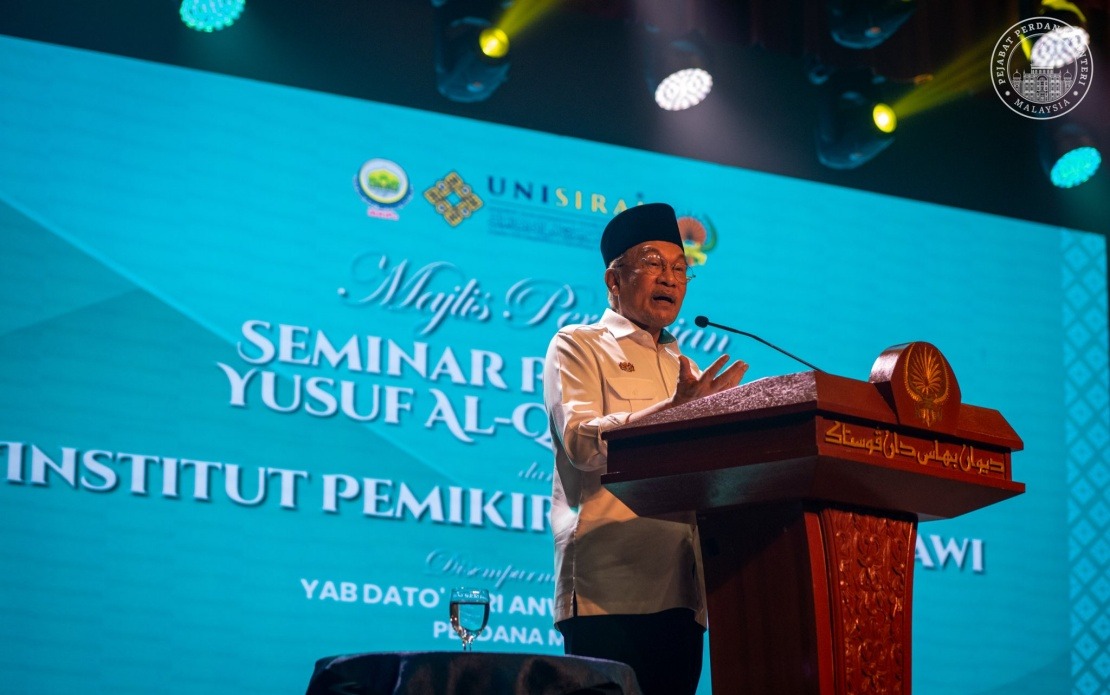
Prime Minister Datuk Seri Anwar Ibrahim has pledged RM2 million in MADANI Government funding towards establishing the Al-Qaradawi Thought Institute, underscoring the administration's commitment to advancing Islamic scholarship and contemporary thought within Malaysia. The announcement was made during the official launch of both the Yusuf Al-Qaradawi Thought Seminar and the institute itself at Wisma Dewan Bahasa dan Pustaka in Kuala Lumpur, marking a significant institutional investment in preserving and developing the scholarly legacy of the late Islamic jurist.
The Prime Minister's personal endorsement reflects his deep admiration for Sheikh Dr Yusuf Al-Qaradawi, whom he credited with providing intellectual guidance, moral encouragement, and genuine friendship throughout his own career in Islamic activism. Speaking through a post on the social media platform X, Anwar expressed his conviction that such initiatives would secure divine blessings while advancing knowledge and wisdom within the Muslim community at large. His remarks suggested that institutional support for Al-Qaradawi's thought represents more than symbolic recognition—it constitutes a deliberate policy choice to embed his philosophical approach within Malaysia's intellectual ecosystem.
Anwar's connection to Al-Qaradawi spans decades of mutual engagement rooted in his involvement with the Malaysian Islamic Youth Movement (ABIM), where he held prominent positions during a transformative period in Malaysian Islamic activism. The Prime Minister recalled how the Egyptian scholar had maintained sustained contact with ABIM's leadership, offering intellectual counsel that proved instrumental in shaping the movement's ideological direction during the early 1980s Islamic resurgence across Southeast Asia. This historical relationship underscores the transnational dimensions of Islamic thought within the region, where scholars like Al-Qaradawi exerted considerable influence on emerging Islamic movements and organizations.
Crucially, Anwar characterised Al-Qaradawi as a catalyst for progressive Islamic reform—someone who embodied intellectual openness while simultaneously engaging substantively with contemporary challenges facing Muslim-majority societies. The scholar's approach stood in stark contrast to more rigid interpretations prevalent during periods of heightened Islamic revivalism, when ideological purity and doctrinal exclusivity sometimes overshadowed engagement with broader intellectual currents. By framing Al-Qaradawi as a "zeitgeist"—a mover of historical forces—Anwar positioned him as someone whose influence transcended narrow sectarian or geographical boundaries.
A defining moment in this relationship involved Al-Qaradawi's explicit counsel that ABIM should eschew hardline positions in favour of wasatiyyah, the Islamic principle of moderation and balance. The Prime Minister acknowledged that this guidance proved invaluable during a period when sectarian fervor and ideological rigidity threatened to alienate broader segments of Malaysian society from Islamic institutions. The emphasis on maintaining intellectual flexibility while engaging with diverse viewpoints represented an approach to Islamic activism that prioritized social cohesion alongside spiritual commitment, a philosophy that resonates with contemporary policy discussions surrounding interfaith dialogue and pluralistic governance.
The establishment of a dedicated institute to study and advance Al-Qaradawi's thought carries significant implications for Malaysia's broader intellectual landscape. The institute will serve as a repository for research on the late scholar's contributions across jurisprudence, Islamic law, ethics, and contemporary Islamic thought, potentially becoming a regional hub for scholars examining how classical Islamic principles can address modern dilemmas. For Malaysian policymakers and religious leaders, such an institution offers a platform for exploring how theological frameworks can accommodate social pluralism, technological change, and democratic governance—questions of mounting urgency across Southeast Asia.
The timing of this initiative reflects the MADANI Government's articulated commitment to advancing Islam within a framework emphasizing inclusivity, democratic values, and institutional development. By channeling RM2 million towards intellectual infrastructure rather than purely religious or ceremonial purposes, the administration signals its belief that Islamic scholarship must remain dynamically engaged with contemporary realities rather than retreating into historical precedent. This approach aligns with global trends among Muslim-majority democracies seeking to reconcile religious identity with pluralistic governance systems.
For the broader Southeast Asian context, the Al-Qaradawi Thought Institute's establishment represents a significant statement about the region's intellectual ambitions. Malaysia positions itself as custodian of a moderate Islamic intellectual tradition, one capable of engaging with Western academic frameworks while maintaining theological authenticity. Such positioning matters considerably for regional soft power and for Malaysian expatriates across the globe who navigate questions of cultural and religious identity within multicultural environments.
The institute's research agenda will likely examine Al-Qaradawi's voluminous writings on contemporary issues ranging from Islamic banking and finance to bioethical questions and environmental stewardship. His work on adapting Islamic jurisprudence to modern circumstances, particularly his development of the concept of maslahah (public interest) as a jurisprudential tool, remains highly relevant to debates about Islamic governance and law reform across the Muslim world. Malaysian researchers will gain institutional access to analytical frameworks that could inform policymaking in areas from Islamic finance to family law.
Implementation of the institute's agenda will require careful attention to scholarly rigor alongside the inevitable political dimensions of Islamic intellectual work. The institute must balance its commemorative function—honouring a towering figure in twentieth-century Islamic thought—with the critical scholarship necessary to understand Al-Qaradawi's work in historical context. Malaysian academics engaged with the institute will need to examine not only his enduring contributions but also the evolving interpretations of his ideas within different Muslim communities and geographical contexts.
The government's financial commitment ultimately represents an investment in Malaysia's soft power and in the institutional infrastructure necessary for sophisticated Islamic thought to flourish domestically. By funding scholarship on a figure respected across diverse Islamic traditions while associated with progressive jurisprudence, the MADANI Government positions Malaysia as a hub for moderate Islamic intellectual engagement—a strategy with implications extending far beyond academic circles into foreign policy, interfaith relations, and the nation's international standing within the Islamic world.

