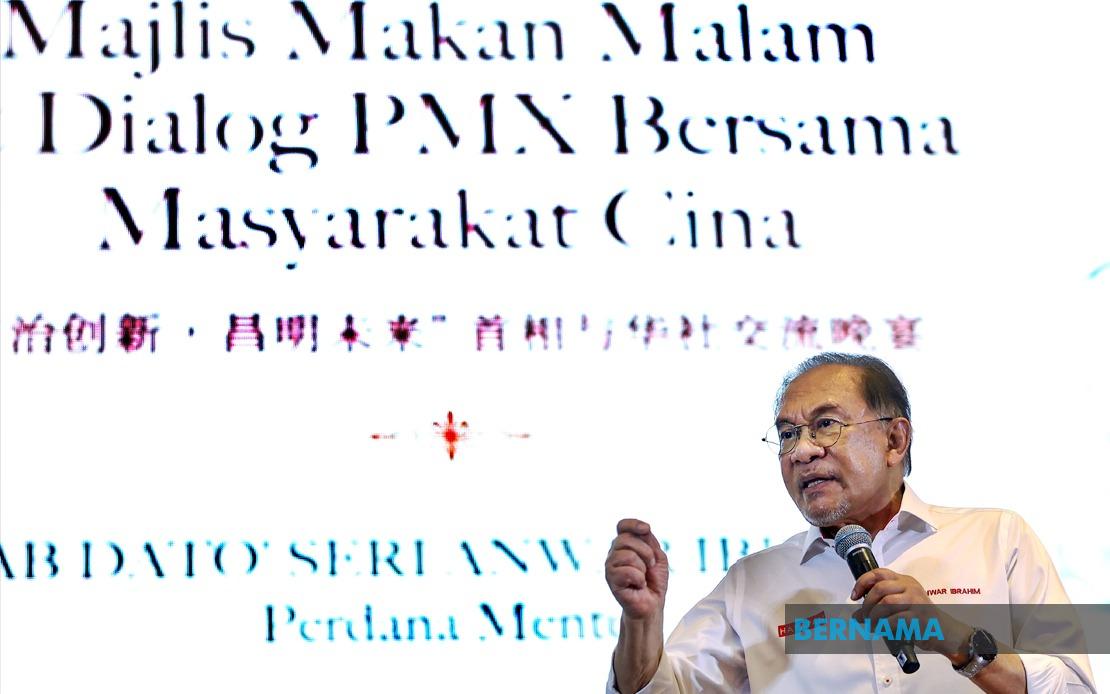
Prime Minister Datuk Seri Anwar Ibrahim has doubled down on his commitment to guide Malaysia towards becoming a prosperous and well-managed nation, speaking before a gathering of the Chinese community in Johor Bahru. The remarks underscore his broader vision of an administration defined by inclusive governance and transparent leadership that transcends communal divisions.
Addressing the dinner event, Anwar articulated a desire to be regarded as a leader genuinely engaged with every section of society. Rather than positioning himself as a representative of any particular group, he framed his role as one requiring him to connect meaningfully with the diverse tapestry of Malaysian citizens. This framing carries significance in Malaysia's multiethnic context, where leaders must navigate complex communal sensitivities while building national cohesion.
The Prime Minister's articulated focus at this stage of his tenure centres on establishing institutional practices and governance norms that will endure beyond his eventual retirement. Recognising his advanced age, Anwar indicated that his immediate priority involves embedding standards of fairness and administrative integrity into the machinery of state. This succession-oriented thinking suggests an effort to institutionalise good governance rather than rely solely on personal authority or leadership charisma.
In his remarks, Anwar emphasised the fundamental principle that every citizen holds equal standing in the eyes of government. This statement, seemingly straightforward, carries implications for how the administration approaches policy formulation and resource distribution across different regions and communities. The assertion that a Prime Minister "must serve everybody" represents a baseline commitment yet remains contested terrain in Malaysian politics, where particular groups sometimes perceive unequal treatment or competing claims to resources.
The emotional register of Anwar's comments—appealing to reciprocal affection between leader and people—reflects a personalised approach to politics that remains prevalent in Malaysian governance. By expressing hope that citizens will remember him as someone who genuinely cared for the population, he positioned leadership not merely as technical competence but as a moral relationship. Whether such sentiment translates into measurable policy outcomes remains a question independent observers continue to examine.
The gathering in Johor Bahru, Malaysia's southern economic hub, held particular significance as an engagement with the business-oriented Chinese community. This demographic segment remains influential in commercial circles and holds considerable sway over investment decisions and economic confidence. By appearing before this audience to reaffirm his inclusive governance philosophy, Anwar signalled awareness of business community concerns regarding political stability and consistent policy direction.
Also attending the event was Selangor Menteri Besar Datuk Seri Amirudin Shari, PKR's vice president and a senior figure within the ruling coalition. His presence underscored party unity within the broader political alliance and suggested coordination between federal and state-level leadership on messaging and strategic priorities. The attendance of prominent PKR figures at community-focused events has become a regular feature of the coalition's engagement strategy across diverse constituencies.
Anwar's invocation of his advancing age carried multiple layers of meaning. By acknowledging that his tenure as Prime Minister would eventually conclude, he positioned the legacy question as urgent and concrete rather than theoretical. This framing may also serve to encourage his administration's current allies to view the present period as consequential, potentially heightening motivation for policy implementation and legislative achievement.
The emphasis on collective national stewardship—framed as citizens caring for Malaysia "as our own, together"—represented an attempt to elevate governance beyond narrow partisan or factional interests. This rhetoric aligns with broader efforts by the current administration to present itself as focused on nation-building rather than short-term political advantage. Whether Malaysian voters perceive such messaging as authentic or rhetorical remains partly contingent on tangible improvements in economic management, corruption control, and service delivery.
For Malaysian readers, the significance of such statements lies less in the sentiments themselves—which appear relatively conventional in political discourse—than in whether administrative practice aligns with declared principles. International observers and domestic analysts continue monitoring whether the administration's stated commitment to clean governance translates into measurable reductions in corruption, improved transparency in government procurement, and genuine devolution of power to communities.
The interaction between leadership rhetoric and institutional performance represents a persistent challenge in Malaysian politics. Anwar's government enters its third year of a mandate that encompasses significant structural challenges including fiscal pressures, geopolitical tensions affecting regional trade, and domestic expectations for improved living standards. The articulation of legacy and values may signal readiness to focus on consolidating governance achievements rather than pursuing additional political expansion.
Regionally, Malaysia's governance trajectory carries implications for Southeast Asian politics more broadly. As a relatively large economy and established democracy within ASEAN, Malaysian governance standards influence perceptions of institutional quality and political trajectory across the region. Anwar's emphasis on fair, inclusive leadership therefore extends beyond domestic audiences to include international observers assessing the region's democratic health and stability.
The Johor event represents one dimension of sustained outreach by the current administration to various community segments. Such engagement, whether ultimately translating into policy change or remaining symbolic, forms part of the broader political calculus through which Malaysian leaders attempt to build and maintain coalitional support. For the business-oriented Chinese community specifically, signals about governance stability and inclusive treatment carry tangible implications for investment decisions and economic participation.

