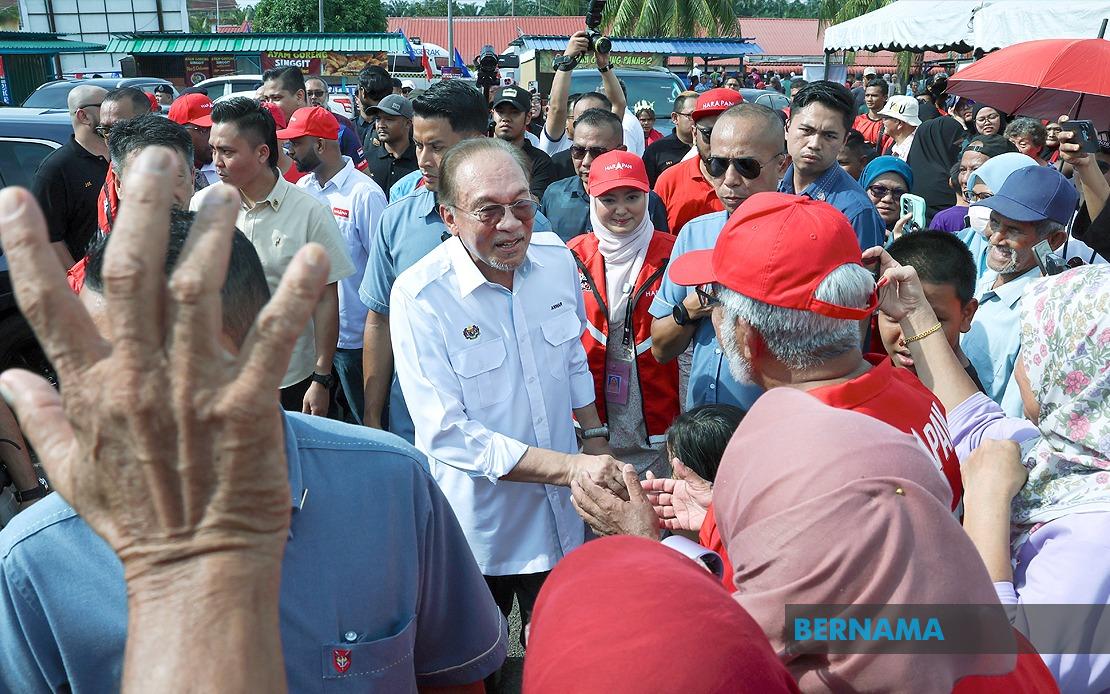
When nine-year-old Muhammad Afif Ikhwan set his heart on meeting Prime Minister Datuk Seri Anwar Ibrahim, his grandmother Rosimah Mohammad did not hesitate to make it happen. The 58-year-old rode a motorcycle through the oil palm estate landscape connecting Kampung Pudu to Felda Palong Timur in Segamat, Johor, transporting her grandson across the rural terrain to attend a political gathering where the Prime Minister was scheduled to appear. What began as a simple act of familial devotion would ultimately blossom into a cherished memory that the child now treasures every evening.
The anticipation that gripped young Muhammad Afif in the days leading up to the event proved almost overwhelming. Sleep eluded the boy as he contemplated the prospect of finally encountering the political figure he had long admired, his excitement building with each passing hour. When grandmother and grandson arrived at the venue on Sunday, they positioned themselves strategically near the pathway to the stage, hoping for an unobstructed view as the Prime Minister made his entrance.
As Anwar Ibrahim progressed along the path, acknowledging well-wishers in the crowd, Muhammad Afif seized his opportunity with the boldness of youth. Pushing through the gathered throng, the nine-year-old extended his hand in greeting. What transpired next exceeded even Rosimah's most optimistic expectations. The Prime Minister not only reciprocated the handshake but made an extraordinary gesture, inviting the young boy onto the stage to accompany him during the formal address he was about to deliver. In that moment, standing beside the nation's leader before an assembled audience, Muhammad Afif experienced a confluence of surprise and joy that would crystallize into one of his defining childhood experiences.
Rosimah's account of the encounter reveals the profound impact the experience had on both generations. She watched her grandson's face register the full magnitude of what was unfolding, understanding better than anyone the significance of what this meeting meant to the child who had dreamed of it for so long. The grandmother expressed deep gratitude that her sacrifice—the motorcycle journey through the challenging terrain—had yielded such an unexpectedly rewarding outcome, one that transcended the basic objective of simply seeing the Prime Minister from afar.
The encounter did not conclude when the event ended. News of Muhammad Afif's heartfelt wish and his memorable meeting with the Prime Minister eventually reached Anwar Ibrahim's office, prompting an extraordinary decision. Rather than allowing the interaction to fade into memory, the PM arranged for a follow-up visit to the boy's home in Kampung Pudu. This gesture demonstrated a recognition of the genuine connection that had formed during their brief but significant encounter at Felda Palong Timur.
The home visit was carried out on behalf of the Prime Minister by PKR deputy information chief Siti Aishah Shaik Ismail, who explained that the initiative came directly from Anwar's personal request. This detail underscores how the Prime Minister himself had been moved by the circumstances of the encounter—a grandmother's determination, a child's pure admiration, and a moment of human connection that transcended the usual formality of political engagements.
Accompanying Siti Aishah's visit were carefully selected gifts, each chosen with consideration for the boy's needs and interests. Muhammad Afif received a bicycle for recreation and mobility, a school bag for his studies, and a new pair of shoes. These items, modest in themselves, carried the symbolic weight of the Prime Minister's personal acknowledgment and encouragement. They were not merely presents but tangible reminders of the extraordinary day when a child's dream became reality.
The impact of the encounter has proven to be enduring and deeply emotional. According to Rosimah, her grandson continues to process and relive the experience with touching sincerity. Each night, Muhammad Afif embraces the shirt he wore during his meeting with Prime Minister Anwar Ibrahim, holding onto this physical connection to a memory that will likely stay with him throughout his life. This nightly ritual speaks to the profound effect that meaningful recognition and encouragement can have on a young person's development and sense of self-worth.
The broader significance of this narrative lies in its illustration of accessibility within Malaysia's political system and the capacity for genuine human moments within formal political structures. In an era when cynicism toward political leadership often dominates discourse, this story offers a refreshing counterpoint—a reminder that encounters between leaders and citizens can be authentic, emotionally resonant, and transformative. The fact that a grandmother's resourcefulness and a child's sincere admiration could spark such a response from the highest office suggests an openness that extends beyond typical political calculation.
For residents of rural Johor and Segamat specifically, this account demonstrates how political figures at the national level can engage meaningfully with local communities. The journey through the oil palm estate—a landscape central to the regional economy and daily life—grounds this story in the lived reality of ordinary Malaysians navigating both geographic and social distances to participate in the political life of their nation. The event also reflects the ongoing relevance of FELDA (Federal Land Development Authority) communities in Malaysia's political engagement and the importance placed on connecting with constituents in these areas.

