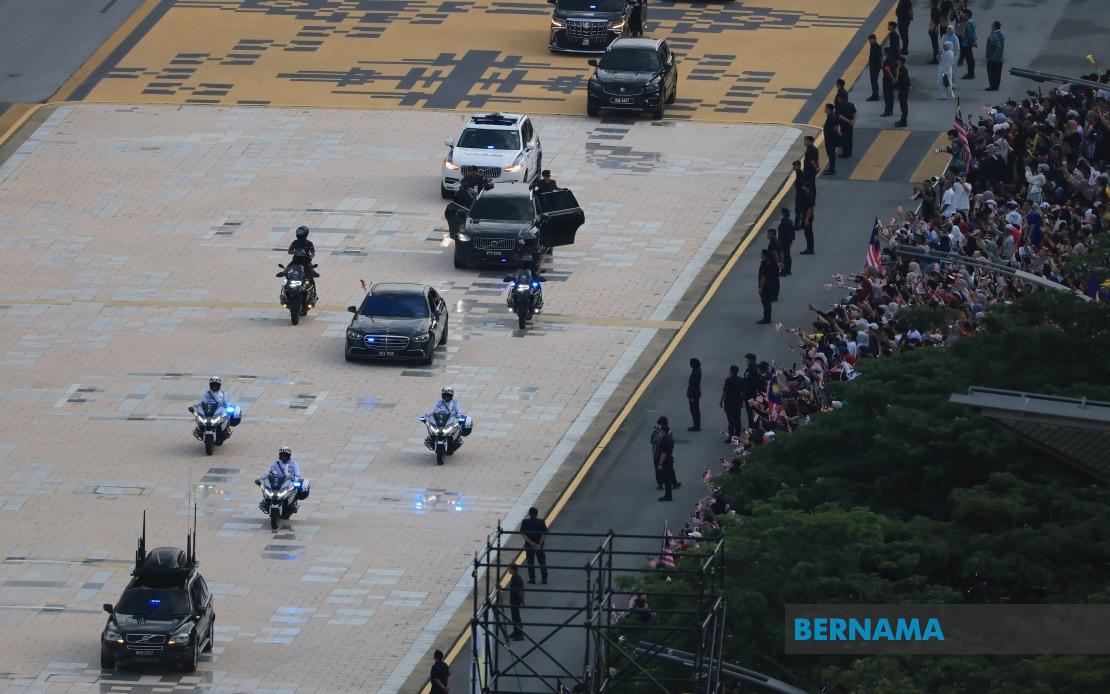
Prime Minister Datuk Seri Anwar Ibrahim, accompanied by his wife Datuk Seri Dr Wan Azizah Wan Ismail, presided over Malaysia's 69th National Day celebrations at Dataran Putrajaya on August 31, joining an assembled crowd of thousands in marking the significant national milestone. The premier and Finance Minister arrived at the royal stage at 7.53 am as the Hormat Perdana song played, setting the ceremonial tone for what organisers had themed "Malaysia MADANI: Kesejahteraan Dinikmati" — a framework emphasising national prosperity and shared wellbeing across Malaysian society.
The event drew representation from across the country's political and diplomatic establishment. Deputy Prime Minister Datuk Seri Dr Ahmad Zahid Hamidi arrived earlier at 7.45 am, while Communications Minister Datuk Seri Fahmi Fadzil, who also chairs the main committee overseeing National Day and Malaysia Day celebrations through 2026, attended alongside Home Minister Datuk Seri Saifuddin Nasution Ismail and Defence Minister Datuk Seri Mohamed Khaled Nordin. The presence of the full Cabinet contingent underscored the government's commitment to the annual observance, a key moment for affirming national unity and purpose.
Beyond the ministerial presence, the gathering encompassed deputy ministers, government officials, and international delegates representing Malaysia's diplomatic partnerships across the region and globally. The inclusion of foreign representatives reflected the contemporary understanding of National Day as both an internal reaffirmation of national identity and an outward demonstration of Malaysia's standing in international affairs. This diplomatic component has become increasingly significant as Southeast Asian nations navigate complex geopolitical environments.
The logistical scale of the 2024 celebration demonstrated considerable organisational effort. More than 10,800 participants drawn from 76 separate contingents marched in formation, accompanied by 22 marching bands that provided musical accompaniment throughout the proceedings. The choreography of such celebrations requires months of coordination, with contingents representing diverse sectors of Malaysian society — from uniformed services to community organisations — each contributing their own narrative to the collective national story.
The spectacle extended far beyond the marching formations themselves. Organisers incorporated 11 specially decorated vehicles into the procession, creating moving visual displays that conveyed thematic elements central to this year's messaging. The involvement of 328 land, sea and air assets represented an opportunity to showcase Malaysia's defence and security capabilities, a traditional but symbolically important component of National Day celebrations that reminds citizens of the institutional structures maintaining territorial integrity and national sovereignty.
A particularly contemporary element emerged through the integration of 22 electric vehicle assets into the proceedings. This inclusion reflects Malaysia's gradual pivot toward environmental sustainability and the government's commitment to transitioning its vehicle fleet as part of broader climate and energy transition commitments. The visible presence of EVs at such high-profile national events serves an educational function, normalising alternative technologies among the viewing public and signalling governmental direction to both citizens and international observers assessing Malaysia's environmental credentials.
The ceremonial use of 112 working animals, meanwhile, maintained traditional elements that connect modern Malaysia to its cultural heritage and agricultural foundations. Such elements prevent National Day celebrations from becoming purely militaristic or technocratic affairs, instead weaving together the nation's diverse strands — its security apparatus, technological advancement, environmental consciousness, and deep-rooted cultural practices. This balance reflects deliberate curatorial choices about which national narratives receive emphasis during these moments of collective commemoration.
For Malaysian readers, these celebrations carry particular resonance given recent political developments and the ongoing process of coalition-building that has characterised national governance since 2022. The prominent attendance of the Prime Minister alongside the Deputy Prime Minister and a full Cabinet roster projected an image of governmental cohesion at a moment when questions about political stability occasionally surface in regional discourse. National Day celebrations provide an opportunity to transcend routine partisan differences and emphasise the continuity of national institutions and shared purpose.
The Malaysia MADANI thematic framework, emphasising shared prosperity and national wellbeing, also signals the government's domestic policy orientation as it moves through the latter stages of its current term. This messaging framework has become central to how the administration articulates its vision for national development, distinguishing its approach from previous eras. The choice to foreground this theme at National Day celebrations indicates deliberate messaging about the government's priorities regarding social cohesion, economic opportunity, and inclusive development.
From a Southeast Asian perspective, Malaysia's National Day celebrations reflect how middle-income nations in the region continue to employ traditional statecraft tools — ceremonial gatherings, military displays, thematic messaging — to reinforce national identity and international positioning. As the region navigates questions about regional order, climate change, and economic integration, countries like Malaysia use these annual observances to demonstrate institutional capacity, political stability, and forward-looking vision. The scale and professional execution of Putrajaya's 2024 celebration underscores Malaysia's continued investment in national pageantry as a tool of political communication.

