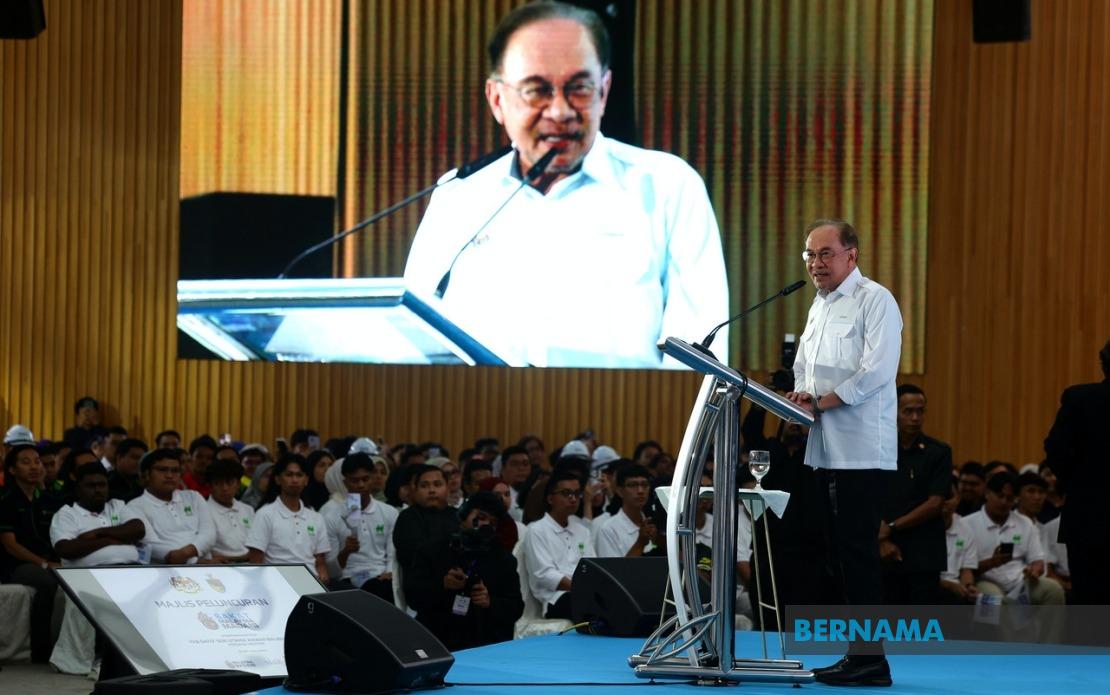
Prime Minister Datuk Seri Anwar Ibrahim has officially launched Bakat MADANI, an ambitious national talent development initiative expected to provide training and employment opportunities to 25,000 Malaysians. The programme, unveiled in Seremban on June 29, represents a collaborative effort among government-linked investment companies, government-linked companies, and Petronas to strengthen the nation's human capital and create pathways for economic mobility across diverse sectors.
At its core, Bakat MADANI addresses a critical gap in Malaysia's skills ecosystem by connecting young people with quality employment opportunities while enhancing their professional capabilities. The initiative moves beyond conventional training by embedding itself within the operational frameworks of major corporate entities, ensuring that graduates have direct access to genuine job placements rather than theoretical credentials. This pragmatic approach acknowledges that skills development remains hollow without corresponding employment prospects, a challenge that has long plagued Malaysia's vocational and technical education system.
Prime Minister Anwar emphasised that the private sector's financial commitment forms the backbone of the programme's viability. His remarks underscored an important principle: success depends not merely on government endorsement but on sustained corporate investment and responsible implementation by participating companies. This framing positions Bakat MADANI as a genuine public-private partnership rather than a one-way government subsidy, placing accountability squarely on both employers and beneficiaries to ensure the initiative delivers measurable outcomes.
Finance Minister II Datuk Seri Amir Hamzah Azizan outlined three strategic pillars underpinning the initiative. The first concentrates on strengthening employability and career advancement within the ecosystem of GLICs, GLCs, and Petronas—entities that collectively command significant market influence and hiring capacity. The second pillar focuses on expanding job placements across high-growth strategic sectors including semiconductors, renewable energy, digital economy ventures, and advanced manufacturing. The third emphasises revitalising Technical and Vocational Education and Training institutions, recognising their pivotal role in developing mid-level skilled workers essential for Malaysia's industrial competitiveness.
The geographical and sectoral focus of Bakat MADANI reveals strategic thinking aligned with Malaysia's longer-term economic transformation agenda. By channelling talent towards semiconductors and renewable energy, the programme positions Malaysian workers to participate in global supply chains where high value-added roles command premium compensation. This contrasts with earlier decades when vocational training often funnelled graduates into lower-wage service roles. The inclusion of digital economy and advanced manufacturing indicates recognition that traditional manufacturing alone cannot sustain middle-class employment growth.
A particularly noteworthy innovation within Bakat MADANI involves new tax incentives offered to companies operating approved training programmes. These incentives, described as an improvement on existing employability measures, expand coverage to include TVET graduates previously excluded from certain benefits. Crucially, they mandate higher minimum allowances for trainees, addressing a longstanding complaint that apprenticeships and entry-level training positions often pay poverty wages. By making compensation more competitive, the programme removes a significant disincentive for low-income Malaysians to pursue skills development.
The structural redesign of existing programmes within Bakat MADANI demonstrates how established initiatives can be modernised and integrated rather than continuously creating parallel structures. Petronas's transformation of VISTA into Vista i-Plus, executed in partnership with Malaysian Petroleum Resources Corporation and the Malaysian Oil, Gas & Energy Services Council, creates an integrated training model spanning multiple TVET institutions including MARA Skills Institutes, National Youth Skills Institutes, Advanced Technology Training Centres, and the Malaysian Construction Academy. This consolidation reduces fragmentation and enables students to navigate a more coherent pathway from basic skills to industry-ready competency.
Within the GLIC and GLC ecosystem, Khazanah Nasional Berhad has mobilised 23 higher education institutions—ranging from Universiti Teknologi MARA and Universiti Teknikal Malaysia Melaka to Universiti Malaysia Sabah—to prepare graduates through industrial training, technical certification, and direct exposure to workplace requirements. This institutional collaboration is particularly significant for Malaysia, where tertiary education enrolment has expanded substantially but graduate employability remains inconsistent. By embedding industry exposure within degree programmes, the initiative addresses the persistent mismatch between academic curricula and employer expectations.
For Malaysian workers and job seekers, Bakat MADANI offers concrete pathways into growing sectors where skills shortages currently constrain employment growth. The programme's emphasis on high-value industries signals that the nation is moving beyond a purely cost-competition development model toward capabilities-based economic positioning. For Southeast Asia more broadly, the initiative demonstrates how middle-income countries can leverage sovereign wealth and state-owned enterprises to tackle skills gaps that typically require either expensive foreign workers or underdeveloped domestic talent pipelines.
The success of Bakat MADANI will depend significantly on the programme's ability to maintain quality standards across 25,000 beneficiaries while ensuring genuine employment absorption rather than merely training completion. The emphasis on corporate responsibility and proper implementation suggests the government recognises that scalability can easily undermine quality. Malaysian policymakers and corporate leaders will need to establish transparent metrics for measuring outcomes—not just training hours delivered but actual employment rates, salary progression, and long-term career advancement among participants.
The programme arrives at a critical juncture for Malaysia's labour market. With automation accelerating and global competition for talent intensifying, the nation cannot afford to leave human capital underdeveloped. Bakat MADANI's integration of government, state-owned enterprises, and the private sector into a coordinated skills ecosystem represents the kind of institutional alignment necessary for meaningful transformation. Whether the initiative becomes a model for sustainable talent development or remains a limited intervention will significantly influence Malaysia's competitiveness over the next decade.

