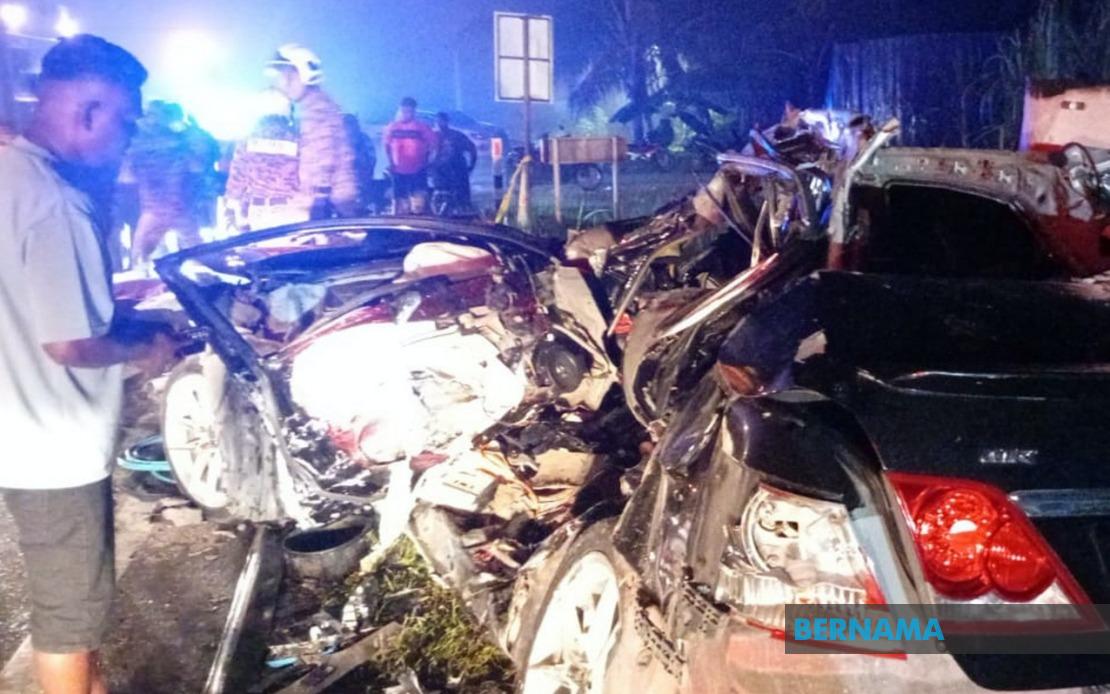
Prime Minister Datuk Seri Anwar Ibrahim has extended formal condolences to the bereaved families following a fatal traffic collision that claimed six lives on Jalan Karak Lama in Bentong, Pahang, in the early hours of Thursday. The premier, alongside his wife Datuk Seri Dr Wan Azizah Wan Ismail, publicly expressed deep sorrow over the tragedy through a statement posted on social media, acknowledging the profound loss experienced by those affected.
The catastrophic incident unfolded at approximately 4 am when a Toyota Vios carrying six occupants collided head-on with a one-tonne lorry on the highway section near Klink Desa Jambu Rias, along the route stretching between Kuantan and Kuala Lumpur. All six passengers in the compact vehicle perished at the scene, representing a complete loss of life for those aboard. The victims included the vehicle's driver, V. Mugilan, aged 25, alongside five young passengers whose ages ranged disturbingly downward from 22 to just 16 years old. The identified victims were K. Dineshvaran, 22; K. Alaganathan, 21; A. Kanabati Raja, 19; S. Kiisven, 17; and M. Paranthaman, 16. The lorry driver, a 31-year-old male, sustained serious injuries requiring medical attention but survived the collision.
According to preliminary investigations conducted by police authorities, the sequence of events leading to the tragedy suggests that the Vios veered across the centre line while negotiating a downhill section of the highway. This deviation from the proper lane resulted in a direct frontal collision with the opposing vehicle, a configuration of impact particularly likely to generate catastrophic outcomes. The circumstances indicate that the compact sedan may have lost directional control during the descent, either due to mechanical failure, driver error, or challenging road conditions at that hour.
In his formal statement, the Prime Minister emphasised the gravity of the moment, urging national reflection on road safety practices. He remarked that the tragedy served as a sobering reminder that highway safety cannot be approached with complacency or negligence. Anwar's message extended wishes for the injured lorry driver to achieve full recovery, while simultaneously invoking strength and resilience for the families navigating the immediate aftermath of losing multiple loved ones in a single incident. Such tragedies disproportionately affect younger communities, as evidenced by the youth of five of the six fatalities, raising questions about vehicle safety protocols and passenger awareness among younger drivers and their companions.
The Jalan Karak Lama corridor represents a critical arterial route connecting Pahang's east coast regions to the greater Klang Valley, serving as a major conduit for commercial and personal traffic. This stretch of highway has historically witnessed numerous accidents, partly attributable to the challenging topography involving numerous hills, curves, and elevation changes that demand heightened driver attentiveness and vehicle control. The early morning timing of this particular collision—a period characterised by reduced visibility, potential fatigue among drivers, and lighter traffic monitoring—may have contributed to the severity of the outcome.
The concentration of fatalities within the Vios speaks to broader concerns about vehicle safety in Malaysia's automotive landscape. Compact sedans, while economical and popular among younger drivers and first-time vehicle owners, offer limited protection compared to larger vehicles or those equipped with advanced safety features. Modern vehicles increasingly incorporate electronic stability control, lane-keeping assistance, and collision avoidance systems, yet many vehicles on Malaysian roads, particularly older models or those in the budget segment, lack such protective technologies. The incident underscores the widening safety gap between vehicle categories on Malaysian highways.
For Malaysian road safety advocates and policymakers, such catastrophic incidents typically catalyse renewed scrutiny of enforcement mechanisms, speed limits, and driver education standards. The younger demographic composition of the victims—with four of the six under 22 years of age—raises particular concerns about passenger behaviour and the risks associated with occupancy of high-risk vehicle categories. Young drivers and their peer groups frequently exhibit heightened accident rates, a pattern documented across numerous jurisdictions and attributed partly to inexperience, reduced risk perception, and vehicle choices.
The lorry driver's survival, despite the severity of the frontal collision, contrasts starkly with the universal fatality among the Vios occupants, illustrating how vehicle mass and structural design substantially influence survivability in such incidents. Larger commercial vehicles, while capable of inflicting devastating injuries on smaller vehicles, provide proportionally greater protection to their own occupants due to enhanced mass and structural reinforcement designed to withstand substantial loads. This disparity raises equity questions about how to better protect occupants of smaller, more vulnerable vehicle classes without discouraging their use or inflating transportation costs for economically disadvantaged populations.
The timing of the Prime Minister's public response reflects the escalating expectation that senior government officials immediately acknowledge major tragedies affecting citizens. Such statements serve multiple functions beyond expressing genuine sorrow—they affirm government concern for public welfare, signal potential policy reviews, and provide a focal point for collective national mourning. In this instance, Anwar's emphasis on road safety vigilance may foreshadow renewed enforcement campaigns or policy discussions within relevant ministerial portfolios.
Road fatalities remain a persistent public health crisis across Southeast Asia, with Malaysia recording thousands of deaths annually despite incremental improvements in vehicle and infrastructure safety. The Bentong collision exemplifies how even short journeys on familiar routes can terminate catastrophically, a reality that demands sustained attention to preventive measures, driver behaviour modification, and continued advancement in vehicle safety technologies. The convergence of factors—hour of day, topography, apparent loss of vehicle control, and the vulnerability of the vehicle class involved—creates a tragedy whose preventability remains tragically uncertain even in hindsight.
Moving forward, the incident will likely feature prominently in road safety discourse at both state and federal levels. The Pahang government and relevant highway authorities may undertake safety audits of the affected corridor, potentially implementing measures such as improved signage, speed reduction initiatives, or enhanced nighttime visibility enhancements. National road safety bodies may analyse the collision data to identify patterns or causal factors applicable to broader highway safety strategies. Meanwhile, families of the deceased navigate an incomprehensible loss, their grief amplified by the sudden, violent nature of their loss and the tragic youth of most victims.

