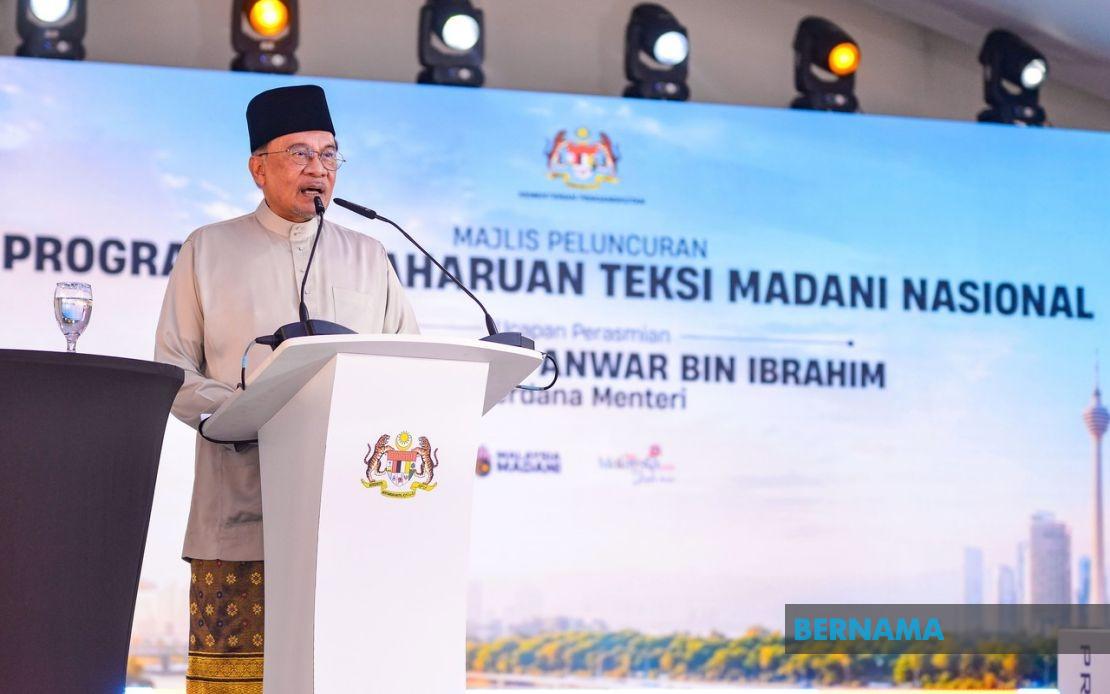
Prime Minister Datuk Seri Anwar Ibrahim has committed an additional RM10 million to accelerate the Vehicle Replacement Matching Grant Programme, signalling the government's determination to modernise Malaysia's taxi fleet and improve service standards in the capital. The fresh allocation represents a doubling of the scheme's initial funding and reflects confidence that demand from operators will exceed available resources. Speaking during the launch of the National MADANI Taxi Reform Programme at Dataran Merdeka on July 3, Anwar, who doubles as Finance Minister, underscored the taxi sector's strategic importance to urban mobility and the broader economy.
The original RM10 million earmarked in Budget 2026 generated substantial interest from taxi operators, indicating widespread recognition that vehicle modernisation is overdue. Many taxis plying Malaysian roads have aged significantly, with some operating models that lack modern safety features, fuel efficiency improvements, and passenger comfort amenities. The enthusiastic response to the initial tranche of funding prompted government officials to fast-track approval for the supplementary allocation, demonstrating responsiveness to grassroots demand within the transport sector. This approach allows the administration to demonstrate tangible support for a constituency that has historically faced economic pressure from ride-hailing platforms and fluctuating fuel costs.
Crucially, the government has negotiated a landmark agreement with national automaker Proton and the Transport Ministry to introduce a bespoke financing scheme enabling taxi drivers to purchase the Proton S70. This partnership represents a strategic intervention to support domestic automotive manufacturing while simultaneously offering operators an affordable entry point to vehicle ownership. The S70, a sedan-class vehicle, meets regulatory specifications for urban taxi operations and promises better fuel economy and lower maintenance costs compared to older stock. By tying the replacement programme to a local manufacturer, the initiative creates positive spillovers for domestic industry while reducing hard currency outflows associated with imported vehicle purchases.
The financing scheme's design is pivotal to programme success. Standard commercial lending often disadvantages individual taxi operators who lack substantial collateral or savings buffers, meaning concessional or subsidised financing terms are essential to unlock uptake. Government involvement in structuring repayment schedules and interest rates can materially improve affordability. For drivers currently operating vehicles that require frequent expensive repairs, the switch to newer Proton models could yield net savings over the medium term despite monthly financing obligations. This economic calculus will likely resonate with pragmatic operators seeking to improve profit margins.
Transport Minister Anthony Loke's presence at the launch ceremony reflected the multi-agency coordination required to execute such schemes. The Transport Ministry oversees regulatory frameworks, vehicle standards, and industry liaison, making departmental buy-in essential. Minister in the Prime Minister's Department (Federal Territories) Hannah Yeoh and Chief Secretary to the Government Tan Sri Shamsul Azri Abu Bakar also attended, underlining cabinet-level commitment and the programme's implications for federal territories governance. This administrative alignment suggests coordinated rollout across Kuala Lumpur, Labuan, and Putrajaya, potentially serving as a pilot for national expansion.
The National MADANI Taxi Reform Programme sits within the government's broader MADANI framework, which emphasises prosperity, transparency, and inclusivity. Taxi reform touches all three pillars: improving driver incomes through efficiency gains, ensuring transparent disbursement of grants, and promoting inclusive urban transport access. The nomenclature signals that modernisation is not merely a technical fix but part of a holistic vision for economic inclusion and service quality enhancement. Taxi operators, many of whom are self-employed entrepreneurs facing intense competition, represent a politically significant constituency, and visible government support carries messaging value.
For Malaysian consumers and commuters, fleet modernisation promises tangible benefits. Newer vehicles typically offer better air conditioning, cleaner emissions, and enhanced safety features such as airbags and stability control. Passengers in Kuala Lumpur and other major cities will experience improved ride quality and reduced health risks from older emission standards. Furthermore, modernised taxis may reduce congestion pressure on alternative transport modes by remaining economically viable competitors to private vehicles and ride-hailing services. Maintaining a healthy, functioning traditional taxi sector preserves service redundancy and ensures transport access for populations that rely on regulated fares.
The programme's funding envelope of RM20 million across both tranches, while substantial, must be contextualised against the estimated national taxi fleet size. If approximately 60,000 licenced taxis operate across Malaysia, even with average grant values of RM50,000 per vehicle, the current budget supports only marginal fleet turnover. However, this initial commitment may catalyse broader private sector financing participation and state-level co-investment, multiplying impact. The Proton partnership reduces per-unit costs compared to international alternatives, improving value for money and grant reach.
Regionally, Malaysia's taxi modernisation initiative carries implications for Southeast Asian transport policy discourse. Competing urbanisation pressures across ASEAN nations have prompted similar fleet upgrade programmes in Thailand, Indonesia, and the Philippines. Malaysia's approach—combining direct subsidies, manufacturer partnerships, and bespoke financing—offers a replicable model addressing affordability constraints that limit operator participation in voluntary modernisation. The emphasis on local manufacturing integration differentiates Malaysia's approach and demonstrates how industrial policy can align with social objectives.
Implementation mechanics will determine success. Clear application procedures, transparent selection criteria for grant recipients, and timely fund disbursement are essential to maintain operator confidence. Any bottlenecks in processing applications or delays in fund transfer could undermine uptake and generate political backlash. The government must also address potential issues such as vehicles purchased under the scheme being transferred or mortgaged to unintended parties, requiring robust monitoring frameworks. Coordination between the Transport Ministry, Proton, participating financial institutions, and city authorities managing taxi operations will test administrative capacity.
Longer term, the government may contemplate extending the scheme beyond the RM20 million committed thus far if early uptake metrics prove encouraging and financial performance improves. Environmental considerations also merit attention; while the Proton S70 offers efficiency gains, an electric or hybrid variant could enhance sustainability credentials and reduce long-term operating costs for drivers. Future iterations might incentivise transition toward low-emission vehicles, aligning transport policy with climate commitments and leveraging Malaysia's renewable energy generation potential.
Anwar's announcement reflects political pragmatism and strategic foresight. Taxi drivers constitute a politically visible group, and tangible support generates grassroots goodwill valuable during electoral cycles. Simultaneously, fleet modernisation yields genuine public benefits through improved service quality, reduced emissions, and preserved transport diversity. By mobilising government resources alongside private sector partnership, the administration demonstrates capacity to execute inclusive economic policies while supporting domestic industry, a combination that reinforces broader MADANI governance narratives.

