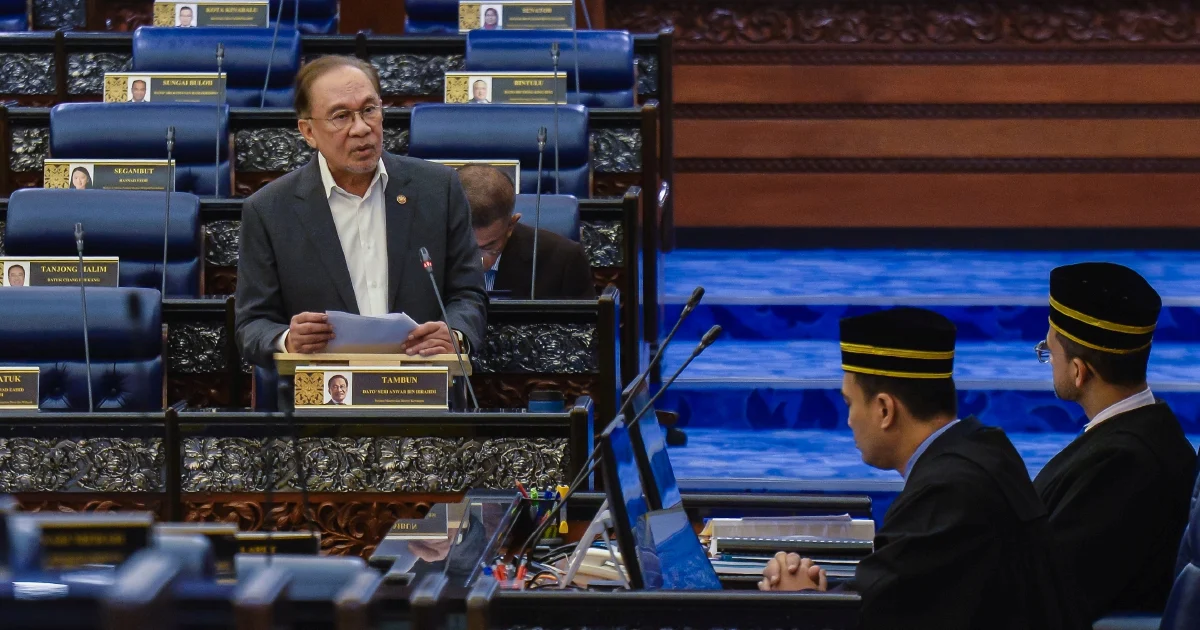
Prime Minister Datuk Seri Anwar Ibrahim has moved to quash speculation about his involvement in the cancellation of a Johor Felda Settlers' Day celebration scheduled for Kluang, reasserting his position before the Dewan Rakyat that no such directive emanated from his office. The clarification comes as questions persist about the event's cancellation and its connection to the electoral cycle, with the Prime Minister emphasizing that his administration operates within established protocols rather than issuing ad-hoc instructions to curtail public gatherings.
Addressing parliamentary concerns directly, Anwar Ibrahim stressed that the only framework constraining the use of state resources during election periods is the conventional prohibition against deploying government machinery for partisan campaign activities. This distinction carries weight in Malaysian political discourse, where the line between legitimate state functions and electioneering has long been contested terrain. The Prime Minister's repeated denial suggests that confusion or miscommunication may have occurred at the implementation level, with local authorities potentially interpreting existing guidelines more strictly than necessary without explicit instruction from the federal leadership.
The Felda settlement scheme, which has deep historical roots in Malaysia's agricultural development strategy, holds particular significance for rural constituencies across the peninsular region. Johor, home to a substantial Felda population, represents an important demographic bloc whose concerns resonate beyond state borders. When government-sponsored or supported community events face cancellation, especially those celebrating settler heritage and cohesion, rural communities often perceive diminished recognition from federal authorities, potentially amplifying political sensitivity in agricultural constituencies.
The timing of the Kluang event cancellation during an election period naturally invites scrutiny, even if technical protocols rather than high-level directives drove the decision. Election commissions worldwide grapple with balancing administrative continuity against the need to neutralize unequal resource advantages during campaign cycles. Malaysia's approach relies on restricting government machinery use, a mechanism intended to level playing ground between competing parties while allowing routine civil functions to proceed normally. The cancellation of a community celebration, however, falls into a grey zone where commemoration and political optics intersect uncomfortably.
Anwar Ibrahim's parliamentary statement reflects a broader challenge facing modern administrations: maintaining clear separation between governance and electoral positioning while acknowledging that citizens routinely interpret government actions through a political lens. For Southeast Asian democracies still developing their institutional frameworks, such clarifications serve an educational function, establishing precedent and expectation about the boundaries of executive authority. The Prime Minister's emphasis on systemic restrictions rather than personal directives suggests an attempt to reinforce institutional discipline and adherence to established electoral codes.
The distinction Anwar Ibrahim drew carries practical implications for how federal guidance flows through bureaucratic channels to state and local levels. If centralized directives were routinely used to cancel community events during elections, it would invite accusations of partisan manipulation. Conversely, if general prohibitions on government machinery use are being applied so rigidly that they eliminate legitimate non-partisan commemorative activities, authorities must recalibrate their interpretation. The Prime Minister's clarification implicitly signals that the latter interpretation may have occurred, warranting review of implementation practices.
Felda-related communities have historically served as reliable voting blocs for establishment coalitions, making their perceptions of government responsiveness politically consequential. When settlers perceive that commemorative events are being suppressed or deprioritized, particularly when framed around community identity rather than electoral campaigns, resentment can calcify into reduced political support. The Johor incident, therefore, transcends the narrow question of whether a single event proceeded as scheduled, touching instead on broader questions of how rural constituencies experience their relationship with federal authority and whether they feel adequately valued by sitting administrations.
The Prime Minister's reiteration of his position reflects awareness that initial denials alone may not fully resolve public perception. In contemporary Malaysian politics, where transparency concerns animate public discourse, repeated clarifications without accompanying investigations into who made the actual cancellation decision can appear incomplete. Stakeholders from settlement communities may reasonably ask not merely whether Putrajaya intervened, but who at state or local level made the determination and on what specific grounds, understanding that systemic prohibitions require human interpretation to become operational decisions.
Moving forward, the incident underscores the need for clearer communication between federal election authorities, state governments, and local administrators regarding which activities constitute permissible government functions during campaign periods and which cross into restricted territory. Felda Settlers' Day celebrations, framed explicitly around honouring settler contributions to national agricultural development, could potentially be compartmentalized from electoral activity if administrative guidelines were more precisely delineated. Such clarification would serve both the government's credibility and rural communities' interests by preventing future incidents where standard protocols generate perception of deliberate suppression.
For Malaysian readers and the broader Southeast Asian audience, this incident illustrates the continuing tension between democratic electoral principles that demand fair play and practical governance that requires government institutions to function throughout campaign cycles. The Prime Minister's explanation, while addressing immediate parliamentary concerns, ultimately highlights the need for institutional evolution toward frameworks that simultaneously maintain electoral neutrality and permit authentic community life to flourish unrestricted by political calendars.

