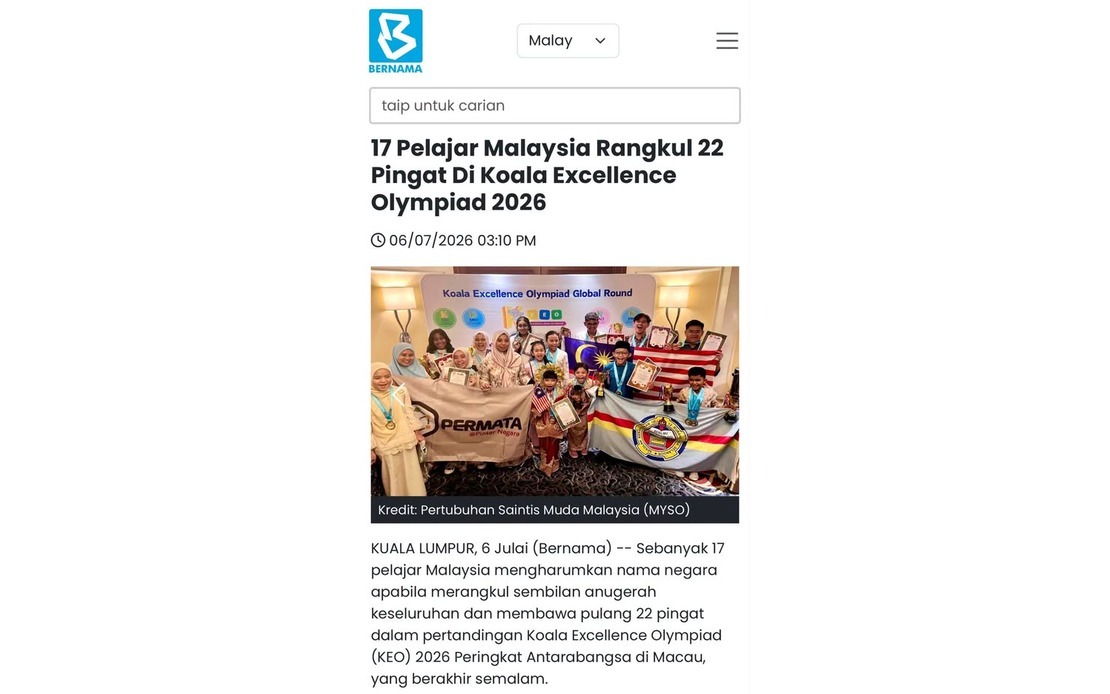
Prime Minister Datuk Seri Anwar Ibrahim has commended the exceptional performance of 17 Malaysian students at the Koala Excellence Olympiad (KEO) 2026 Global Finals, which concluded recently in Macau. The delegation achieved a noteworthy haul of nine overall awards coupled with 22 individual medals, cementing Malaysia's standing in international academic competitions. Through a social media post, the Prime Minister expressed his pride in the young Malaysians' accomplishments and encouraged them to maintain their pursuit of excellence and aspire towards even greater achievements in future endeavours.
The medal tally comprised five gold medals, six silver medals, and 11 bronze medals, according to Aidah Misran, who led the Malaysian contingent to the competition and serves as coordinator for the Malaysia Young Scientists Organisation (MYSO). This distribution underscores a balanced performance across the contingent, with the team securing medals in multiple categories rather than concentrating achievements in a single discipline. The breadth of success reflects the quality of preparation undertaken by the participating students and their mentors ahead of the global platform.
KEO represents an established international competition framework developed collaboratively by Australian educational specialists and university graduates. The platform encompasses four distinct academic disciplines—English, Mathematics, Science, and Arts—creating a comprehensive assessment structure that evaluates students across humanities and STEM subjects. This multidisciplinary approach distinguishes KEO from narrowly focused olympiads, offering participants exposure to diverse fields of intellectual endeavour and encouraging well-rounded academic development among competing students globally.
The 2026 iteration brought together student representatives from numerous countries, creating a genuinely international learning environment where participants could benchmark their capabilities against peers from different educational systems and cultural backgrounds. For Malaysian students, such exposure carries particular value, as it provides practical experience in competing at global standards whilst fostering cross-cultural understanding and networking opportunities with young achievers from around the world. The presence of Malaysian students among medal winners signals that domestic educational standards are competitive when measured against international benchmarks.
MYSO, in collaboration with KEO and Miss Man International Group, coordinated Malaysia's participation in this year's competition. The partnership demonstrates how specialist organisations focused on youth development and scientific advancement can effectively mobilise talent and facilitate participation in prestigious international forums. MYSO's role as coordinating body underscores the importance of institutional support systems in identifying, nurturing, and presenting Malaysian talent on the global stage. Such organisational frameworks have proven instrumental in elevating Malaysian students' participation in science and academic olympiads internationally.
The significance of this achievement extends beyond the immediate accolades. International competition success serves as a confidence booster for young Malaysian academics and signals to policymakers and educators that investment in talent development yields measurable returns. When students perform credibly in such forums, it validates the pedagogical approaches employed domestically and inspires younger cohorts to engage more seriously with academic pursuits. The visibility generated by medal-winning performances also enhances Malaysia's reputation as a nation that produces capable young minds capable of competing at the highest levels.
For the Malaysian education ecosystem, these results provide empirical evidence of student capabilities across critical domains. The representation in English, Mathematics, Science, and Arts reflects the competence of Malaysian students in foundational academic disciplines essential for future academic and professional pursuits. Success in such competitions often serves as a catalyst for enhanced parental and student interest in these subject areas, potentially influencing enrolment patterns in specialised programmes and fostering a broader cultural emphasis on academic excellence within schools and communities.
The Prime Minister's public recognition of these achievements carries symbolic weight within the national context. Government endorsement of academic excellence through high-level acknowledgment sends a clear message about the administration's valuation of intellectual achievement and scientific advancement. Such recognition can influence attitudes towards academic pursuits within families and communities, potentially inspiring younger students to pursue similar pathways and contributing to a broader cultural shift towards prioritising educational and intellectual development as markers of national pride.
Looking forward, the momentum generated by these medal-winning performances provides a foundation for sustained Malaysian engagement with international academic competitions. The success of this contingent establishes benchmarks against which future participants can measure themselves and demonstrates that Malaysian students possess the capability to succeed consistently at global level. Continued participation and strong performance in platforms such as KEO will likely enhance Malaysia's visibility in international academic circles and contribute to the nation's soft power positioning globally.

