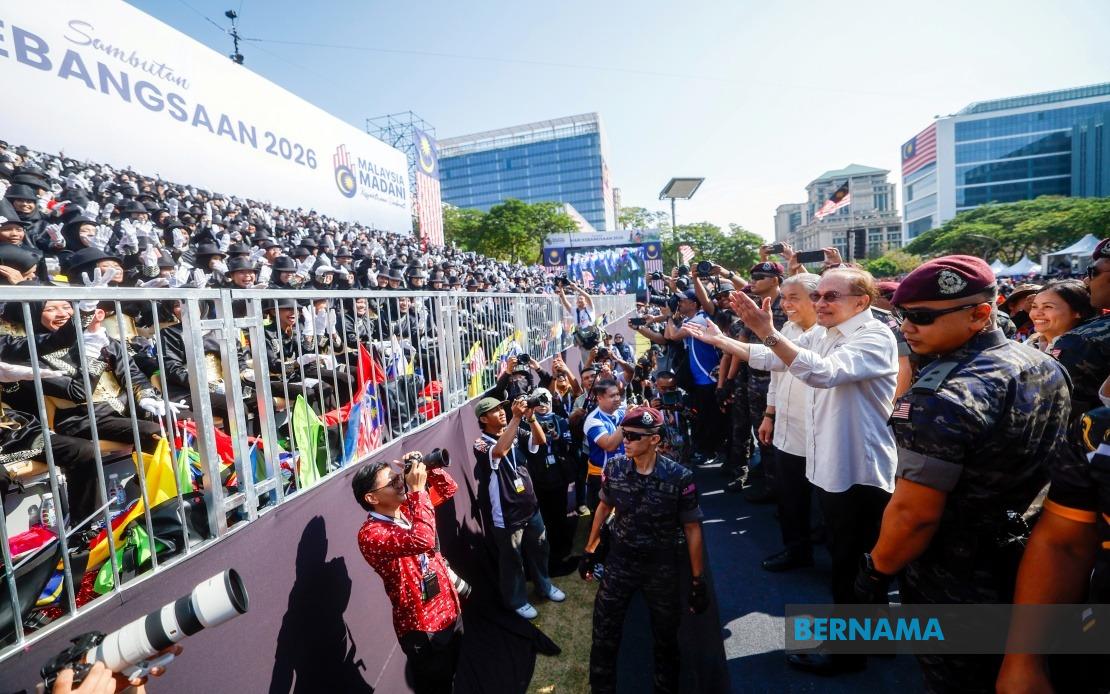
Prime Minister Datuk Seri Anwar Ibrahim expressed his delight at the success of the 69th National Day celebration held at Dataran Putrajaya on August 31, commending both the organisers and the enthusiastic public participation that characterised the event. Addressing journalists immediately after reviewing the ceremonial parade and procession, Anwar offered warm praise for what he described as an impressive display of national unity and patriotic fervour. His visible pleasure at the occasion reflected broader government satisfaction with how the day's festivities unfolded and the apparent public appetite for engaging with Malaysia's foundational commemoration.
The scale of the celebration underscored the government's commitment to making National Day a centrepiece of civic engagement. More than 100,000 Malaysians converged on the ceremonial grounds, with dedicated supporters camping overnight to secure prime viewing positions. The parade itself represented a substantial logistical undertaking, marshalling nearly 11,000 participants distributed across 76 contingents and 22 musical ensembles. The spectacle incorporated 328 military, naval and air force assets alongside 112 service animals, creating a visually comprehensive demonstration of national institutional capacity. Notably, the organisers integrated 22 electric vehicles into the procession, signalling the government's interest in embedding sustainability messaging within patriotic observance.
The event's governing theme, "Malaysia MADANI: Kesejahteraan Dinikmati" (Malaysia MADANI: Well-being Enjoyed), reflected the administration's broader policy agenda centred on improving material living standards and safeguarding cultural plurality. This thematic framing proved more than symbolic, as it provided organisational coherence to parade segments showcasing everything from military capability to developmental achievements. The human graphics performances staged on the terraces added theatrical sophistication while reinforcing the message that national progress depends on coordinated popular participation. For Southeast Asian observers, the celebration demonstrated how Malaysia's government attempts to reconcile pluralist governance with unified national identity-building.
Anwar's extended engagement with gathered crowds, walking over 500 metres across the ceremonial ground and accommodating photograph requests, represented a deliberate exercise in accessible governance. These interactions conveyed the impression of a leader connected to ordinary citizens and responsive to their immediate concerns. One participant's unsolicited thanks for the fuel subsidy expansion illustrated how National Day celebrations function as opportunities for the government to broadcast policy achievements while simultaneously allowing public feedback. The informal exchange between Anwar and the citizen exemplified how state pageantry can be repurposed as a venue for direct communication about tangible welfare improvements.
The celebration was formally graced by His Majesty Sultan Ibrahim and Her Majesty Raja Zarith Sofiah, whose attendance underscored the event's constitutional significance. The protocols surrounding their arrival, with Anwar and his wife Datuk Seri Dr Wan Azizah Wan Ismail greeting them alongside Communications Minister Datuk Seri Fahmi Fadzil (who chairs the National Day organising committee), reinforced the ceremonial importance of the occasion. The royal presence transformed the gathering from a merely administrative commemoration into a reaffirmation of Malaysia's constitutional monarchical framework.
The government used the National Day platform to announce substantive policy adjustments aimed at household budgets, recognising that Malaysian voters respond positively to concrete welfare improvements. During his address on August 30, Anwar detailed six initiatives targeting popular well-being. Most prominently, the government restored the monthly BUDI MADANI RON95 fuel subsidy from 200 litres to 300 litres, immediately benefiting more than 16 million users of subsidised petrol. This restoration represented a reversal of austerity measures and signalled the government's assessment that fiscal space now permitted welfare expansion. For Malaysian consumers facing inflationary pressures, the additional 100 litres monthly translates into meaningful savings.
The diesel subsidy expansion extended programme benefits to previously excluded constituencies. Effective September 1, eligible owners of diesel-powered pickup trucks and utility vehicles would receive up to 400 litres monthly through the BUDI Diesel programme, potentially covering more than half a million vehicle proprietors. This extension targeted rural and semi-rural populations whose economic livelihoods depend on vehicle usage, thereby addressing regional welfare disparities. The timing of the announcement during National Day festivities maximised publicity while demonstrating government attentiveness to constituencies often peripheral to urban political discourse.
The fuel subsidy announcements carry broader implications for Malaysia's fiscal trajectory and regional competitiveness. Simultaneously maintaining price controls on essential commodities while pursuing developmental ambitions requires careful macroeconomic calibration. The government's apparent confidence in announcing expansion reflects either improved fiscal projections or political calculations about election-year generosity. Regional competitors including Indonesia and Thailand manage comparable subsidy programmes, making Malaysia's positioning within ASEAN energy markets relevant for investors and policymakers monitoring regional stability.
National Day celebrations historically serve multiple governmental purposes beyond ceremonial commemoration. They function as venues for announcing popular policies, demonstrating institutional capacity and coherence, reinforcing national narratives, and forging emotional connections between leadership and population. Anwar's visible satisfaction with the 2026 celebration suggested his assessment that the event achieved these multiple objectives. The gathering provided a backdrop for highlighting government achievements in welfare provision whilst simultaneously portraying Malaysia as a nation where diversity coexists with unified patriotic expression. For foreign observers, such celebrations offer insight into how established democracies navigate the complexities of multicommunal governance.

