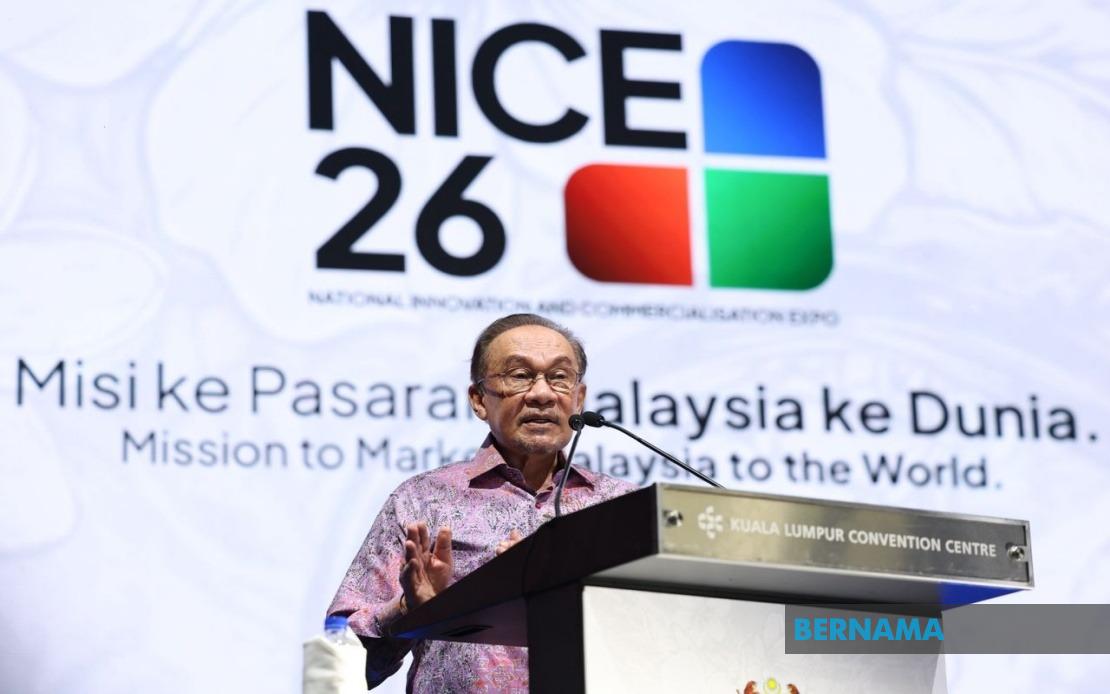
Prime Minister Datuk Seri Anwar Ibrahim has delivered a pointed critique of Malaysia's entrenched administrative systems, asserting that traditional approval mechanisms are fundamentally incompatible with the pace demanded by modern innovation and technology commercialisation. Speaking at the National Innovation and Commercialisation Expo (NICE) 2026 at the Kuala Lumpur Convention Centre (KLCC), Anwar stressed that the nation risks competitive disadvantage unless it abandons procedures that have become vestigial in an era of rapid technological change.
The urgency of Anwar's message reflects a broader tension within Malaysia's governance framework: the tension between institutional caution and the velocity required by global innovation ecosystems. His comments underscore recognition that contemporary markets reward speed and adaptability, particularly in fields such as artificial intelligence where competitive windows close quickly. Nations that cannot mobilise institutional capacity rapidly find themselves relegated to followers rather than leaders in emerging technologies.
Anwar illustrated his point through a concrete example drawn from Malaysia's recent experience with artificial intelligence development. Several local universities succeeded in establishing AI faculties within three months, a timeframe that represents a departure from the conventional pathway. Under traditional procedures, such initiatives typically demanded a year or longer to navigate bureaucratic approval chains, requiring multiple rounds of senate meetings, council deliberations, and ministerial sign-offs. This compression of timeline offers a template for what becomes possible when institutional rigidity is relaxed.
The gap between three months and twelve months may appear marginal in conventional administrative contexts, yet in technology sectors it represents the difference between market leadership and obsolescence. A faculty established quickly can begin producing graduates and conducting research before competitors have completed preliminary approvals. Universities in rival jurisdictions that operate with greater administrative flexibility can capture talent, funding, and partnerships that determine long-term competitive positioning. Malaysia's experience with accelerated AI faculty creation demonstrates that domestic institutions possess the substantive capability to execute such projects; the limiting factor has been procedural architecture rather than technical or intellectual capacity.
The Prime Minister's remarks carry particular resonance for Malaysian stakeholders invested in technology commercialisation and innovation ecosystems. Entrepreneurs developing artificial intelligence applications, blockchain solutions, or advanced manufacturing processes encounter approval delays that impose tangible costs. A startup seeking regulatory clearance for a new financial technology application or a researcher attempting to commercialise intellectual property faces administrative processes designed for stability in stable environments, not agility in dynamic ones. These procedural frictions accumulate across the economy, collectively imposing a drag on innovation metrics and commercialisation rates.
Anwar's directive appears specifically targeted at the Ministry of Science, Technology and Innovation (MOSTI) and aligned agencies, signalling that ministerial leadership should champion procedural modernisation rather than defending inherited practices. His framing as an imperative—describing what "needs to happen" rather than requesting consideration—indicates executive impatience with incremental change. The characterisation of the current era as "post-normal," a term suggesting unprecedented disruption and uncertainty, positions speed and flexibility not as luxury preferences but as survival requirements for maintaining institutional relevance.
The National Innovation and Commercialisation Expo itself functions as a platform where Malaysia displays technological capabilities and signals commitment to innovation pathways. Held at KLCC, a venue symbolising Malaysia's technological ambitions, the event creates an audience receptive to Anwar's message about removing obstacles to innovation acceleration. Within such contexts, governmental rhetoric about dismantling bureaucratic barriers carries weight because it reaches stakeholders who experience those barriers as direct impediments to their work.
The broader Southeast Asian context amplifies the stakes embedded in Anwar's intervention. Regional competitors including Singapore, South Korea, and Vietnam have invested deliberately in reducing administrative friction for technology development and commercialisation. Singapore's approach to fintech regulation, which has achieved rapid innovation adoption, reflects conscious governmental choices to subordinate traditional approval methodologies to commercialisation velocity. Vietnam's attraction of semiconductor manufacturing investment partly reflects governmental willingness to accelerate project approvals beyond conventional timelines. Malaysia's competitiveness depends partly on matching or exceeding such responsiveness, particularly as multinational corporations evaluate regional locations for technology investments and research centres.
The specific mention of approval processes for AI faculties connects to Malaysia's positioning within the artificial intelligence economy. Nations that rapidly develop AI talent pools through university-based research and education secure advantages in deploying AI expertise across economic sectors. Companies seeking locations for AI research and development operations prioritise jurisdictions with robust talent pipelines and supportive institutional ecosystems. A one-year delay in establishing university AI capacity translates directly into competitive disadvantage relative to jurisdictions that accommodate three-month deployment.
Anwar's comments implicitly acknowledge that procedural reform requires governmental cultural shifts rather than merely technical adjustments. Moving from processes requiring multiple institutional approvals to expedited pathways demands that bureaucratic actors accept reduced control and approval authority. Resistance from those accustomed to gatekeeping positions represents an almost inevitable institutional response. The Prime Minister's invocation of his own authority and his characterisation of procedural change as non-negotiable suggests determination to overcome such resistance, though successful implementation would require sustained pressure and likely ministerial reorganisation of incentives and accountability structures.
The innovation commercialisation agenda aligns with broader Malaysian economic diversification initiatives aimed at reducing reliance on commodity exports and traditional manufacturing. Technology-driven sectors promise higher value-added activities and employment for educated workforces. Yet such sectors flourish only within institutional environments that permit rapid experimentation and accelerated deployment. Universities unable to quickly launch new faculties, regulators requiring twelve-month evaluation periods for novel technologies, and government agencies bound by procedures designed for stability rather than change create cumulative friction that stifles the innovation dynamics essential to technology-led economic development.
For Malaysian technology entrepreneurs and academic researchers, Anwar's statements at NICE 2026 carry significance as indicators of governmental seriousness regarding bureaucratic modernisation. Whether rhetorical flourishes translate into sustained procedural change remains uncertain, yet the Prime Minister's explicit, repeated emphasis on the necessity of abandoning "old bureaucracy" and the concrete example of expedited AI faculty approvals suggest movement beyond abstract commitment. Implementation through MOSTI and aligned agencies will require genuine structural reorganisation and cultural reorientation within Malaysia's administrative apparatus.

