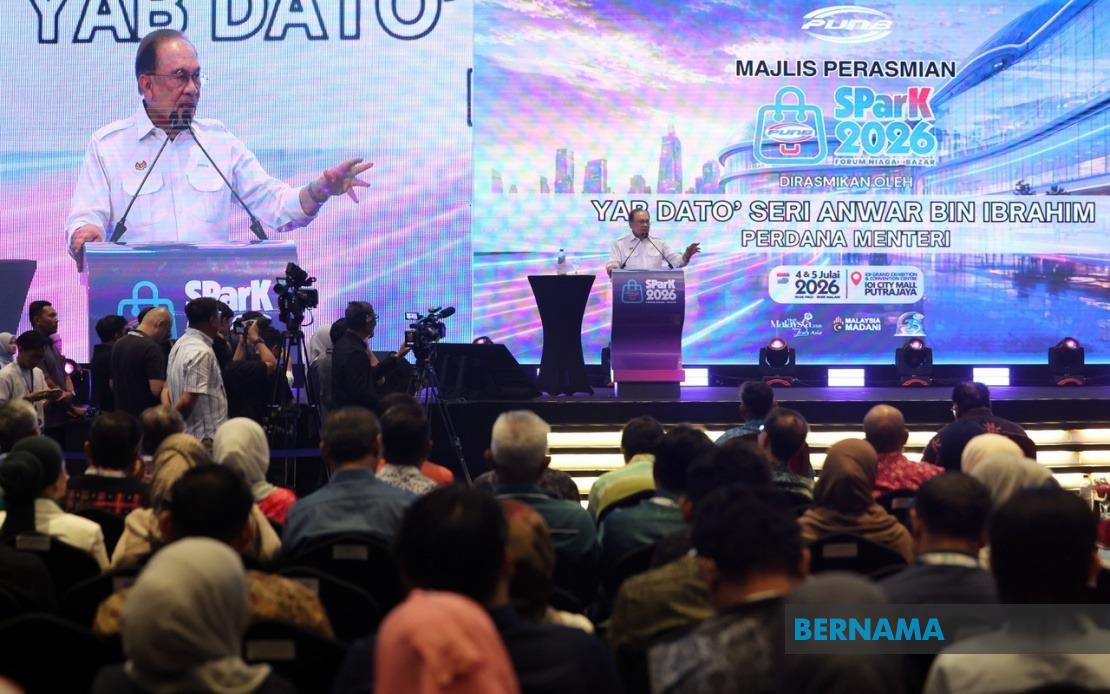
Prime Minister Datuk Seri Anwar Ibrahim has launched a direct assault on the entrenched culture of political patronage that has long plagued Malaysia's entrepreneur financing system, declaring that the practice of awarding loans through letters of support and personal connections must cease immediately. Speaking at the SPaRK 2026 event organised by Perbadanan Ushawan Nasional Bhd in Putrajaya on July 4, Anwar, who simultaneously holds the Finance Minister portfolio, characterised the current system as a relic of failed governance that continues to undermine both government credibility and business viability.
The Prime Minister's remarks represent an acknowledgement that decades of institutional decay have allowed informal networks and political favours to supersede merit-based assessment in the allocation of public capital meant for entrepreneurship. Anwar specifically singled out the practice of issuing loans based on proximity to influential figures or the colour of the letter accompanying an application—a stark metaphor for how opaque and arbitrary the system has become. This critique cuts to the heart of a structural problem that has persisted across multiple administrations, suggesting that fixing the system requires not merely procedural reform but a fundamental shift in how government agencies evaluate and fund small and medium enterprises.
What distinguishes Anwar's intervention from previous rhetorical calls for accountability is his explicit acknowledgement that such practices actively damage both the public purse and the entrepreneurs ostensibly being helped. The Prime Minister noted that government-backed loans frequently end up funding lifestyle improvements rather than genuine business expansion—instances where recipients use capital to upgrade office premises or purchase vehicles before their enterprises collapse. This misallocation represents a double failure: money intended to stimulate economic activity instead finances personal consumption, while entrepreneurs who secured funding through political channels rather than genuine business potential are set up for predictable failure.
The distinction Anwar drew between business failures attributable to legitimate market forces and those resulting from poor governance is crucial for understanding his position. He signalled that the government accepts a natural rate of entrepreneurial failure driven by economic cycles, competitive pressures, and unforeseen market shifts. However, he made clear that tolerance for such failures comes with a prerequisite: that the entrepreneurs receiving public support demonstrate genuine transparency and commitment to their ventures. This framing shifts accountability away from blanket subsidies or forgiving all loan defaults, instead insisting on a baseline of seriousness and honesty from recipients.
The timing of Anwar's statement carries particular significance for Malaysian business policy. As the economy navigates post-pandemic recovery and heightened regional competition, the efficient deployment of government resources becomes increasingly critical. Every ringgit directed toward poorly-vetted borrowers is a ringgit unavailable for entrepreneurs with genuine potential and viable business models. The cumulative effect of decades of patronage-based lending is that many capable business owners lack access to capital, while inefficient operators hoard resources based on political connections. Anwar's push to reverse this dynamic suggests recognition that Malaysia's productivity and competitiveness depend on breaking this zero-sum competition for government favour.
The comments also reflect broader tension within the government apparatus itself. Government agencies tasked with managing loan schemes have accumulated reputational damage from high default rates and perceived corruption. Anwar's reference to using support letters as a method to "cover up agencies" indicates frustration with institutional practices that allow poor decisions to be made under the cover of administrative process. By demanding transparency and merit-based assessment, he is implicitly criticising the civil service infrastructure that has accommodated political interference in lending decisions.
For entrepreneurs currently navigating Malaysia's ecosystem, Anwar's statement signals a potential shift in how applications will be evaluated going forward. Those relying on political connections or support letters rather than solid business fundamentals face increased scrutiny. Conversely, entrepreneurs who have been disadvantaged by a system rewarding connections over capability may find new pathways to financing. This recalibration could take time to implement—entrenched networks do not dissolve overnight—but the explicit endorsement from the Prime Minister establishes political cover for officials willing to challenge the status quo.
The broader regional context matters here. Across Southeast Asia, governments have increasingly recognised that entrepreneur financing schemes deliver better returns and economic stimulus when allocated on merit rather than patronage. Countries like Vietnam and Indonesia have made similar pushes to professionalise loan approval processes. Malaysia risks falling further behind if its public capital continues to flow toward politically-connected but economically unviable ventures rather than high-potential entrepreneurs regardless of their networks.
Implementing Anwar's vision will require concrete institutional mechanisms. This likely means establishing independent evaluation criteria for loan applications, creating audit trails that prevent political interference, and potentially separating loan approval decisions from elected officials. Some government agencies have experimented with such reforms, but systematic implementation across all entrepreneur financing programmes remains incomplete. Anwar's statement suggests this will become a priority, with implications for how dozens of schemes currently operate.
The Prime Minister's comments also carry a moral dimension beyond economics. Awarding public resources based on political loyalty rather than need or capability represents a betrayal of the social contract. Entrepreneurs who borrowed money based on connections rather than business merit carry the psychological and financial burden of inevitable failure. By insisting on higher standards for loan approval, Anwar is arguing for a system that serves entrepreneurs better by being more rigorous about who receives support in the first place.
For Malaysian business associations and industry groups, Anwar's statement opens space for advocacy. Organizations representing entrepreneurs can push for specific reforms—transparent criteria, independent appraisal boards, regular audits—that embed merit into lending processes. The Prime Minister has provided political momentum; now the question is whether concrete policy changes will follow.

