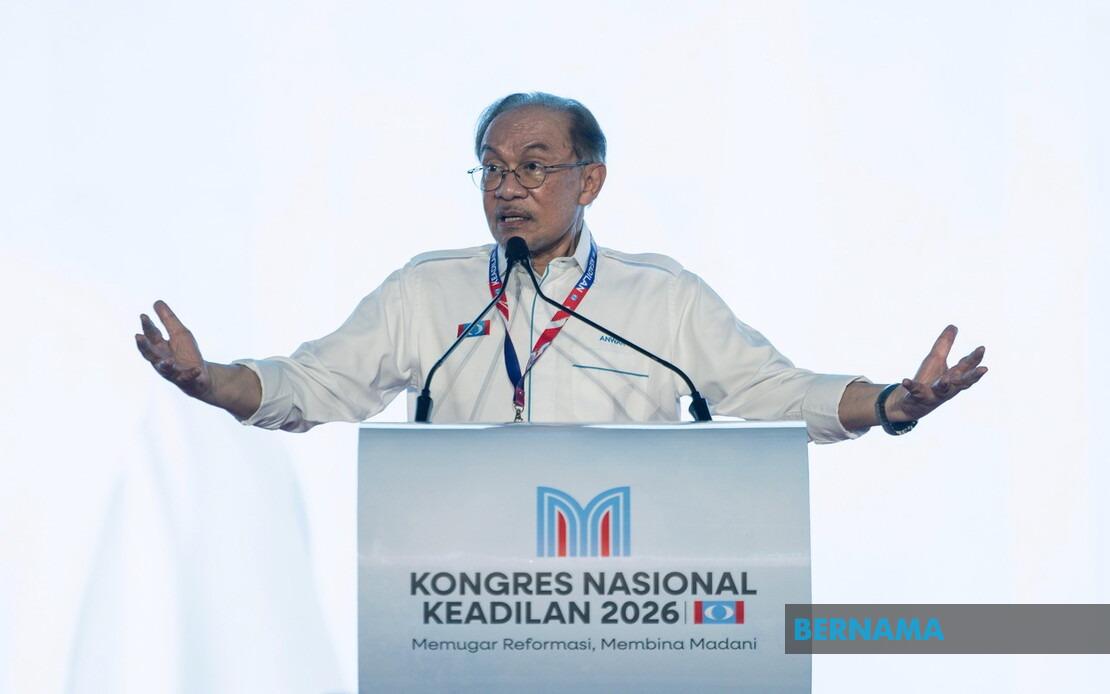
The Malaysian government has greenlit a significant financial commitment to accelerate development at the constituency level, with Prime Minister Datuk Seri Anwar Ibrahim pledging RM1 million in additional funds to every parliamentary seat across the nation. The announcement, made during his closing address at the 2026 PKR National Congress at the Melaka International Trade Centre on August 16, signals a deliberate shift towards decentralising resource allocation and placing decision-making authority closer to communities experiencing the most pressing challenges.
Anwar, who simultaneously holds the Finance Ministry portfolio, positioned the fresh injection as a demonstration of the MADANI Government's commitment to grassroots empowerment. Rather than routing assistance through conventional channels that often involve multiple approval layers, the direct allocation model aims to expedite responses to welfare concerns, infrastructure gaps, and localised social issues. The Prime Minister specifically noted that this approach would circumvent what he characterised as cumbersome bureaucratic processes that traditionally delay the delivery of assistance to affected populations.
The significance of this initiative extends beyond mere numerical allocation. By designating funds specifically for parliamentary constituencies—the most granular electoral division in Malaysia's political framework—the government essentially transfers discretionary power to representatives who possess intimate knowledge of their communities' requirements. This structural choice reflects broader administrative philosophy prioritising responsiveness and local accountability over centralised budgeting models that may struggle to capture hyperlocal variations in need.
The additional RM1 million per constituency complements rather than replaces existing social protection mechanisms already embedded within government policy architecture. The MADANI administration continues operating flagship assistance programmes including Sumbangan Tunai Rahmah and Sumbangan Asas Rahmah, which together command RM16 billion in annual funding. These parallel schemes target diverse demographic segments, from lower-income households through middle-income families, ensuring that welfare provision extends across broader socioeconomic strata rather than concentrating on the poorest quintile alone.
Poverty reduction has featured prominently in the government's messaging regarding its economic and social record. Anwar highlighted that Malaysia's hardcore poverty rate has contracted to just 0.09 per cent, representing substantial progress from historical baselines. This metric carries particular relevance for a nation where economic polarisation has historically driven political discourse and electoral dynamics. The government's framing suggests that macroeconomic stability and growth must translate into tangible improvements in household living standards, and the new allocation mechanism represents a methodological attempt to close the gap between national prosperity and individual household circumstances.
The announcement occurred within the specific context of a major political party congress, where internal party dynamics and messaging strategies carry considerable weight. Anwar's emphasis on direct, unbureaucratised support delivery serves multiple audiences simultaneously—reassuring government supporters of continued commitment to welfare provision while attempting to counter opposition narratives regarding governance inefficiency or neglect of ordinary citizens. Within Malaysia's competitive electoral environment, such fiscal commitments often function as both policy initiatives and political positioning exercises.
The breadth of programmes encompassed within the government's welfare framework demonstrates an intentional approach to poverty and cost-of-living pressures that avoids binary categorisation. School assistance, subsidised retail sales, housing finance support, and direct cash transfers represent a graduated intervention ladder targeting different manifestations of economic stress. This multifaceted strategy acknowledges that financial hardship rarely stems from single causes and that effective mitigation requires diverse policy instruments addressing various pressure points throughout the income distribution.
Anwar specifically called upon party machinery at branch and grassroots levels to undertake systematic engagement with constituents, ensuring not merely that assistance programmes exist but that eligible beneficiaries understand eligibility criteria and navigate application processes successfully. This element proves critical, as evidence from assistance programme implementation across the region consistently demonstrates that programme awareness gaps significantly impede uptake among eligible populations. The Prime Minister's directive essentially recognises that policy excellence requires complementary communication infrastructure.
For Malaysian voters and Southeast Asian observers monitoring regional governance trends, this announcement carries implications extending beyond immediate fiscal distribution. The emphasis on bypassing hierarchical bureaucracy and devolving discretion downward reflects global governance patterns increasingly favouring decentralisation and local decision-making. In the Malaysian context, where federal-state relations and resource distribution have historically generated political tension, this model may signal evolving approaches to intragovernmental fiscal federalism.
The RM1 million allocation per constituency translates to approximately RM680 million cumulatively across Malaysia's 222 parliamentary seats, representing a meaningful supplementary expenditure within overall budget architecture. While not transformative relative to total government spending, the funds' strategic deployment through representatives genuinely invested in particular localities could potentially yield outsized effectiveness relative to conventionally channelled assistance. Implementation fidelity will ultimately determine whether this initiative achieves stated objectives of accelerating response times and improving assistance targeting accuracy.

