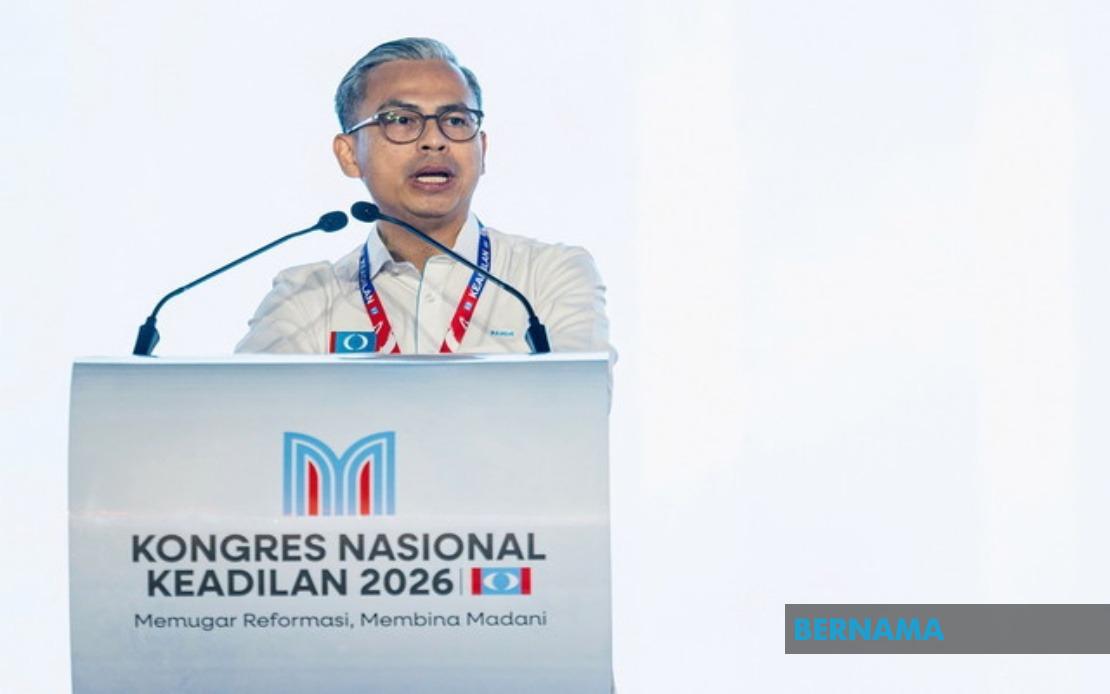
The ruling PKR party has signalled a fresh push to communicate its policy agenda more effectively to voters, with Communications Minister Datuk Seri Fahmi Fadzil arguing that the government's economic gains are failing to translate into improved public perception. Speaking at the 2026 PKR National Congress in Melaka on August 16, Fahmi outlined plans to deepen engagement with grassroots communities and refine how the administration frames its achievements, moving beyond headline statistics toward messaging that resonates with the lived experiences of ordinary Malaysians.
The acknowledgement from PKR's information chief reflects a wider challenge facing the government: strong macroeconomic indicators have not automatically generated political goodwill among voters. Fahmi referred to this paradox as the gap between what he called the "pot economy"—aggregate growth figures and national-level performance—and the pocketbook concerns of everyday families navigating rising costs and economic uncertainty. He argued that without better communication, government policies, no matter how beneficial, risk remaining abstract to the people they are designed to serve.
Fahmi framed the party's challenge as fundamentally emotional and psychological rather than merely informational. He contended that achievements need to be not simply known by the public but felt by them, suggesting that statistical success stories require narrative framing to gain traction in people's hearts and minds. This represents a subtle shift in approach: rather than flooding the public with data, PKR intends to craft stories around government initiatives that illustrate their concrete benefits in housing, employment, healthcare, or education—areas where citizens directly experience outcomes.
A cornerstone of the new strategy involves expanding grassroots engagement mechanisms. PKR plans to work closely with division chiefs and local leaders to ensure information flows more organically from party structures into communities. Fahmi singled out smaller-scale town halls and dialogues as a preferred format, arguing that informal settings allow nuance and foster genuine interaction between government representatives and citizens. These sessions, conducted in a more relaxed environment than formal press conferences, would create space for questions and address local concerns without the adversarial tone sometimes associated with larger public forums.
The Communications Ministry is also intensifying cooperation with the Malaysian Communications and Multimedia Commission (MCMC) to address a growing problem: coordinated misinformation campaigns exploiting sensitive cultural and religious issues. Since the recent Johor state election, MCMC has identified more than 8,410 fake accounts weaponising the "3R" issues—religion, race, and the royal institution—to sow discord and undermine confidence in government messaging. Fahmi signalled that combating this disinformation is now a priority, as false narratives can overwhelm legitimate government communication by triggering emotional responses.
This anti-misinformation effort carries particular significance for Malaysia, where communal sensitivities remain a political flashpoint and where false claims about religious minorities or national symbols can rapidly inflame social tensions. By identifying and removing fake accounts at scale, the government hopes to prevent manufactured outrage from drowning out factual reporting on policy implementation. The strategy reflects recognition that controlling communication in the digital age requires not just positive messaging but active defense against coordinated bad-faith actors attempting to create noise.
Fahmi also addressed the delicate relationship between government and media, emphasising that PKR is not seeking to control editorial decisions but rather will engage through proper channels when inaccurate reporting occurs. He framed the approach as respectful and courteous rather than confrontational, suggesting that corrections will be pursued through dialogue rather than regulation or pressure. This stance attempts to balance media accountability with press freedom—a balance increasingly difficult to maintain in polarised political environments where accusations of bias flow freely in both directions.
The party intends to strengthen coordination between its communications apparatus and the Wanita (Women's) wing, recognising that female party members and grassroots organisers often reach voters, particularly in residential areas and community groups, whom formal government channels might otherwise miss. By systematising information sharing across these networks, PKR hopes to amplify the reach and credibility of its messaging, since word-of-mouth endorsement from trusted local figures typically carries more weight than top-down pronouncements from the capital.
The timing of these announcements matters. Malaysia's next general election is not imminent, but political positioning is continuous. PKR, as the dominant party in the government coalition, faces pressure to demonstrate that its leadership translates into tangible improvements for voters' lives. Poor communication of achievements—or worse, the perception that the government is disconnected from ordinary struggles—can erode support regardless of underlying policy success. Fahmi's remarks suggest the party has internalised this lesson and is recalibrating its approach accordingly.
The broader implication for Malaysian politics is that as economic growth remains uneven and inflation continues to erode purchasing power for many households, parties in government cannot rely solely on macroeconomic indicators to sustain electoral coalitions. Instead, they must craft compelling narratives that link national policies to individual and family welfare, and do so authentically enough to overcome public cynicism about political messaging. PKR's plan to engage grassroots leaders, expand town halls, combat misinformation, and coordinate across party structures reflects an implicit acknowledgement that the next election will be won or lost not in cabinet rooms but in neighbourhoods, schools, and markets where Malaysians experience the real-world consequences of government decisions.
Fahmi's winding-up speech at the congress also underscored party unity around this revised communication agenda, with approval from the Central Leadership Council signalling that PKR intends to implement these changes systematically. The emphasis on emotional connection, local engagement, and countermeasures against falsehoods suggests the party is preparing for a more competitive electoral environment in which traditional advantages may no longer suffice. Whether enhanced communication can genuinely narrow the gap between headline economic success and voter satisfaction remains to be tested, but the commitment to try reflects clear-eyed recognition that government effectiveness depends partly on how well it explains itself to the people it serves.

