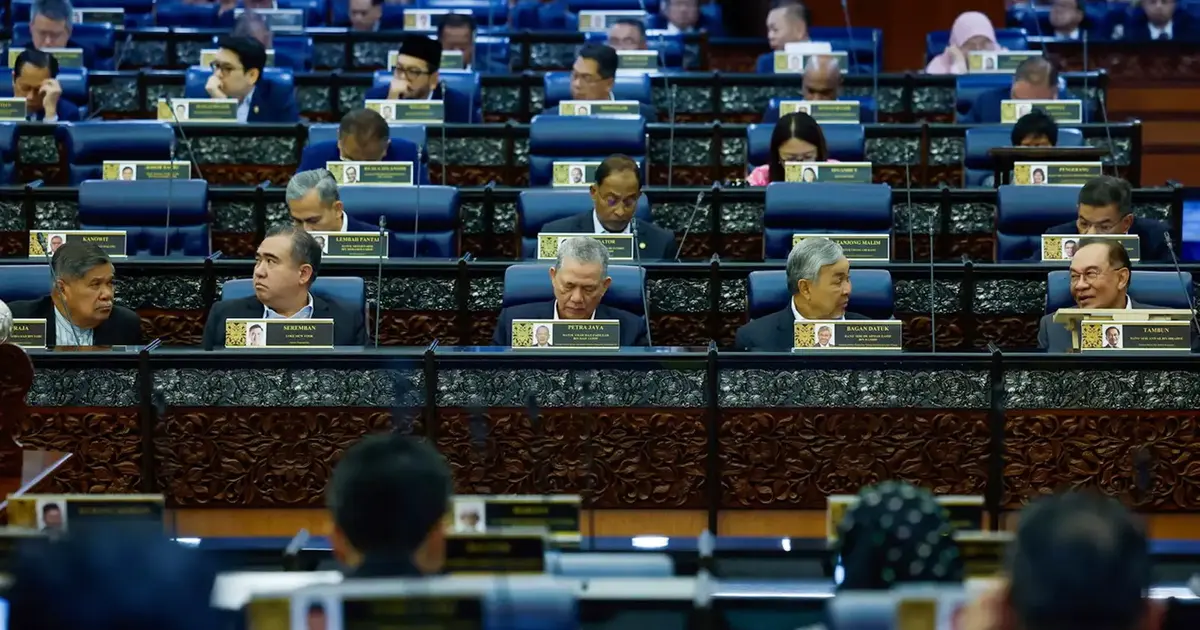
The stability of Malaysia's government coalition appears secure even in the event of a significant political reshuffle, according to a senior PKR official who has dismissed concerns that a ministerial withdrawal by one of its principal partners could destabilize parliament. PKR deputy secretary-general Saifuddin Shafi Muhammad has clarified that Democratic Action Party members holding parliamentary seats will continue their representation in the government bloc regardless of whether their party surrenders executive cabinet positions.
This statement carries substantial weight for understanding the political landscape that emerged following the 2022 general election, when Pakatan Harapan underwent a dramatic realignment. The formation of unity governments across both federal and state levels represented an unprecedented consolidation of diverse political interests, bringing together previously opposing blocs. Within this context, the relationship between PKR and DAP has become particularly significant, as both parties occupy substantial representation in Parliament and the cabinet structure.
The clarification from Saifuddin addresses a fundamental misconception about how Malaysia's coalition politics operate. Many observers conflate ministerial office with parliamentary representation, assuming that a party's departure from the executive necessarily entails withdrawal from legislative support. This equation does not hold in the Malaysian system, where parties can maintain parliamentary group membership while declining cabinet portfolios. Such an arrangement would allow DAP to effectively reduce its administrative responsibilities without triggering the cascading constitutional crisis that fresh parliamentary dissolution would represent.
The broader implications for Southeast Asian stability warrant attention. Malaysia's political system has experienced considerable volatility in recent years, with government configurations shifting dramatically. Institutional uncertainty of this magnitude affects investor confidence, policy implementation capacity, and regional standing. A clarification that the government can weather significant coalition adjustments without returning to the ballot box suggests that decision-makers are prioritizing continuity over the confrontational politics that have previously characterized Malaysian governance disputes.
DAP's position within the ruling coalition has remained somewhat distinctive compared to other partners. The party brings both organizational strength and ideological distinctiveness to the government formation, yet faces periodic pressure from both supporters and critics regarding the nature and extent of its participation. The party leadership has previously articulated positions around development priorities, governance standards, and social policy that sometimes diverge from coalition partners. Maintaining parliamentary representation while adjusting ministerial involvement would theoretically permit DAP to participate in legislative oversight and policy debate without being bound by every executive decision.
PKR's reassurance also reflects the numerical realities of current parliamentary composition. The government coalition possesses a working majority that can accommodate various tactical adjustments without losing its fundamental control over legislative proceedings. This mathematical security permits flexibility in how power-sharing arrangements are configured. A party can reallocate resources between cabinet duties and parliamentary backbench work without risking the coalition's viability. Such structural capacity for maneuver distinguishes the current arrangement from earlier government formations that operated with razor-thin majorities vulnerable to individual defections.
The absence of any requirement for parliamentary dissolution in response to ministerial shuffles offers advantages for policy continuity. Legislative agendas, budget cycles, and regulatory initiatives require sustained attention across fiscal years. Forcing elections merely because a coalition partner adjusts its internal involvement would interrupt ongoing parliamentary business, delay budget allocations, and introduce months of political uncertainty. The Malaysian economy, already navigating regional competitive pressures and inflationary conditions, benefits from administrative predictability.
Saifuddin's comments should be understood as part of broader coalition management communication. As deputy secretary-general of PKR, his role involves articulating party positions on sensitive matters to both internal audiences and the broader political community. Such statements often serve multiple purposes simultaneously: they reassure coalition partners of stability, discourage external actors from testing the government's cohesion, and signal to supporters that party leadership maintains control over political developments. The timing and prominence of this clarification suggest that concerns about coalition fragility had circulated sufficiently to warrant an authoritative response.
The statement also touches on fundamental questions about democratic representation and executive power. Malaysia's system permits a distinction between parties that support the government in parliament and parties whose members hold ministerial office. This flexibility allows for nuanced political arrangements where parties can support government legislation while maintaining institutional independence on certain matters. However, such arrangements require clear communication and mutual understanding among coalition partners to function effectively, particularly when the party playing a support role retains significant parliamentary strength.
Historically, coalition governments in Malaysia have survived numerous ministerial reorganizations, power-sharing disputes, and internal disagreements. The capacity to retain parliamentary support while adjusting executive participation represents a tested mechanism for managing intra-coalition tensions. When parties reach impasses over specific policies or resource allocation, offering alternative roles can preserve overall government stability while addressing particular grievances. DAP's potential shift toward a parliamentary rather than ministerial presence would follow established patterns in Malaysian coalition politics.
Looking forward, the coalition's ability to absorb such adjustments will depend on maintaining clear protocols for decision-making and resource allocation. As Malaysia approaches mid-term challenges including budget reviews and electoral preparations, a stable legislative arrangement becomes increasingly valuable. Saifuddin's clarification addresses one source of political uncertainty while affirming that the government intends to complete its term through to scheduled elections without artificial parliamentary dissolution. This commitment to electoral timing provides businesses, civil society organizations, and citizens with extended planning horizons.
The underlying message conveyed through PKR's statement reflects a maturation in coalition governance practices. Rather than viewing coalition adjustments as existential threats requiring emergency elections, the government framework now permits tactical repositioning while maintaining institutional continuity. This approach aligns more closely with comparable democracies in the region, where multi-party coalitions routinely adjust ministerial compositions without destabilizing parliament. Whether DAP ultimately pursues such a reconfiguration remains to be determined through private coalition negotiations, but PKR's signal indicates that such discussions, if they occur, need not portend governmental collapse.

