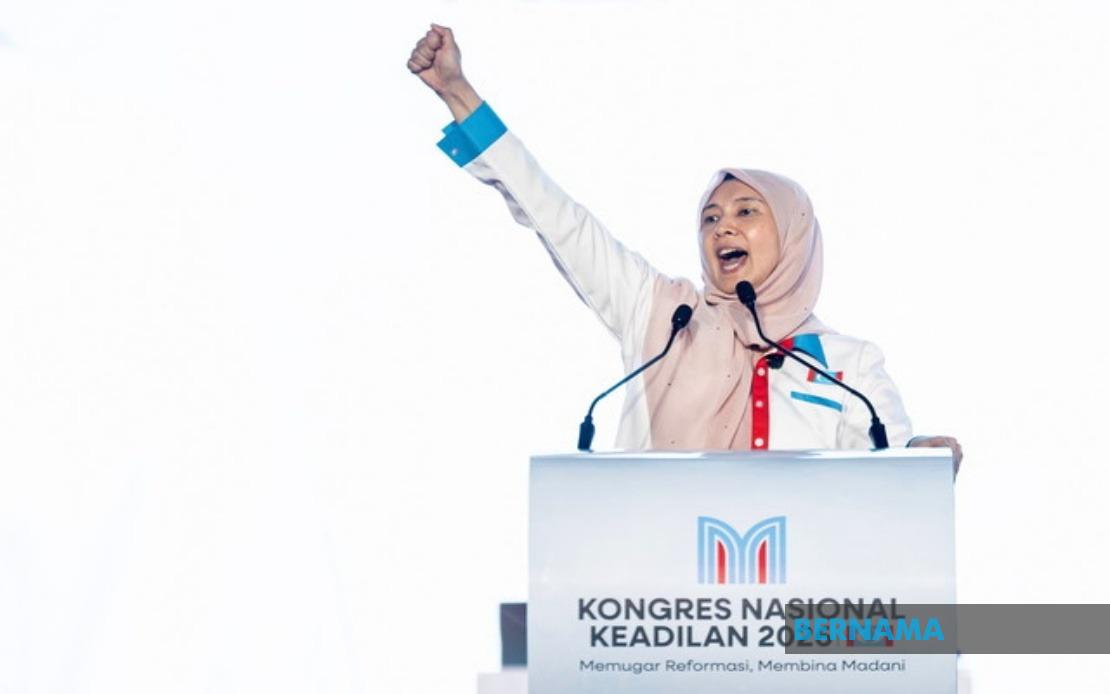
At the PKR 2026 National Congress in Melaka on August 16, party deputy president Nurul Izzah Anwar delivered a stark reminder to her colleagues: the struggle for reform that gave birth to the party must not be abandoned now that PKR holds ministerial positions within the ruling coalition. Speaking at the Melaka International Trade Centre, she emphasised that reform represents the party's foundational mandate and that this commitment cannot be treated as a burden to discard upon attaining electoral success.
Nurul Izzah, widely recognised within Malaysian political circles as the 'Princess of Reform', articulated a vision of continuous institutional change rather than a one-time transformation. She stressed that party members must recognise that the reform mission extends beyond simply passing legislation or initiating policy when circumstances allow. Instead, the party's rank-and-file shoulders a responsibility to champion systemic improvements persistently, whether the party occupies the opposition benches or government ministerial seats. This distinction matters considerably in Malaysian politics, where parties sometimes moderate their reformist stances once they gain access to state resources and patronage networks.
One concrete illustration of PKR's reform ambitions materialising through government involvement concerns university governance. The party had long campaigned against the Universities and University Colleges Act (AUKU) 1971, which historically restricted student activism and academic freedoms. Now positioned within government, Nurul Izzah noted that PKR could finally translate this long-standing objective into legislative reality. The AUKU repeal exemplifies how reform movements gain practical leverage only when positioned to influence executive and parliamentary machinery, a reality that underscores the importance of maintaining ideological consistency once in power.
However, Nurul Izzah's remarks extended beyond legislative achievements to encompass the equitable distribution of economic gains. She observed that while the MADANI Government has achieved robust economic growth figures, the tangible impact on ordinary Malaysians' living standards remains inconsistent. This gap between headline growth statistics and household prosperity represents a persistent challenge across Southeast Asia, where aggregate economic performance often masks widening inequality and stagnant wage growth in significant sectors.
The deputy president identified several dimensions requiring sustained structural reform. Job creation must accelerate beyond headline employment figures to encompass quality employment that provides dignity and progression. Small and medium enterprises (SMEs) require not merely rhetorical support but genuine access to capital, markets, and technical expertise. Women and young people, demographics that represent substantial portions of Malaysia's workforce, need meaningful pathways into mainstream economic participation rather than concentration in precarious or low-wage sectors. These priorities reflect broader regional concerns, as most Southeast Asian nations grapple with similar employment structure challenges amid technological disruption and globalisation pressures.
Critically, Nurul Izzah highlighted wage stagnation as warranting structural intervention. She advocated for reformed salary structures that ensure compensation rises proportionately with worker productivity, a principle that contrasts with decades of Malaysian industrial relations where wage growth frequently lagged productivity improvements. This distinction carries significant implications for social cohesion and consumer spending power, particularly as automation and artificial intelligence reshape labour markets across the region.
Beyond economic concerns, Nurul Izzah addressed the ethical dimension of political power that proves especially pertinent in Malaysia's complex political landscape. She cautioned PKR leadership against treating political office as personal property to be exploited for individual benefit. In a country where power-sharing arrangements, coalition dynamics, and competing factional interests frequently dominate political calculations, this exhortation represents an implicit warning against the kind of patronage-driven politics that has historically characterised Malaysian governance.
Her philosophical framing deserves particular attention. Nurul Izzah observed that ministerial positions prove transient—office-holders change, titles lose relevance, and names fade from public discourse. What endures, she contended, comprises the substantive work accomplished and the values upheld during one's tenure. This perspective invites PKR members to measure their contributions by legacies of institutional improvement and policy reform rather than by accumulation of titles or organisational influence. Such framing implicitly critiques the personality-centred politics that has long characterised Malaysian political parties across the ideological spectrum.
The timing of these remarks at PKR's national congress carries particular significance. Party congresses represent moments when organisations assess strategic direction and reinforce ideological commitment among members. By emphasising reform continuity at this institutional gathering, Nurul Izzah sought to embed reform as a permanent party characteristic rather than a temporary positioning confined to opposition periods. This approach recognises that reform momentum can dissipate quickly when parties transition from opposition to government, particularly as access to state resources and bureaucratic machinery creates competing priorities and accommodation pressures.
For Malaysian observers and Southeast Asian political analysts, Nurul Izzah's statements illuminate ongoing tensions within reformist political movements. Such movements often mobilise supporters around aspirations for institutional change, governance improvement, and equity, yet face the practical challenge of maintaining these commitments while managing coalition partnerships, bureaucratic constraints, and competing economic pressures. PKR's experience across multiple electoral cycles illustrates how sustaining reform agendas requires deliberate cultural reinforcement within party structures and continuous political will from leadership.
The broader context matters equally. Malaysia's political landscape has undergone substantial volatility over recent years, with multiple changes in government and shifting coalition arrangements. Within this environment, parties claiming reformist credentials face heightened scrutiny regarding whether they genuinely pursue systemic improvement or simply employ reform rhetoric instrumentally. Nurul Izzah's explicit commitment to persistent reform, articulated publicly at a major party gathering, represents an attempt to establish benchmarks against which PKR's governance can be evaluated by both supporters and critics.
Moving forward, how effectively PKR translates these reform principles into concrete policy outcomes—particularly concerning wage structures, SME support, university governance, and gender-inclusive economic participation—will substantially determine whether the party's reform positioning reflects genuine commitment or represents standard political discourse. For Malaysia and the region, observing how established parties manage the perpetual tension between idealism and pragmatism remains instructive for understanding political evolution across Southeast Asia.

