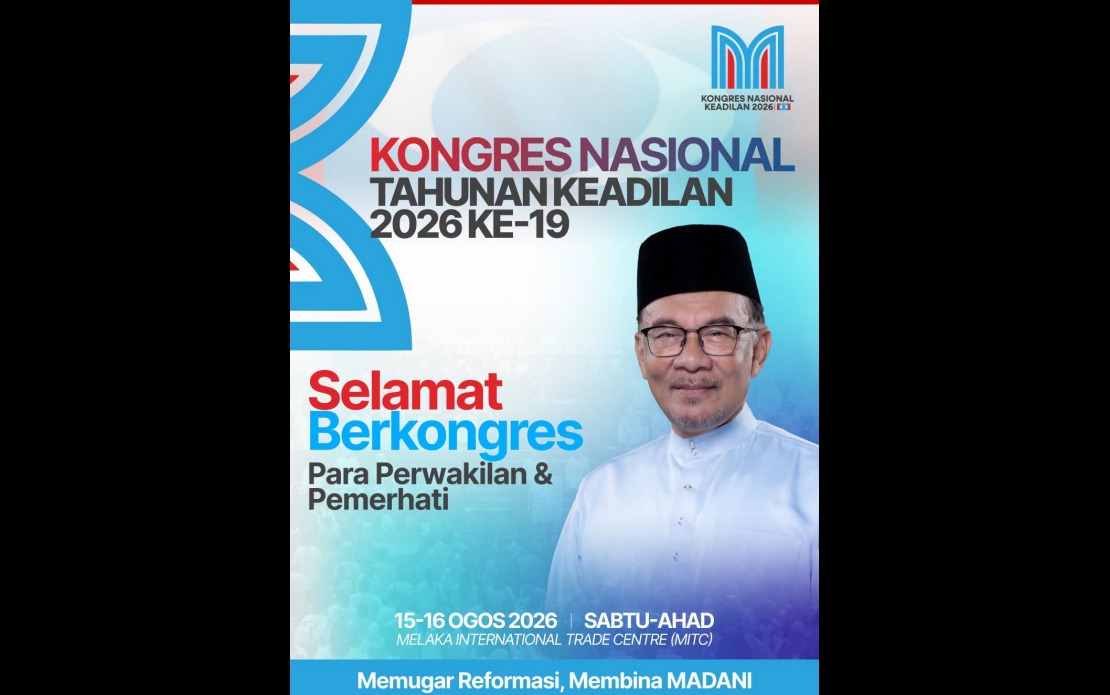
Prime Minister Datuk Seri Anwar Ibrahim has issued a pointed reminder to Parti Keadilan Rakyat that the party must remain fundamentally committed to serving as a mass movement grounded in principles of integrity and social justice, rather than devolving into a mere apparatus for winning elections. In a Facebook message released on Wednesday, Anwar emphasised that PKR's continued relevance depends on its unwavering dedication to these foundational values, alongside unity and the preservation of public trust—elements he identified as essential to constructing a Malaysia that is more dignified, prosperous, and equitable for all citizens.
The timing of Anwar's statement is significant, arriving ahead of PKR's National Congress 2026, a two-day gathering that commences at the Melaka International Trade Centre in Ayer Keroh and carries the thematic focus "Memugar Reformasi, Membina MADANI" (Revitalising Reformasi, Building MADANI). The congress represents a critical juncture for the party to engage in substantive reflection regarding its trajectory and effectiveness since returning to government as the backbone of the Pakatan Harapan coalition.
Anwar characterised the upcoming assembly as an invaluable opportunity for party delegates to conduct introspection and conduct a comprehensive audit of achievements realised thus far. More broadly, he framed the congress as a venue for the party to reinvigorate its commitment to the reformasi agenda—the transformative political and social reform movement that crystallised in PKR's founding and has defined its ideological orientation for over two decades. This emphasis on self-examination suggests awareness within party leadership that questions about PKR's evolution, internal cohesion, and fidelity to its reformist roots continue to circulate among both party members and the broader electorate.
The invocation of the Reformasi movement carries particular weight in Malaysian political discourse. Founded during the tumultuous late 1990s following Anwar's own dramatic fall from power and arrest, PKR emerged as the organisational vessel for demands for systemic change, political accountability, and judicial independence. Over the ensuing decades, the party has navigated the tension between maintaining its role as a movement for fundamental reform and functioning within the pragmatic constraints of electoral politics and coalition governance. Anwar's exhortation that PKR serve as a movement rather than merely an electoral vehicle thus reflects an acknowledgment that this tension remains unresolved and requires continuous reaffirmation.
The Prime Minister is scheduled to officiate the congress opening and deliver a comprehensive policy address intended to articulate PKR's strategic direction and programmatic priorities. This keynote intervention will carry considerable symbolic and substantive weight, as it offers Anwar an opportunity to articulate his vision for the party's evolving role within Malaysian politics during a period of relative stability following the 2023 general election. The speech is expected to address the party's positioning on critical national issues, from economic management to social welfare expansion and institutional reforms.
PKR's position within the ruling coalition presents both opportunities and challenges that the congress must address. As the dominant component of Pakatan Harapan and the party of the Prime Minister, PKR bears substantial responsibility for the government's performance and policy outcomes. Simultaneously, the party must maintain credibility with its base, particularly younger members and supporters attracted to reformist ideals. Balancing these imperatives—delivering effective governance while preserving transformative aspirations—represents an enduring challenge that no Malaysian ruling party has entirely resolved.
The emphasis on social justice and unity in Anwar's statement reflects awareness of persistent divisions within PKR and broader coalition partner dynamics. Internal factional tensions, questions about candidate selection and party democratisation, and disputes over resource allocation have periodically surfaced within PKR's structures. By reiterating commitments to justice, integrity, and inclusive governance, Anwar appears to be signalling that internal party management and principled conduct remain non-negotiable elements of PKR's identity and legitimacy.
For Malaysian observers and regional analysts tracking the country's democratic trajectory, the congress offers important signals regarding the durability of coalition arrangements, the viability of reformist ideals within government, and the extent to which dominant parties can maintain grassroots mobilisation while managing the inevitable compromises of executive power. Southeast Asia's broader experience with dominant-party politics suggests that such maintenance is perpetually contested and requires ongoing recommitment to foundational principles.
Anwar concluded his statement with an invocation to divine blessing for the party's endeavours and the nation's welfare, a rhetorical gesture common in Malaysian political discourse that simultaneously signals both spiritual earnestness and cultural sensitivity to Malaysia's Muslim-majority character. The congress thus unfolds not merely as an internal party management exercise but as a public demonstration of PKR's ideological cohesion and strategic clarity at a pivotal moment in Malaysia's political evolution.

