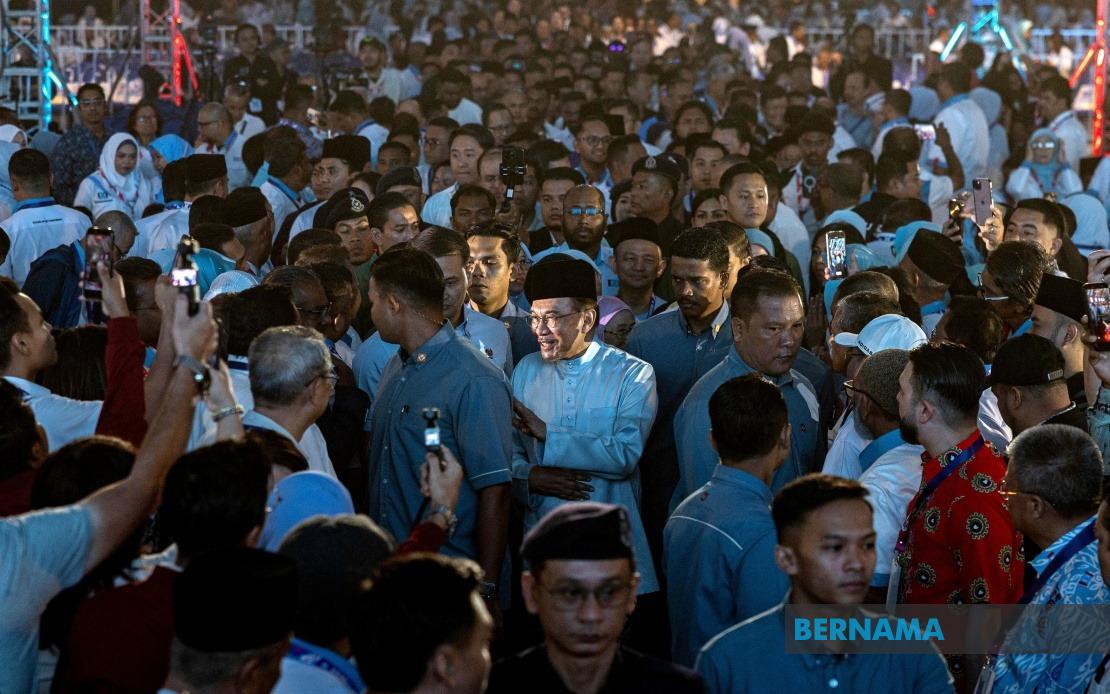
Tengku Datuk Seri Zafrul Tengku Abdul Aziz, the Prime Minister's senior political adviser and ex-officio member of the PKR Political Bureau, has signalled that the party must use its upcoming 2026 National Congress as a catalyst for internal strengthening and restoring public faith in its leadership. Speaking in Melaka, Tengku Zafrul outlined a vision where PKR members converge not to celebrate past victories, but to conduct a rigorous examination of organisational weaknesses and chart a path toward renewed effectiveness.
The timing of his remarks reflects the broader context of recent state electoral outcomes that have prompted introspection across the political landscape. Rather than focus on external factors or the performance of coalition partners within the Unity Government framework, Tengku Zafrul directed PKR's gaze inward, emphasising that the party controls its own destiny. His counsel carries particular weight given his proximity to the highest levels of government and his position as a senior figure within PKR's hierarchy. The strategy he outlines amounts to a recalibration: accepting that while PKR cannot dictate the actions of its political allies, it can and must transform its own operational capacity.
The call for comprehensive self-reflection addresses a fundamental challenge facing the party in the contemporary Malaysian political arena. Electoral setbacks in recent state contests have underscored a disconnect between PKR's policy aspirations and how effectively the party communicates its achievements to ordinary voters. This disconnect, Tengku Zafrul suggests, demands more than surface-level corrections. The party machinery requires systematic evaluation at all levels, from neighbourhood-level operations where party volunteers interact directly with residents, through to the decision-making structures at the national headquarters. Such a comprehensive audit would help identify where bureaucratic bottlenecks exist, where messaging fails to resonate, and where party leaders lose touch with community concerns.
Central to his message is an acknowledgment that perception shapes political outcomes. Even where the government has implemented policies intended to benefit citizens, if those benefits remain invisible or poorly explained, the political cost manifests in electoral losses. PKR members must become more adept communicators, translating administrative achievements into language and narratives that ordinary Malaysians understand and value. This responsibility extends beyond professional party officials to encompass every member who engages with the public. The implication is that PKR's electoral challenges stem partly from a failure in the crucial intermediary function that political parties play between government and citizens.
Tengku Zafrul's framework for improvement rests on a specific model of engagement. Rather than adopting a defensive posture when confronted with criticism, party members should listen without immediately formulating rebuttals. This approach represents a departure from the confrontational political style that often characterises Malaysian discourse, where rival parties and their supporters engage in rapid-fire exchanges rather than genuine dialogue. Listening with an open heart, in his framing, means suspending the urge to counter-argue and instead seeking to understand the substantive grievances underlying public dissatisfaction. Many residents may harbour legitimate concerns about service delivery, infrastructure, economic opportunities, or social support that remain unaddressed regardless of which party holds power.
The sequential formula he proposes—listen, acknowledge, then deliver—establishes a protocol for renewed party-citizen relations. The listening phase requires genuine receptivity. The acknowledgment phase demands honesty about what the party has and has not accomplished. Only after both preconditions are met should PKR focus on demonstrating tangible results. This approach implicitly critiques a pattern where parties promise much but struggle to implement, creating cycles of disappointment that erode voter confidence. For PKR specifically, the challenge is particularly acute given its role in national government as part of the ruling coalition. Voters hold the party accountable not only for its own initiatives but for the broader performance of the administration to which it contributes.
The 2026 Congress represents a pivotal moment for this renewal process. Party congresses in Malaysian politics typically blend ceremonial functions with substantive deliberation, serving as forums where party members reaffirm commitment to shared principles while also addressing practical concerns. In PKR's case, such a gathering could catalyse broader cultural change within the party, signalling to members at all levels that introspection and continuous improvement are valued over defensiveness and turf protection. The signal from a senior political adviser carries weight in shaping how party members interpret the leadership's priorities.
The emphasis on party unity carries implications beyond internal PKR dynamics. As a key component of the Unity Government coalition, PKR's ability to maintain cohesion and project effectiveness influences the stability of the broader administration. Coalition stability in Malaysia's multiparty environment depends partly on how successfully individual parties manage their own memberships and maintain public legitimacy. A PKR that is fractious and losing ground electorally becomes a vulnerability for the entire government apparatus. Conversely, a PKR that successfully undertakes renewal and rebuilds voter confidence strengthens the coalition's overall electoral prospects in the medium term.
For Malaysian and Southeast Asian observers of Malaysian politics, Tengku Zafrul's intervention underscores the precarious position of ruling parties in democratic systems. Incumbency brings both advantages and hazards. Governing parties can claim credit for public works, social programmes, and economic management, yet they also become targets for accumulated grievances and unrealistic expectations. The challenge is to maintain the political machinery in good working order while governing effectively. PKR's particular challenge is navigating multiple constituencies—its own party faithful who expect recognition and patronage, urban and rural voters with diverse economic interests, and coalition partners with competing agendas—without losing coherent organisational identity. The path forward, as outlined, requires both structural improvement and cultural shift toward greater receptiveness and transparency.

