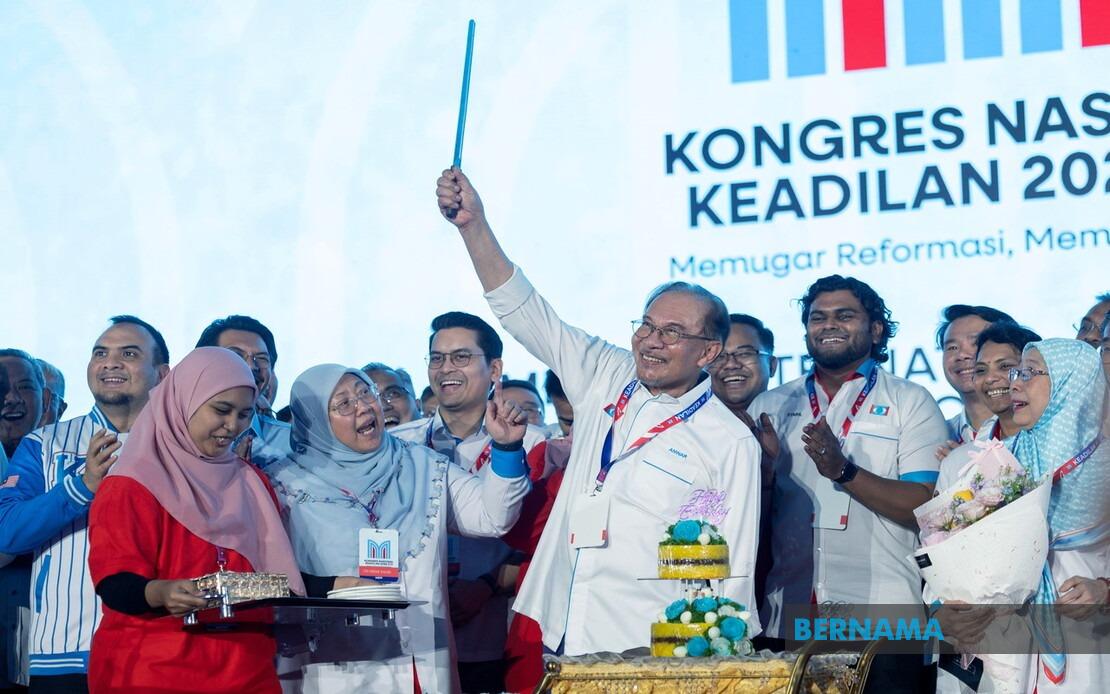
The PKR National Congress 2026 in Melaka concluded with party leadership reinforcing a dual commitment: sustaining the political equilibrium that underpins Malaysia's Unity Government arrangement while simultaneously advancing the structural reforms that have defined the party since its founding. This balancing act reflects the inherent tensions facing any reform-oriented party that transitions from opposition politics into government, where immediate stability concerns can collide with longer-term transformation objectives.
Party president Datuk Seri Anwar Ibrahim used his closing address to signal unwavering support for the ongoing coalition framework with UMNO and Barisan Nasional, framing this cooperation as essential for economic growth and political predictability. The Prime Minister's continued emphasis on this partnership carries significant weight given his dual role as both PKR leader and head of government, positioning him as the principal architect of inter-party arrangements. However, Anwar notably attributed future sustainability of this cooperation to UMNO and BN leadership decisions, a formulation that acknowledges PKR's subordinate numerical position within the coalition while subtly distributing responsibility for continuity across multiple shoulders.
A noteworthy aspect of Anwar's messaging concerned the boundaries of acceptable political behaviour. He explicitly cautioned all coalition partners against precipitous actions that might destabilise the government, suggesting underlying tensions within the alliance despite public displays of unity. This admonition appears targeted at managing intra-coalition dynamics where different partners harbour divergent interests and ideological orientations. For Malaysian observers, such warnings are familiar preludes to periods of coalition management and negotiation, though they underscore that the Unity Government arrangement remains fragile without continuous active maintenance.
PKR deputy president Nurul Izzah Anwar articulated the party's case for why reform cannot be abandoned merely because the party now holds ministerial portfolios. She contended that without sustained focus on transformative policies, PKR risks becoming merely another governing party indistinguishable from its predecessors. The repeal of the Universities and University Colleges Act (AUKU) 1971 served as her concrete example of reform achievement within government, demonstrating that change remains possible even within institutional constraints. This example carries particular resonance for Malaysian society given decades of student activism and debates surrounding campus autonomy and political expression.
Anwar's specific assurance regarding AUKU's replacement is politically significant. By pledging that no successor legislation will impose comparable restrictions on student movements, he signals PKR's intent to resist authoritarianism even while wielding state power. His argument that existing criminal law provisions suffice to address genuine misconduct essentially reframes the student movement question away from special governance structures toward equal application of general law. For a party whose base includes significant youth contingents and university-educated professionals, such positioning protects both ideological credibility and grassroots morale.
The congress highlighted PKR's organisational development priorities, with particular emphasis on electoral readiness independent of immediate parliamentary dissolution timelines. This forward-planning stance suggests the party leadership operates with realistic expectations about coalition longevity and understands the importance of maintaining organisational muscle regardless of political calendar developments. Such preparedness serves multiple purposes: it prevents atrophy during periods of apparent stability while ensuring rapid mobilisation capability when circumstances shift.
Education Minister Fadhlina Sidek's emphasis on expanding women's representation in decision-making structures addresses a persistent governance challenge across Malaysian political institutions. Her concurrent call for leaders to demonstrate openness toward criticism reflects awareness that government accountability mechanisms sometimes atrophy when parties become accustomed to power. These twin themes—gender inclusion and receptiveness to critical feedback—connect to broader governance quality questions that extend beyond PKR to affect the entire Unity Government's legitimacy and effectiveness.
Youth-focused initiatives discussed during the congress, particularly through Angkatan Muda Keadilan, reveal PKR's attention to generational economic concerns. The emphasis on Bumiputera participation in emerging technology sectors like artificial intelligence, semiconductors, and biotechnology acknowledges both the imperative for structural economic transformation and the continued importance of Bumiputera considerations in Malaysian policy frameworks. These positions attempt to reconcile PKR's social democratic orientation with pragmatic recognition of Malaysian demographic and constitutional realities.
The congress's attention to gig economy recognition and stronger social protections for younger workers addresses concrete economic anxieties affecting Generation Z and millennial employment experiences. These policy concerns reflect labour market transformations occurring across Southeast Asia, where traditional full-time employment increasingly coexists with informal and platform-based work arrangements. PKR's willingness to foreground such issues distinguishes it from mainstream Malaysian political discourse, which often focuses on traditional manufacturing and public sector employment frameworks.
Mental health and social wellbeing emerged as explicit youth policy concerns during the congress, signalling PKR's engagement with psychological and emotional dimensions of development beyond conventional economic metrics. This framing reflects global trends in political discourse but represents relatively progressive positioning within Malaysian context, where mental health discussions have historically received limited political attention. The inclusion of such concerns in party congress discussions suggests PKR leadership recognises that economic growth alone cannot address contemporary generational anxieties.
The congress proceedings ultimately portrayed a party navigating the inherent contradictions between stability maintenance and transformative ambition. PKR's continued emphasis on both dimensions reflects astute political calculation: abandoning reform would alienate the idealistic base that powers grassroots organising, while undermining stability would invite both coalition partner recriminations and international economic concerns. This balancing strategy may succeed temporarily, but historical experience across democracies suggests such dual commitments eventually face testing moments demanding difficult choices about which principle takes precedence.
For Malaysia's broader political development, the congress reaffirmed that coalition politics in the contemporary era require constant negotiation and messaging calibration. PKR's performance as a governing reform party will likely influence whether subsequent generations view coalition arrangements as practical necessities compatible with progressive governance or as inevitable compromises that erode principled political opposition. The stakes extend beyond PKR itself to shape public expectations about what political parties can accomplish once they transition from challenger to incumbent status.

