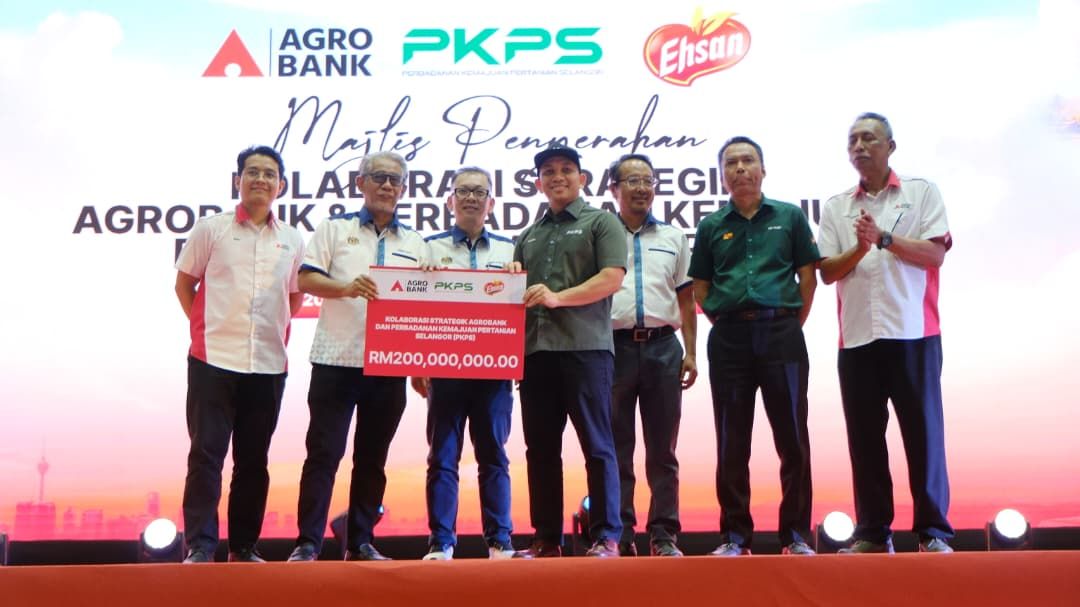
The Selangor Agricultural Development Corporation (PKPS) has secured a RM200 million trade financing facility from Agrobank in a strategic move designed to accelerate infrastructure development and bolster the state's agrifood sector. The agreement, formalised during the Malaysia Agriculture, Horticulture and Agrotourism Exhibition (MAHA) 2026 at the Malaysia Agro Exposition Park (MAEPS) Serdang on August 29, represents a significant commitment to enhancing Selangor's food supply chain resilience at a time when regional food security concerns are mounting.
The financing mechanism will address dual objectives: funding major capital projects while simultaneously meeting PKPS's operational working capital requirements. Unlike traditional project finance arrangements, the facility adopts a structured disbursement approach tied directly to project progress milestones. This methodical release of funds—scheduled to commence officially in March 2027—ensures transparent cash management and reduces the financial risks typically associated with large-scale agricultural infrastructure development. The ceremonial mock-cheque handover, conducted by Agrobank Group President and Chief Executive Officer Datuk Tengku Ahmad Badli Shah Raja Hussin and received by PKPS Group Chief Executive Officer Datuk Dr Mohamad Khairil Mohamad Razi, underscored the partnership's significance within Malaysia's broader food security agenda.
The flagship initiative under this facility will be the construction of Selangor's halal food warehouse, a dedicated storage and logistics hub designed to streamline distribution across the state's diverse districts. This facility addresses a critical infrastructure gap in Malaysia's halal supply chain, which has become increasingly important both as a domestic requirement and as a competitive advantage in export markets. The warehouse will serve as a centralised consolidation point, reducing transportation costs and minimising food wastage—two persistent challenges in Malaysia's agrifood logistics network.
Beyond the flagship warehouse project, the RM200 million allocation encompasses several complementary infrastructure developments that collectively represent an ecosystem approach to agricultural modernisation. A dedicated halal chicken processing centre will enhance value-added processing capacity, while an Ehsan product processing facility will extend the range of shelf-stable food products suitable for distribution. The simultaneous construction and upgrading of central distribution warehouses across Selangor's districts addresses the geographic dispersion challenge that has historically constrained the state's food distribution efficiency, particularly for perishable commodities.
The financing commitment extends substantially into operational and research dimensions beyond bricks-and-mortar infrastructure. PKPS's Ehsan brand, which focuses on value-added ready-to-eat and ready-to-heat products, will receive dedicated operational support through the facility. More significantly, the agreement allocates resources toward high-impact research and development activities, including the operation of the Ehsan Agricultural Research Centre. This investment in smart agriculture research reflects recognition that technological adoption—precision farming, data-driven crop management, and automated systems—represents the genuine productivity frontier for Malaysian agriculture.
Human capital development forms another pillar of this partnership, with the Ehsan Agricultural Training Centre receiving support to cultivate skilled workers throughout the agrifood supply chain. This aspect proves particularly vital given Malaysia's persistent agricultural labour challenges and the necessity of retaining younger demographic participation in the sector. By coupling infrastructure investment with workforce development, PKPS acknowledges that capital assets alone cannot deliver sustainable productivity gains without corresponding improvements in operational expertise and management capacity.
The agritourism dimension, involving development at the Ehsan Resort and Convention Centre, signals PKPS's recognition that diversified revenue streams strengthen the financial sustainability of agricultural enterprises. Agricultural tourism has emerged across Southeast Asia as a mechanism for capturing value from urban consumers seeking authentic farm experiences while simultaneously generating supplementary income for rural communities. Selangor's proximity to the Klang Valley population centres makes this segment particularly promising for PKPS's portfolio expansion.
This partnership resonates directly with MAHA 2026's central theme of "Value Creation for Food Security," emphasising that contemporary food security transcends mere production volume. Instead, modern food security demands integrated supply chain efficiency, technological sophistication, and strategic infrastructure positioning. For Malaysia, which imports substantial quantities of staple foods and faces vulnerability to global supply disruptions, state-level initiatives like the PKPS-Agrobank collaboration represent tangible policy implementation of food security rhetoric. Selangor's role proves particularly significant given its status as Malaysia's economic anchor and its concentrated population requiring reliable food availability.
The facility's emphasis on sustainability and technological modernisation aligns PKPS's strategic direction with global agricultural trends emphasising resource efficiency and environmental stewardship. Climate variability increasingly threatens traditional agricultural patterns across Southeast Asia, making investment in research-driven adaptive capacity essential for long-term food system resilience. By integrating R&D funding alongside infrastructure development, the partnership acknowledges that tomorrow's food security depends on today's innovation investments.
For Malaysian stakeholders, this arrangement demonstrates how strategic financial partnerships can catalyse agricultural transformation beyond what government budgetary allocations alone might achieve. Agrobank's specialised expertise in agricultural financing, coupled with PKPS's operational knowledge and asset base, creates a complementary arrangement potentially replicable across other Malaysian states. The transparent disbursement framework also establishes a governance model that could influence how other agricultural finance arrangements operate regionally.
The delayed implementation timeline—March 2027—provides essential preparation time for PKPS to complete detailed project planning, secure necessary regulatory approvals, and mobilise supply chains for major construction components. This interim period also allows market conditions to stabilise and enables comprehensive stakeholder engagement across Selangor's agricultural community. The phased approach suggests that both parties prioritise successful implementation over rushed deployment, reducing execution risks that frequently plague large agricultural infrastructure projects.
Ultimately, this RM200 million commitment addresses a fundamental tension within Malaysian agriculture: the sector simultaneously requires dramatic transformation in production methods, supply chain efficiency, and value-chain integration, yet operates within tight financial constraints. By bridging the gap between government policy ambitions and available financing, the PKPS-Agrobank partnership exemplifies how public-private collaboration can mobilise resources toward shared food security objectives. For Southeast Asia more broadly, Selangor's initiative may establish a template for how states can strengthen domestic food system resilience while building institutional capacity for sustained agricultural modernisation.

