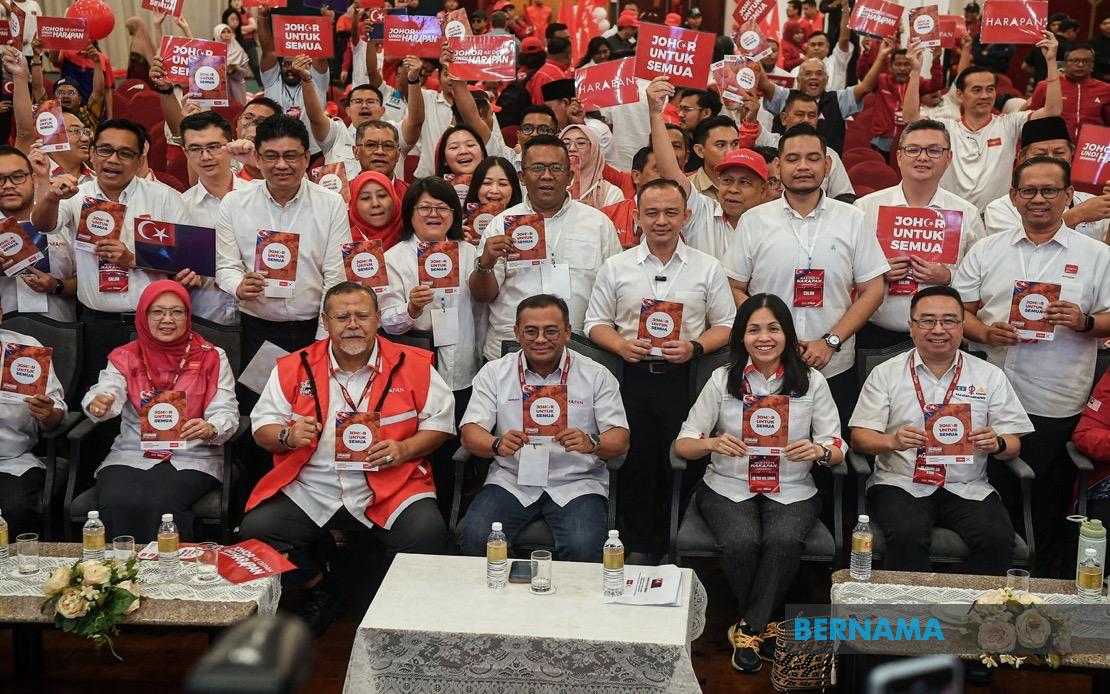
Pakatan Harapan launched its election manifesto for Johor on Wednesday with a deliberate emphasis on practicality rather than aspirational promises. The 'Johor Untuk Semua' (Johor For All) platform, unveiled ahead of the 16th Johor state election scheduled for July 11, was framed by party leaders as a response to genuine community concerns and the state's distinct economic circumstances, rather than generic political pledges disconnected from ground realities.
Johor DAP chairman Teo Nie Ching, who also serves as Deputy Communications Minister at the federal level, positioned the manifesto as carefully calibrated to address segments across the demographic spectrum. Her repeated assurance that the proposals are achievable hinges critically on securing meaningful cooperation from the federal government, underscoring the interdependence between state and national policy implementation. This prerequisite reveals the structural challenge facing PH: ambitious state-level commitments may falter without aligned federal machinery and resources.
The manifesto centres on ten substantive policy offerings designed to resonate with Johor's economic needs and demographic aspirations. Education emerges as a cornerstone priority, reflecting persistent public concern about schooling quality and accessibility—a perennial issue across Malaysian states. Equally prominent is a pledge to halve waiting times at the Johor-Singapore border crossings, a proposal with direct economic implications given the corridor's importance to both commerce and daily commuter traffic.
Teo's confidence regarding border efficiency improvements rests on coordination with the Home Ministry, suggesting the initiative would require synchronised administrative procedures between Malaysian and Singaporean authorities. The feasibility of cutting congestion by fifty percent depends on factors beyond state control, including immigration infrastructure upgrades and bilateral agreements—a complexity that underscores why Teo emphasised federal partnership as essential to delivery.
Among the manifesto's signature commitments is the proposed Johor Health Scheme, drawing explicitly on Selangor's established model. By invoking Selangor's experience, PH attempts to demonstrate that similar comprehensive health programmes have proven implementable within Malaysian state contexts. This reference serves a dual purpose: it provides empirical reassurance to sceptical voters while reducing the perceived novelty or risk of the proposal. Selangor's scheme implementation offers what amounts to a proof-of-concept argument, though each state faces distinct healthcare infrastructure, demographic, and fiscal circumstances.
First-time homebuyer assistance through deposit support addresses a demographic cohort increasingly priced out of property markets across Malaysia. Housing affordability has become a defining economic concern for young adults, particularly in urban and semi-urban areas, making this pledge strategically targeted at younger voters whose electoral participation remains crucial to opposition parties' prospects. The psychological and practical relief of reduced down-payment burdens could substantially influence voting intention among this group.
The manifesto's allocation of RM500 million toward youth development indicates recognition that post-pandemic youth unemployment and underemployment require dedicated investment rather than passive policy frameworks. This fund suggests PH views youth empowerment not merely as social responsibility but as essential economic renewal, particularly given Johor's manufacturing base and service sector expansion.
Education receives treatment as both a foundational right and an economic imperative—measures to strengthen the sector address parental anxieties about academic quality whilst positioning education as essential infrastructure for Johor's economic competitiveness. This dual framing helps reconcile social and economic policy arguments, appealing both to voters prioritising immediate welfare and those concerned with long-term regional prosperity.
Teo's characterisation of the manifesto as "balanced" carries significant weight in Malaysian electoral discourse, where accusations of bias toward particular groups carry electoral cost. By claiming broad coverage from youth to mothers to children, she attempts to inoculate PH against charges of narrow or factional policy-making. The inclusivity claim, however, requires substantiation through implementation should PH secure power.
The manifesto's public-facing launch represents only the initial phase of electoral messaging; its credibility will be tested through detailed costing documents, implementation timelines, and responses to scrutiny from rival parties and civil society. Voters accustomed to manifesto commitments going unfulfilled will likely remain cautious, particularly regarding flagship promises like border crossing efficiency and health scheme implementation.
With early voting scheduled for July 7 and election day on July 11, the timeframe for persuasion remains compressed. The 'Johor Untuk Semua' messaging strategy relies on demonstrating that PH has moved beyond rhetorical politics toward evidence-based, deliverable commitments—a positioning that distinguishes it from broader electoral discourse characterised by grandiloquent but vague pledges. Whether voters perceive the manifesto as genuinely grounded or merely revised rhetoric will substantially influence PH's ability to retain or expand its Johor representation in the coming elections.

