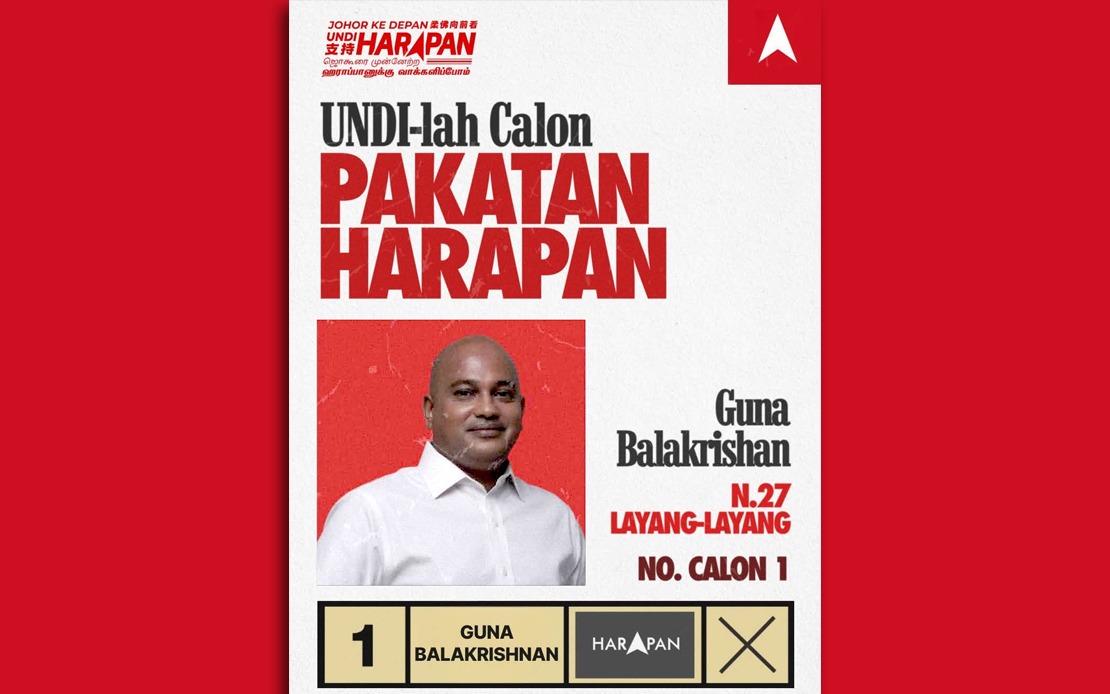
Pakatan Harapan's candidate for the Layang-Layang state constituency, Guna Balakrishnan, has unveiled an expansive development roadmap centred on inclusive growth and tangible improvements to residents' quality of life. Speaking in Kluang ahead of the Johor state election scheduled for July 11, Guna articulated six interconnected policy commitments designed to address both immediate infrastructure challenges and longer-term economic opportunities within the constituency.
The manifesto reflects a deliberate strategy to position the PH candidate as a responsive, community-focused representative willing to bridge the gap between grassroots concerns and government action. Guna emphasised that his approach hinges on sustained engagement with local communities, positioning himself as an advocate capable of translating everyday grievances into concrete policy interventions. This emphasis on accessibility and responsiveness represents a common thread across opposition campaigning in Malaysian state elections, where candidates increasingly stress their capacity to be accessible representatives rather than distant bureaucrats.
Flood management emerges as the most pressing infrastructure priority within Guna's platform. Layang-Layang residents in vulnerable zones including Kampung Senda, Sungai Sayong, Kampung Tengah Renggam, Ulu Benut, Simpang Renggam, and Kampung Chokro have experienced recurring inundation, a chronic problem that has festered across multiple electoral cycles. Guna's commitment to accelerate flood mitigation implementation and modernise drainage infrastructure directly responds to this constituency pain-point. The pledge carries particular significance given Malaysia's intensifying monsoon patterns and the political capital associated with delivering tangible relief from seasonal flooding that disrupts livelihoods and damages property.
Beyond water management, Guna has positioned digital infrastructure as a foundational development lever. Proposals to expand internet coverage across rural areas within Layang-Layang acknowledge the digital divide that persists in peripheral constituencies, where connectivity deficits constrain both educational opportunities and entrepreneurial activity. Enhanced street lighting similarly addresses a safety and quality-of-life dimension that resonates with residents concerned about evening mobility and security. These infrastructure pledges, while unglamorous, form the bedrock upon which more ambitious economic development initiatives rest.
The economic dimension of Guna's platform centres on unlocking Layang-Layang's latent commercial potential through grassroots entrepreneurship and tourism activation. Support for small traders and leveraging Renggam's tourism attractions represents an attempt to diversify income generation beyond traditional agriculture and wage employment. This approach aligns with broader Malaysian development thinking that emphasises rural economic diversification and the integration of secondary towns into regional commerce networks. Tourism particularly holds promise given Renggam's accessibility from major urban centres and potential cultural or recreational assets that remain underexploited.
Youth development constitutes another strategic pillar, with Guna proposing expanded technical and vocational education access alongside establishing a motorsports facility. The motorsports commitment is notably specific and reflects recognition that young people within the constituency possess entrepreneurial and sporting aspirations that conventional economic structures may not adequately serve. TVET expansion addresses skills gaps that persist in peripheral regions, where young people often lack pathways to stable, skilled employment and consequently migrate to major urban centres. This brain drain represents a longstanding challenge for Malaysian state governments seeking to retain talent and build human capital outside Klang Valley and Penang.
Gendered development features prominently in Guna's manifesto, particularly through emphasis on women's entrepreneurship strengthening and senior citizen welfare through establishment of a Senior Citizens Activity Centre. These commitments signal recognition that inclusive development must explicitly address demographic groups—elderly residents and women seeking to enter commerce—whose needs often receive inadequate policy attention. The PAWE facility would provide social infrastructure centred on active ageing, allowing senior citizens to maintain community engagement and dignity rather than relegation to passive dependency.
Guna's framing of these pledges as realistic commitments rather than hollow campaign rhetoric warrants scrutiny. The candidate positions himself as a bridge between constituents and government machinery, a characterisation that resonates within Malaysia's democratic culture but requires institutional capacity to execute. Layang-Layang, with 25,181 registered voters, contests as a three-way race between Guna, Barisan Nasional's Chua Jian Boon, and incumbent Perikatan Nasional representative Abd Mutalip Abd Rahim. This triangular contest adds complexity, as voters effectively choose among three competing visions for the constituency's trajectory.
The electoral context demands consideration of governance capacity and resource allocation dynamics. A PH state representative would require cooperation from the Johor state government and municipal authorities to translate manifesto promises into implementation. Flood mitigation projects, infrastructure upgrades, and facility establishment all demand sustained funding, technical expertise, and inter-agency coordination that extend beyond an individual assemblyman's direct authority. Guna's stress on collaborative governance with state agencies and local authorities implicitly acknowledges this constraint, yet voters remain sceptical about whether such cooperation materialises when political control fragments across different coalitions.
Regional development disparities within Malaysia increasingly feature in electoral calculations, and Layang-Layang's peripheral positioning within Johor amplifies these concerns. Constituencies further from Johor Bahru frequently report infrastructure neglect, inadequate service delivery, and economic opportunities concentrated within metropolitan zones. Guna's manifesto directly addresses this geographic inequality by prioritising rural-specific infrastructure, digital inclusion, and decentralised economic activity. Whether such commitments can overcome structural advantages enjoyed by urban constituencies under any political administration remains an open question influencing voter calculations.
The July 11 election will ultimately determine whether Layang-Layang residents entrust Guna with implementing this development agenda or prefer continuity under incumbent representation or BN stewardship. Early voting commenced July 7, and campaign intensity will accelerate through the final campaign week. Guna's coalition affiliation with Pakatan Harapan carries implications beyond the state level, contributing to broader narratives about opposition party viability and governance credibility that extend across Southeast Asia's largest Muslim-majority democracy.

