The Philippine Department of Public Works and Highways is actively examining how Singapore's proven flood control approaches can be adapted to protect its vulnerable population, following a showcase of cutting-edge water management solutions in Makati City. Undersecretary Charles Calima indicated the agency will conduct comprehensive assessments of which technologies are suitable for local conditions and calculate implementation expenses, recognising that the archipelago faces unique challenges that demand carefully tailored interventions.
Singaporean technology firms demonstrated an array of sophisticated flood management systems at the 2026 Stormwater Summit, ranging from real-time hazard monitoring to innovative rainwater harvesting and recycling schemes. These solutions reflect Singapore's decades of investment in becoming one of Asia's most resilient cities despite its geographic constraints. The showcase highlighted how smaller nations with limited land area and high population density have developed world-class infrastructure to manage water crises, offering potential lessons for larger Southeast Asian neighbours struggling with similar vulnerabilities.
Companies such as Flexi Systems presented the Tethys platform, an integrated monitoring system that simultaneously tracks five critical data streams essential for flood prediction and management. The platform aggregates water quality measurements, rainfall patterns and forecasts, blockage alerts, real-time flood level information, and tidal influences on drainage systems. This multi-layered approach enables authorities to anticipate flooding events rather than merely respond reactively, fundamentally shifting how cities can approach disaster management. Chief executive April Yang emphasised that real-time intelligence provides both operational efficiency and psychological reassurance to communities vulnerable to floods.
PUB Consultants, the international division of Singapore's national water authority PUB, outlined the city-state's comprehensive infrastructure strategy developed over fifty years. Ryan Yuen described how Singapore has systematically regulated reservoir capacity, enhanced drainage networks, and implemented natural filtration systems such as rain gardens to treat runoff before it reaches vulnerable areas. Beyond engineering solutions, Singapore has integrated water recycling into its sustainability framework, treating every drop of precipitation and wastewater as a precious resource for reuse. This circular economy approach to water management contrasts sharply with many developing nations that lack the technical capacity or financial resources for such systems.
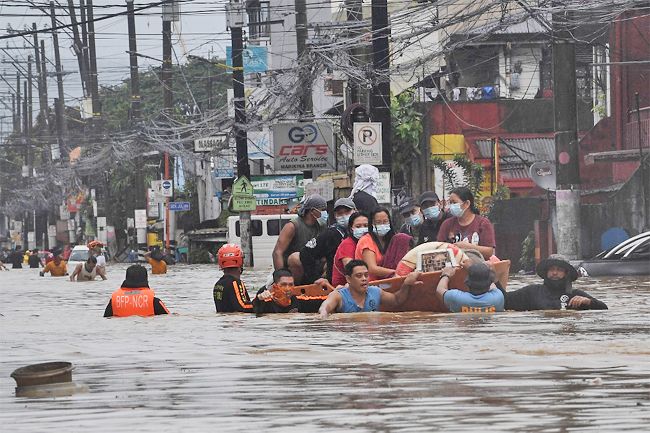
The Philippines faces extraordinary hydrological challenges that distinguish its situation from Singapore's. As an archipelago of at least 112 million people scattered across thousands of islands, the country experiences approximately twenty cyclones annually that originate over the Pacific Ocean, compounded by intense monsoon rainfall during specific seasons. This combination creates recurring flood emergencies that displace millions and damage critical infrastructure, undermining economic development and perpetuating cycles of poverty in affected communities. Unlike Singapore's compact geography and concentrated urban areas, the Philippines' dispersed population and varied terrain demand flood management solutions that function across diverse contexts and scales.
Calima indicated that the government recognises waste management as a foundational component of any comprehensive flood prevention strategy. Accumulated debris and improperly disposed waste clog drainage systems, reducing their capacity to handle rainfall and creating localised flooding even during moderate precipitation events. This challenge particularly affects informal settlements where waste management infrastructure remains minimal, forcing residents to live in conditions where flood risk is compounded by sanitation hazards and environmental degradation. Addressing these underlying issues requires not merely adopting foreign technology but fundamentally improving municipal services across the country.
Exerts acknowledged that engineering excellence alone cannot eliminate flood risk without accompanying social resilience. Both Yang and Yuen recognised that even the most sophisticated technological systems require community understanding and preparation to function effectively. This insight has particular relevance for the Philippines, where many vulnerable populations lack information about approaching storms or evacuation procedures. Building social resilience demands sustained investment in education, early warning systems that reach remote areas, and community-based disaster preparedness programmes that empower residents to protect themselves.
Actor Dingdong Dantes, serving as an ambassador for the Office of Civil Defense, elevated the discussion beyond technical solutions to emphasise the human dimension of disaster resilience. Reflecting on a documentary he produced about a woman named Evelyn whose home was permanently inundated, Dantes articulated a vision of resilience that transcends merely recovering from disasters. His narrative highlighted the tragic normalisation of extraordinary hardship, where individuals adapt to living with chronic flooding because systemic solutions remain unavailable. The story of Evelyn, sleeping on her home's upper floor while floodwaters persistently occupy the lower levels, crystallises the daily reality facing millions of Filipinos in flood-prone regions.
Dantes redefined resilience as encompassing courage, discipline, humility, and determination—qualities that extend beyond technological capacity to encompass individual and collective fortitude. This characterisation resonates throughout Southeast Asia, where climate change intensifies precipitation patterns and many nations lack resources for comprehensive infrastructure upgrades. True resilience in the Philippine context requires simultaneous advancement across multiple dimensions: improved drainage systems, real-time monitoring, waste management, community education, and systemic poverty reduction that enables vulnerable populations to relocate away from flood-prone areas.
The Philippines' exploration of Singapore's approaches occurs within a broader regional context of climate vulnerability. Southeast Asian nations increasingly recognise that traditional development models inadequately address mounting environmental challenges. Singapore's example demonstrates that advanced economies can systematically reduce flood risk through sustained investment and technological innovation, yet each nation must customise solutions to match local circumstances. The Philippines cannot simply replicate Singapore's model but must extract relevant principles and adapt them to its vastly larger, more dispersed, and economically diverse population.
Implementing Singapore-inspired flood management at scale across the Philippines will require substantial financial investment and technical capacity building. The government's commitment to assessing which technologies can be adopted and determining costs represents a preliminary step toward evidence-based infrastructure planning. However, translating assessments into functioning systems demands political will, sustained funding, and coordination among national agencies, local governments, and communities. The success of such initiatives will depend not on technology alone but on the comprehensive transformation of how Philippines society approaches disaster risk reduction.

