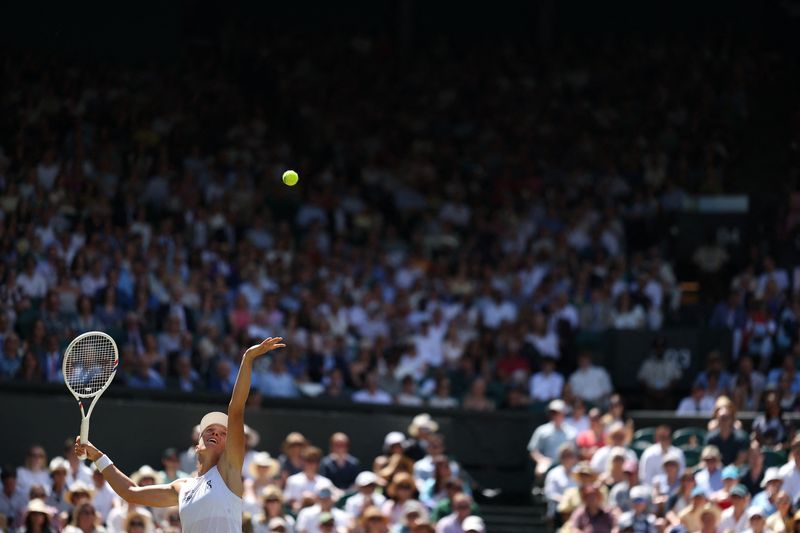
The Wimbledon stage witnessed a changing of the guard on Saturday afternoon as defending champion Iga Swiatek's title defence crumbled against an inspired Alexandra Eala, the rising Philippine talent claiming a 7-6(9) 6-2 victory in a Centre Court encounter that will define the young player's emerging career. The Polish third seed, who had put persistent doubts about her grass-court credentials to rest with last year's triumph, arrived at the All England Club still searching for rhythm after stumbling early at the Bad Homburg warm-up event, a warning sign that would prove prescient against Eala's relentless baseline assault.
For Eala, the moment transcended the immediate sporting achievement. In a raw and emotional address after the match, the 19-year-old reflected on her improbable journey from the Philippines, where she trained daily after school alongside her brother and grandfather, attired in the modest trappings of a young aspiring player. "Maybe for someone like Iga, who has won so many Grand Slams, or maybe someone like Serena or Venus Williams, this achievement may seem small," she told the crowd, voice thick with emotion. "But for someone who grew up in the Philippines with my ruffled socks and my light-up shoes and chubby cheeks, so... to her, this is everything." Yet even in celebrating the breakthrough, Eala's competitive fire remained undiminished. "Because I'm emotional does not mean I'm satisfied," she declared, her gaze already fixed on the next challenge.
The opening set proved to be the decisive battleground, a high-octane affair where neither player offered the other respite. Both competitors attacked with purpose from the baseline, engaging in prolonged rallies that left the Centre Court crowd thoroughly engaged. The tension mounted as the set stretched toward a tiebreak, with Eala's powerful striking and aggressive court positioning gradually tilting momentum in her favour. Though Swiatek forced a dramatic tiebreak at 6-6, Eala's nerve held firm as she secured the set 7-6(9), a result that seemed to unsettle the champion. The Pole's visible frustration boiled over as she directed sharp comments toward her entourage in the stands and famously smashed her racket against a chair in a rare display of pent-up emotion, while Eala basked in the crowd's mounting enthusiasm and encouragement.
Swiatek's prior meeting with Eala had ended in her favour, a revenge victory on the clay courts of Madrid following an earlier upset loss in Miami that underscored the Latin American player's increasing threat to established order. On grass, however, the dynamics shifted decisively. Eala's left-handed serve and penetrating baseline game, which had troubled Swiatek from the match's opening moments, now swelled into an irresistible force as the second set commenced. The Philippine star seized immediate control, engineering a double break to establish a commanding 3-0 advantage that essentially sealed the contest. Although Swiatek momentarily clawed back a break to suggest a potential comeback, Eala's dominance proved insurmountable. A forehand winner clinched the decisive break and the match itself, sending Eala through to a fourth-round encounter with 2024 runner-up Jasmine Paolini.
This result carries profound implications for Philippine tennis, a nation where the sport has historically struggled to produce elite global competitors. Eala's breakthrough performance on grass, traditionally viewed as the surface where only established champions and elite technique excel, demonstrates that the young player possesses the all-around weaponry required to compete at the sport's highest echelon. Her ability to deconstruct Swiatek's game through aggressive baseline play and serve-and-volley moments suggests a maturity beyond her years, a tactical intelligence that transcends mere physical attributes. For Southeast Asian tennis, Eala's advancement to the second week of a Grand Slam represents a statement that the region's talent pipeline extends beyond historical outliers and toward systematic player development.
Swiatek's exit marked the conclusion of a tournament that had already exposed the defending champion's lingering vulnerabilities. Despite her victory at Wimbledon the previous year, questions about surface mastery had never entirely disappeared from the discourse surrounding her game. This year's early defeat in Bad Homburg signalled that inconsistency remained her persistent companion, and against an opponent bringing peak form to the grass, the vulnerabilities proved fatal. The champion's battles with Taylor Townsend and Karolina Pliskova had suggested growing confidence, yet neither opponent possessed Eala's combination of power, precision, and psychological resilience in crucial moments.
Eala's own words in the aftermath revealed the emotional and motivational architecture underlying her stunning victory. She spoke of Wimbledon as her "dream court," a place where she had long fantasised about competing at the highest level. The roar of the Centre Court crowd when she secured victory transcended mere sporting noise; it represented validation of years spent grinding away from the global spotlight. Each opportunity, as she emphasised, represented a blessing rather than an entitlement, a perspective born from her unconventional path to professional tennis. This philosophy translated directly into her tactical approach, where calculated aggression replaced the hesitation that sometimes afflicts younger players facing elite opposition.
Looking forward, Eala's fourth-round assignment against Paolini presents a formidable examination. The Italian, who reached the 2024 Wimbledon final, brings grass-court pedigree and experience at the sport's grandest stages. Yet if Eala's performance against Swiatek represents her authentic level of capability rather than a one-off flash of brilliance, she enters the match with considerable momentum and evidence that she can trouble any opponent on grass courts. The fourth round of a Grand Slam demands sustained excellence across multiple matches, a test that will definitively establish whether this breakthrough represents the beginning of a sustained rise or a memorable but isolated achievement.
The broader tennis landscape has now registered Eala's arrival as a consequential player. Scouts, rival players, and tournament organisers recognise that ignoring her name in seeding considerations or match projections would constitute negligence. Her victory over Swiatek retroactively casts new light on her earlier performance at the Miami Masters, where she had announced herself as dangerous before subsequently facing adversity. This Wimbledon campaign, should it continue beyond Paolini, promises to reshape perceptions of Philippine tennis capability and inspire a generation of young players in Southeast Asia to pursue excellence in a sport historically dominated by European and North American competitors.

