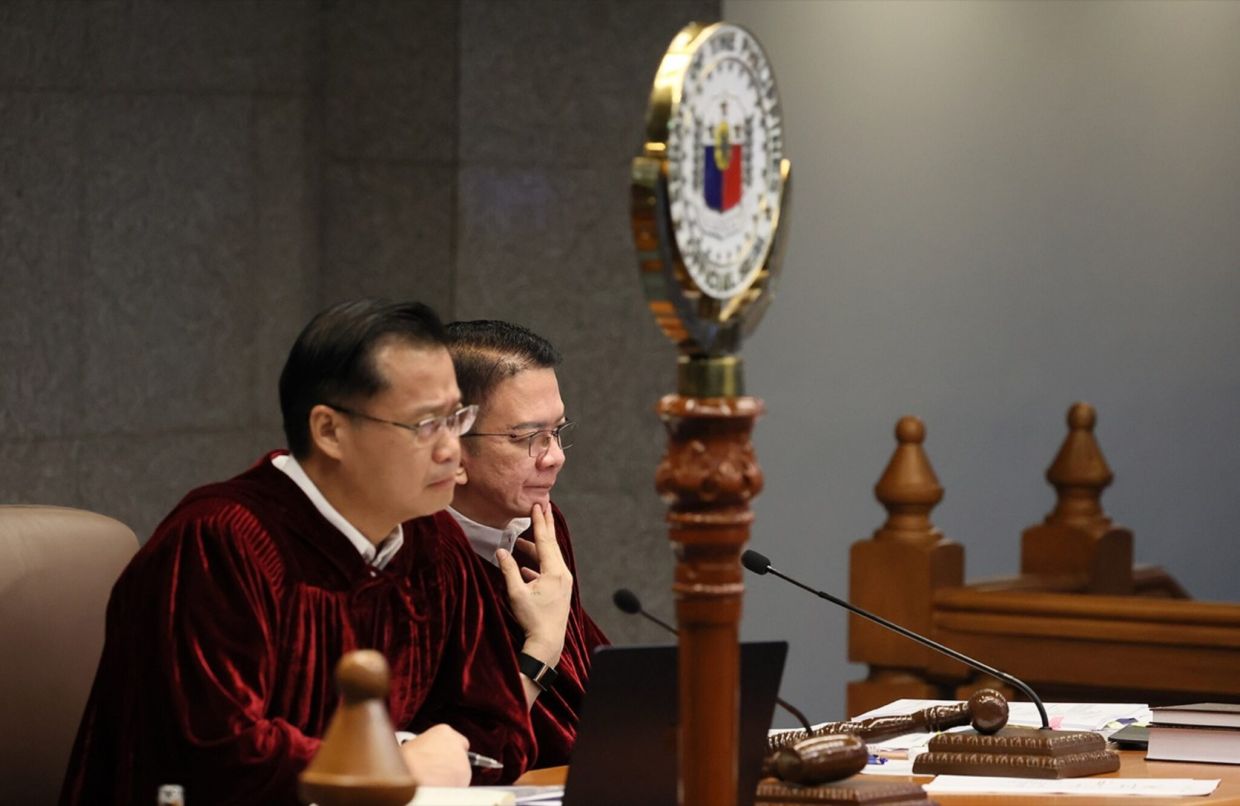
The Philippine Senate impeachment court is poised for a pivotal procedural decision that could significantly shape Vice President Sara Duterte's trial, with lawmakers expected to vote Monday on whether financial institutions should be compelled to release her bank accounts, tax documents, and records from the Anti-Money Laundering Council. House prosecutors have expressed confidence the Senate will grant the subpoena request, framing disclosure as fundamental to establishing whether Duterte accumulated wealth disproportionate to her official income and violated constitutional prohibitions on business interests. The vote represents one of the trial's most consequential moments, coming on its seventh day as impeachment proceedings continue to dominate Philippine political discourse.
Prosecutors are seeking comprehensive financial documentation spanning multiple decades and encompassing not only Duterte's personal accounts but also those of her husband, lawyer Manases Carpio. House prosecution spokesperson Benjamin Tolosa Jr. argued that existing legal frameworks provide clear authority for such disclosure, pointing to Republic Act No. 1405, the bank secrecy law, which explicitly carves out an exception for impeachment proceedings. He further referenced the 2012 impeachment trial of former Chief Justice Renato Corona, where the Senate successfully compelled production of confidential banking information despite customary financial privacy protections, establishing precedent that impeachment proceedings override ordinary confidentiality rules.
The prosecution's case hinges on allegations contained in Article II of the impeachment articles, which accuses Duterte of acquiring unexplained wealth during her tenure as a public official. Prosecutor Chel Diokno emphasized that financial records would enable the impeachment court to uncover truth surrounding the Vice President's financial activities, maintaining that the Senate sitting as an impeachment body derives constitutional authority to compel disclosure regardless of ordinary legal restrictions. Diokno cited an Anti-Money Laundering Council report showing Duterte's financial activity exceeded three billion Philippine pesos from 2007 to 2013, suggesting the records are directly relevant to substantiating the wealth accumulation allegations. He argued that documentation from her earlier service as Davao City vice mayor and mayor remains pertinent because the impeachment complaint itself alleges she accumulated unexplained wealth across her entire public service record.
The defense has mounted a robust counterargument, characterizing the subpoena request as an impermissible fishing expedition that violates due process protections and constitutes an unconstitutionally broad intrusion into financial privacy. Lead defense counsel Michael Poa contested the scope of the request, objecting to documents spanning nearly two decades and encompassing periods when Duterte held positions not subject to impeachment. Poa cited a 2025 Supreme Court ruling holding that impeachable offenses must occur while occupying an impeachable office, arguing that records from Duterte's tenure as Davao City vice mayor fall outside the scope of removable conduct. The defense further argued that while the bank secrecy law recognizes an impeachment exception, this exception does not automatically permit disclosure without satisfying due process requirements.
A critical technical distinction underpins the defense position regarding document categories. While prosecutors and the defense largely acknowledge that the bank secrecy law contains an impeachment exception, the defense contends that neither the Anti-Money Laundering Act nor the National Internal Revenue Code contain comparable exceptions, meaning AMLC reports and tax records should remain protected. Additionally, the defense objected to including financial documents belonging to Carpio, emphasizing that he is not an impeachable official and therefore has greater privacy expectations than the Vice President. These narrow technical arguments reflect sophisticated constitutional lawyering aimed at limiting document production even if the Senate votes favorably on the subpoena request itself.
Civil society organizations have intervened in the public discourse surrounding the Senate vote, urging lawmakers to approve the subpoena while invoking historical parallels from the Estrada impeachment. The August Twenty-One Movement warned against repeating the controversial "second envelope" vote that occurred during former President Joseph Estrada's 2001 impeachment trial, when key financial evidence was withheld through a procedural maneuver that ultimately backfired politically. Atom argued that suppressing critical evidence fueled public distrust and ultimately contributed to Estrada's downfall, suggesting that transparency regarding Duterte's finances would better serve institutional credibility regardless of evidentiary outcome. The group contended that if Duterte is genuinely innocent of wealth accumulation charges, financial disclosure would vindicate her rather than prove damaging.
Faith-based and activist groups have similarly mobilized around the subpoena vote, framing the issue as fundamental to public accountability of elected officials. Kingdom Keepers, a coalition led by activist priest Fr. Robert Reyes and social anthropologist Dr. Melba Padilla Maggay, argued that public officials cannot rely on privacy and confidentiality claims to shield financial accountability from democratic scrutiny. The coalition contended that serving as vice mayor, mayor, and ultimately Vice President inherently subjects financial dealings to heightened transparency obligations, suggesting that Duterte's resistance to disclosure appears inconsistent with presumptions of innocent stewardship. The groups' rhetorical framing posed a challenge to the Senate by suggesting that confidentiality claims seemed suspicious absent legitimate concerns about underlying conduct.
The impeachment trial itself encompasses four articles of accusation directed against Duterte, extending well beyond the wealth accumulation allegations central to the subpoena dispute. The charges include accusations of misusing confidential funds, threatening the President, First Lady Liza Araneta-Marcos, and former House Speaker Martin Romualdez. The stakes of this impeachment proceeding are extraordinarily high by Philippine standards, as conviction would result not merely in removal from office but permanent disqualification from holding any future public position, effectively ending Duterte's political career. The trial has already consumed weeks of Senate attention and generated intense national debate regarding constitutional limits on executive power, the scope of legitimate impeachment grounds, and the proper balance between official accountability and individual privacy rights.
Prosecutors signaled their broader trial strategy during the subpoena argument hearing, emphasizing that financial documents represent merely one evidentiary strand in a more comprehensive case against Duterte. Tolosa stated that impeachment allegations do not depend upon a single piece of evidence, suggesting prosecutors have marshaled additional testimony and documentation to support their case. The prosecution announced that National Bureau of Investigation Director Melvin Matibag would testify the following Tuesday regarding the NBI's investigation into Duterte's alleged threatening remarks against President Ferdinand Marcos. Matibag's anticipated testimony would address NBI findings that Duterte's statements were not spontaneous outbursts but reflected a deliberate strategy, a characterization that would substantially elevate the severity of the charges from intemperate language to coordinated intimidation.
The Monday Senate vote on the subpoena request will establish crucial procedural and substantive parameters for the remainder of the trial. A favorable vote would dramatically strengthen the prosecution's position by providing forensic financial evidence that could either corroborate or undermine wealth accumulation allegations. A negative vote would constrain prosecutors' evidentiary arsenal and potentially signal Senate reluctance to pursue aggressive investigative approaches, though the prosecution indicated its case does not depend exclusively on financial documentation. The vote also carries symbolic significance, as Senate judges will be publicly communicating their apparent stance toward governmental transparency and official accountability, messaging that will resonate throughout Philippine society during a politically volatile period.
For Malaysian and Southeast Asian observers, the Duterte impeachment trial offers instructive lessons regarding institutional mechanisms for holding elected executives accountable. The trial demonstrates how legislative bodies can deploy impeachment procedures as checks on executive overreach, though it simultaneously illustrates the contested legal terrain surrounding evidentiary access and financial privacy protections. The subpoena dispute specifically highlights persistent tensions between transparency imperatives and individual privacy rights, questions that resonate across democratic systems grappling with appropriate accountability frameworks for senior officials. The Philippines' approach to resolving these tensions through Senate votes will likely influence regional debates regarding institutional design and executive oversight mechanisms as other Southeast Asian democracies contemplate comparable accountability mechanisms.

