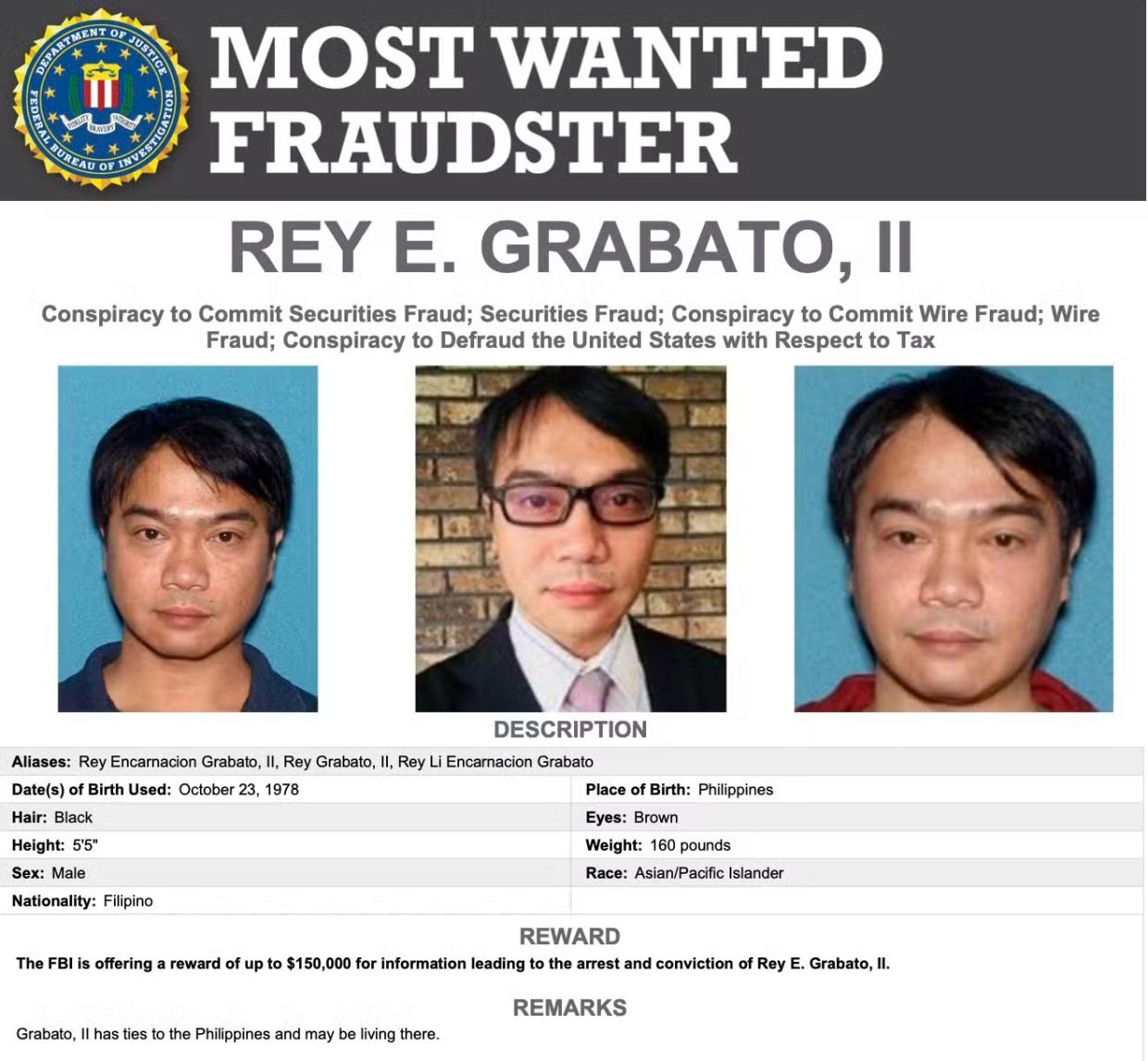
The Federal Bureau of Investigation has placed Rey E. Grabato II, the son of Mina Mayor Rey P. Grabato in Iloilo, on its Most Wanted Fraudsters list following accusations that he orchestrated a massive investment swindle affecting roughly 2,000 people and resulting in losses exceeding US$650 million. The bureau is offering a reward of up to US$150,000 for credible information leading to his apprehension and eventual conviction. Grabato, who previously served as president and controlling shareholder of National Realty Investment Advisors LLC, or NRIA, is being pursued for multiple federal charges including securities fraud, wire fraud, and conspiracy to defraud the United States through tax evasion mechanisms.
Grabato hails from a politically connected family in the Iloilo region. His father, Rey P. Grabato, currently holds the position of mayor in Mina, while his mother, Lydia Encarnacion Grabato, previously served as mayor of the same municipality. This provincial leadership background stands in striking contrast to the allegations of large-scale financial crime being investigated by American federal authorities, underscoring how transnational fraud networks can involve individuals with substantial domestic political connections and social standing.
The scheme at the heart of the charges operated between February 2018 and January 2022, with federal prosecutors characterizing it as a classic Ponzi operation. Working alongside Thomas Nicholas Salzano, Grabato allegedly convinced victims to channel money into the NRIA Partners Portfolio Fund I LLC, which was presented as a legitimate real estate investment vehicle. The marketing operation deployed an extensive playbook designed to reach potential investors, including thousands of targeted electronic communications, widespread television and radio spots, prominent billboard placements, and in-person presentations across multiple states. Hundreds of affected investors resided in New Jersey, though the scheme's reach extended throughout the country, reflecting the broad geographic scope of the fraud network's operations.
Central to the deception was a carefully crafted narrative about NRIA's financial health and investment performance. Potential investors received representations suggesting the company maintained robust financial stability and generated consistent, substantial returns. In reality, prosecutors contend, the operation generated minimal or virtually no legitimate profits whatsoever. Instead, it functioned through the textbook mechanism of a pyramid scheme, in which payments distributed to earlier investors derived exclusively from capital supplied by newly recruited participants. This classic redistribution model is sustainable only through continuous expansion, making the scheme's eventual collapse inevitable once recruitment slowed.
Beyond the primary investment fraud, Grabato and his associates stand accused of embezzling millions of dollars directly from investor contributions. Rather than channeling all collected funds into the stated investment activities, they allegedly diverted substantial sums for personal enrichment and other unauthorized purposes. This layer of misappropriation compounded the harm inflicted on victims, who not only received fraudulent investment returns but also learned their money had been systematically stolen by those managing their accounts.
Federal investigators also identified a separate fraudulent scheme involving deliberate obstruction of tax collection efforts. Between November 2007 and August 2022, Grabato allegedly participated in activities specifically designed to prevent the Internal Revenue Service from collecting approximately US$26 million in documented tax obligations owed to the federal government. This extended timeline suggests a pattern of systematic evasion spanning more than a decade, indicating sophisticated knowledge of how to evade tax authorities rather than simple non-compliance arising from oversight or financial hardship.
A federal arrest warrant for Grabato was issued on October 12, 2022, following formal charges filed in the US District Court for the District of New Jersey in Newark. At that time, authorities identified him as having residential connections to both Hoboken, New Jersey, and the Philippines, suggesting he maintained ties allowing potential movement between jurisdictions. Despite the issuance of the warrant, Grabato has remained at large, evading capture for an extended period. His co-conspirator Salzano was apprehended in October 2022, but Grabato's whereabouts have remained unknown to authorities.
The suspect has utilized multiple identity variations in an apparent effort to obscure his movements and complicate law enforcement tracking. Beyond his common name, Rey E. Grabato II, he has also employed the identities Rey Encarnacion Grabato II, Rey Grabato II, and Rey Li Encarnacion Grabato, according to FBI records. These name variations may reflect different documentation held across multiple countries or deliberate obfuscation tactics designed to fragment investigative trails and complicate financial record-keeping.
Grabato's inclusion on the FBI's Most Wanted Fraudsters list reflects an American law enforcement initiative launched in June 2026 to increase public awareness and generate leads regarding major fraud fugitives. This specialized designation differs from the bureau's broader Most Wanted list, targeting individuals whose crimes involve financial deception at significant scales. The creation of this distinct category acknowledges the growing scope and sophistication of modern fraud schemes, particularly those exploiting digital communication networks and interstate commerce mechanisms.
The presence of multiple individuals with Philippine backgrounds among the FBI's most wanted fraud fugitives underscores how transnational crime networks have expanded, with perpetrators leveraging connections across Pacific jurisdictions. Michael Lizaso Marasigan, a dual Filipino-American citizen with connections to Guam and the Philippines, was convicted in May 2025 on charges encompassing illegal gambling, money laundering, and wire fraud. Additionally, husband-and-wife team John Michael Dimitrion and Julieanne Baldueza Dimitrion, who operated a mortgage fraud scheme in Hawaii, entered guilty pleas in 2009 but absconded before sentencing in July 2010, remaining fugitives for over a decade.
For Malaysian and Southeast Asian readers, the Grabato case illustrates vulnerabilities within regional investment markets and the ease with which fraudsters can exploit international borders and regulatory gaps. The scheme's success in recruiting 2,000 victims across the United States demonstrates how sophisticated marketing and false credibility claims can overcome investor skepticism, even among relatively affluent individuals capable of making substantial investments. The extended timeline before law enforcement intervention highlights how financial crimes can operate openly for years before detection, particularly when perpetrators maintain international mobility and access to multiple jurisdictions.
The FBI continues to seek information regarding Grabato's location and movements. Individuals possessing credible leads are encouraged to contact their nearest FBI field office or the closest United States embassy or consulate within their country. The US$150,000 reward remains available for information resulting in arrest and conviction, providing potential financial incentive for those with direct knowledge of the fugitive's whereabouts or activities.

