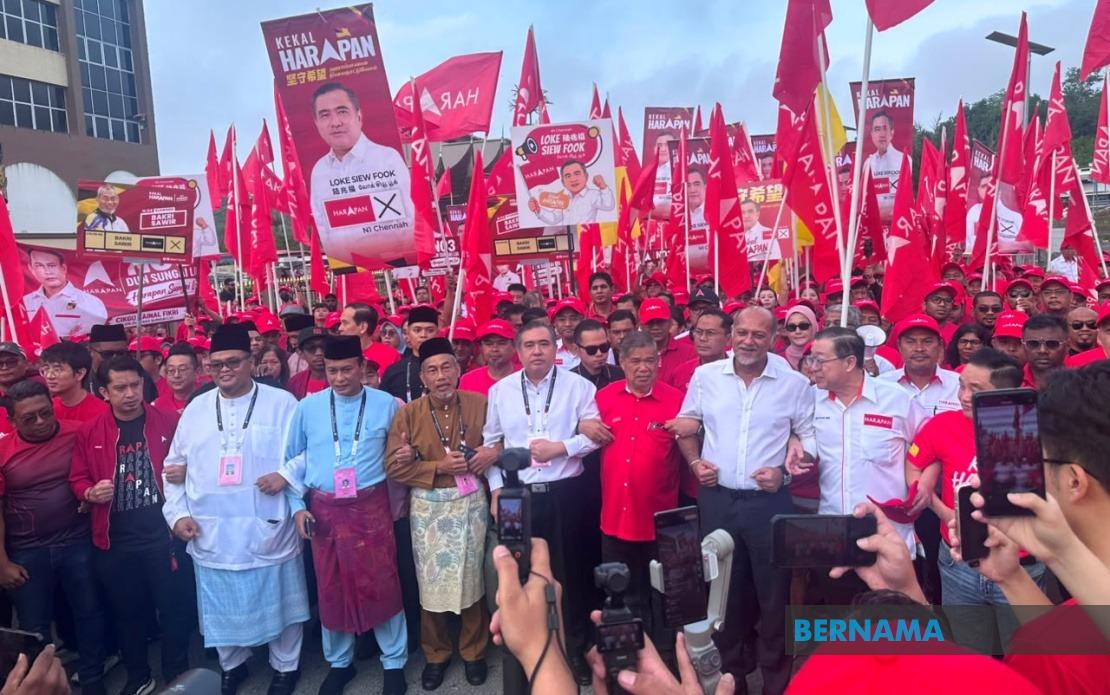
The Pakatan Harapan coalition deployed its senior hierarchy across Negeri Sembilan on July 18 as candidates formally submitted nomination papers for the 16th state election, a tactical show of strength that underscored the coalition's determination to retain control of Malaysia's smallest state. High-level turnout at multiple nomination centres throughout the day telegraphed PH's confidence heading into the August 1 polling, with party veterans and serving ministers personally escorting candidates through the administrative process.
In Jelebu, Transport Minister and DAP secretary-general Anthony Loke arrived at Dewan Besar Kuala Klawang at 8.30 am to lodge nomination papers for the Chennah state seat, his appearance flanked by an impressive roster of party firepower. DAP chairman Gobind Singh Deo, former Penang chief minister Lim Guan Eng, and Amanah president Datuk Seri Mohamad Sabu accompanied Loke, signalling that a seat held by a national-level party figure warranted top-tier protection. The concentration of party leadership at a single nomination centre reflected both the strategic importance of urban constituencies and the symbolic value of having cabinet-tier politicians actively campaigning from day one.
Across the state in Jempol, the momentum continued with Deputy Communications Minister Teo Nie Ching, who also chairs Wanita DAP, arriving at the district office to support Teo Kok Seong's nomination for the Bahau seat. Communications Minister Fahmi Fadzil subsequently appeared at the same centre, having travelled there to personally shepherd four additional PH candidates through the nomination process for the Serting, Palong, Jeram Padang and Bahau constituencies. Fahmi's presence alongside three newcomers—Yaacob Mahmood, Muhammad Zahin Zinal Abidin and Manivanan Gowin—alongside the Bahau incumbent suggested a calculated strategy of deploying ministerial credibility to validate fresh faces within the coalition's roster.
The Port Dickson nomination centre hosted Negeri Sembilan Menteri Besar Datuk Seri Aminuddin Harun, the state PH chairman defending the Linggi seat in his bid for re-election. Aminuddin's entourage included DAP deputy secretary-general Hannah Yeoh, PKR secretary-general Datuk Dr Fuziah Salleh, and the Prime Minister's political secretary Datuk Farhan Fauzi, reflecting the elevated stakes surrounding a chief minister's personal electoral contest. Three incumbent state assemblymen—Yew Boon Lye (Chuah), Choo Ken Hwa (Lukut), and Dr G Rajassekaran (Sri Tanjung)—similarly filed their nomination papers at the same venue, indicating coordinated logistics that ensured maximum party visibility during the nomination window.
Entrepreneur and Cooperatives Development Minister Steven Sim marshalled six PH candidates at Wisma Majlis Bandaraya Seremban, accompanied by Selangor State Legislative Assembly Speaker Lau Weng San, Bukit Gelugor MP Ramkarpal Singh, and PKR vice-president Datuk Seri R. Ramanan. This distribution of ministerial and parliamentary figures across multiple nomination centres suggested that PH had strategically distributed its top talent to amplify candidate profiles and demonstrate institutional reach into every contested district. The presence of federal and state legislators signalled that Negeri Sembilan remained central to the coalition's broader political calculations, despite its modest size within Malaysia's electoral landscape.
The organisational discipline displayed across nomination day reflected lessons learned from PH's fraught 2023 state election campaign in Negeri Sembilan, when the coalition retained just 17 of the assembly's 36 seats against Barisan Nasional's 14 and Perikatan Nasional's five. That narrow margin—merely two seats above half the chamber—left minimal room for defections or unexpected losses and heightened the pressure to defend every existing constituency while challenging marginal opposition seats. The lavish deployment of national-tier figures throughout the nomination process signalled that the coalition intended to reverse the erosion of its earlier supermajorities, treating the 2024 contest as a referendum on PH governance rather than a routine mid-term electoral refresh.
The timing of the Negeri Sembilan dissolution itself carried significant political weight. Following Yang Dipertuan Besar Tuanku Muhriz Tuanku Munawir's dissolution of the state assembly on June 5, the coalition faced a compressed campaign window to consolidate its base and recover ground lost to opposition parties over the preceding year. The early voting on July 28, followed by the main poll on August 1, compressed the campaign season into a fortnight—an interval in which high-profile party solidarity and visible leadership backing became essential tools for rallying grassroots support and reassuring supporters that central party leadership remained invested in state-level contests.
The spectacle of ministerial motorcades and top-tier party officials processing through nomination centres held subtle messaging value beyond mere logistics. Voters observing or hearing reports of cabinet ministers and national party leaders accompanying local candidates received the subliminal signal that Negeri Sembilan mattered to federal PH leadership, that the state was not being taken for granted as a peripheral electoral domain. For opposition parties watching from the sidelines, the coordination demonstrated that PH retained the organisational discipline and resource concentration to mount integrated campaigns, even in smaller states where historical patterns might suggest complacency.
For Malaysian observers tracking PH's post-2022 trajectory, the Negeri Sembilan nomination day offered a window into coalition discipline and confidence levels. The absence of internal recriminations or publicised tensions over candidate selection, combined with the seamless choreography of senior figures across multiple venues, suggested that constituent parties within PH had negotiated seat allocations without acrimony. This contrasted sharply with past campaigns where internal disputes over nominations had rippled through campaign messaging and voter perception. The 2024 Negeri Sembilan exercise thus served as a case study in coalition cohesion—a valuable metric as PH contemplated navigating Malaysia's demanding electoral calendar toward a potential federal general election within the next twelve months.
Beyond immediate state-level implications, the concentration of federal ministerial firepower in Negeri Sembilan underscored PH's broader vulnerability in state-level contests. While the coalition commands a comfortable federal parliamentary supermajority following the 2022 general election, its state-level performance remains uneven across the federation. Negeri Sembilan represents a state where PH cannot afford complacency or internal fragmentation, making the visible commitment from Lim Guan Eng, Fahmi Fadzil, Anthony Loke and other national figures a calculated investment in retaining what remains a strategically important foothold within peninsular Malaysia's power structure.

