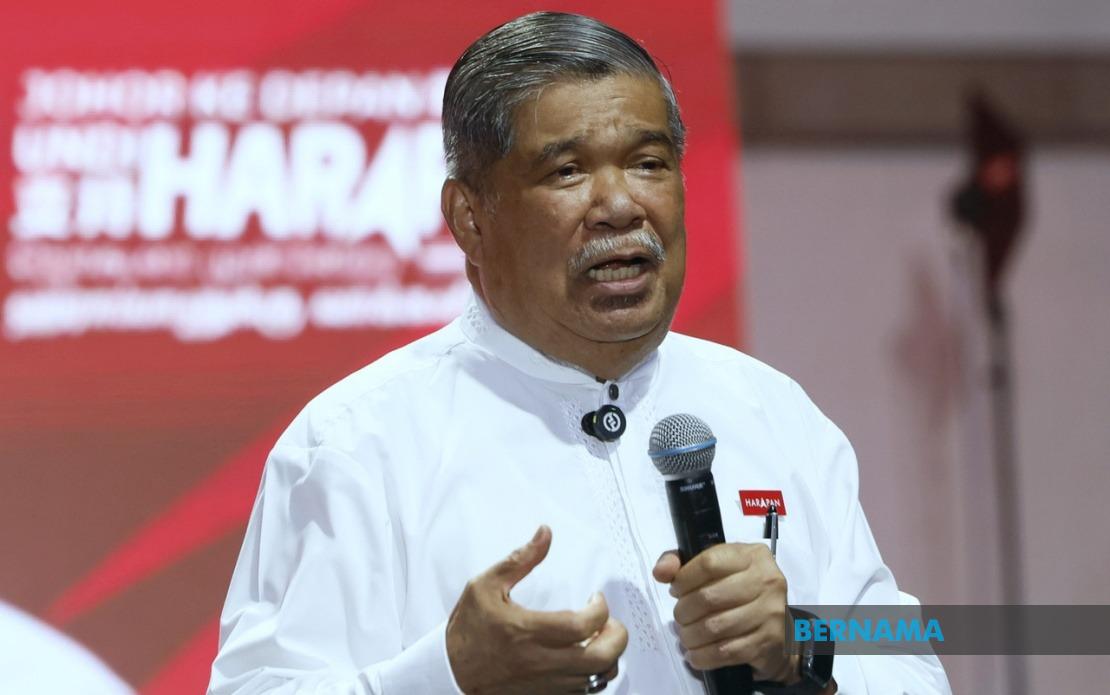
Pakatan Harapan's campaign machinery remains undeterred by Parti Islam SeMalaysia's recent instruction to its supporters to vote for Barisan Nasional candidates in seats where PAS is not running, according to Amanah president Datuk Seri Mohamad Sabu. Speaking after a PH rally in Permas Jaya on July 1, Mohamad rejected suggestions that the directive posed any threat to the opposition coalition's electoral prospects in the Johor state election scheduled for July 11. The PH leadership instead characterised the move as yet another tactical manoeuvre among competing political strategies, one that would not distract the coalition from its planned campaign activities.
Mohamad, who holds the ministerial portfolio for Agriculture and Food Security at the federal level, emphasised that PH would not allow itself to be provoked or sidelined by opposition tactics. The coalition intends to press ahead with its scheduled campaigning without modification, projecting confidence in its organisational capacity and voter appeal. This stance reflects PH's broader strategic calculation that its core message and grassroots mobilisation efforts remain sufficiently robust to withstand competing political narratives and cross-party manoeuvring.
Central to PH's appeal, Mohamad argued, is the coalition's emphasis on multiracial and multi-religious political cooperation. He framed this inclusive approach not merely as a political virtue but as a foundational requirement for sustainable political stability and economic progress. The implication is that such collaborative governance structures create the institutional conditions necessary for long-term development planning and investor confidence. By positioning its internal diversity as a strategic asset rather than a liability, PH seeks to contrast its model with alternatives that may rely more heavily on communal or sectarian appeals.
Mohamad urged Johor voters to resist appeals based on racial or religious sentiment, instead directing them to evaluate candidates on the basis of competence, service record, and commitment to justice. This framing attempts to shift the electoral calculus away from identity-based voting patterns toward performance-based assessment. Such messaging has become increasingly important as Malaysian elections increasingly witness cross-communal coalition-building and the mobilisation of swing voters concerned with governance quality rather than communal representation.
A key argument advanced by PH concerns administrative alignment between state and federal governments. Party leaders contend that when the state administration shares the same political colour as Putrajaya, development projects can be accelerated through streamlined coordination and unified policy implementation. In the Johor context, this alignment would ostensibly unlock strategic infrastructure initiatives including public transport system overhaul, improvements to facilities at international border crossings, and initiatives to attract manufacturing and services investment to the state.
DAP strategic director Liew Chin Tong, who also serves as Deputy Finance Minister, shifted focus toward a critical demographic variable: youth voter turnout. Liew's analysis of the previous Johor state election in 2022 identified low electoral participation, particularly among younger voters, as a factor that benefited BN. He highlighted the specific circumstance that many Johor residents employed in Singapore were unable to return for voting due to pandemic-related travel restrictions, reducing the Opposition's traditional voting base. This observation carries implications for how campaigns target different age cohorts and the logistical challenges that affect electoral outcomes beyond messaging alone.
Liew advocated for the second campaign phase to transcend purely partisan rivalry in favour of substantive policy discourse. He contended that voter engagement should centre on specific proposals capable of improving living standards and economic opportunity. This rhetorical shift attempts to reframe the election not as a zero-sum competition between coalitions but as a referendum on which government can better address concrete governance challenges.
Key policy priorities identified by Liew include employment creation, particularly high-quality jobs offering competitive compensation that would retain young Johoreans within the state rather than driving them toward Singapore employment opportunities. This framing addresses a structural challenge facing Johor: the outflow of skilled labour to neighbouring Singapore creates economic leakage and contributes to demographic challenges. By promising improved job prospects, PH appeals directly to economic anxiety among younger voters seeking advancement within Malaysia.
Additional policy areas highlighted encompass public transport infrastructure, flood management and drainage system maintenance, preparations for an ageing demographic profile, and childcare service provision. This expansive policy agenda reflects recognition that electoral competitiveness increasingly depends on demonstrating capacity across multiple governance domains rather than concentrating on narrow sectoral interests. Each policy area carries particular salience for specific voter segments: flood management speaks to Johor voters in vulnerable areas, transport infrastructure addresses commuter concerns, while ageing population policy resonates with older voters and adult children managing elderly parent care.
Liew emphasised that successful policy implementation requires sustained cooperation between federal and state governments, particularly for large-scale development initiatives. The Johor-Singapore Special Economic Zone (JS-SEZ) exemplifies the type of cross-border, multi-stakeholder project that demands political alignment and institutional coordination at multiple governance levels. PH's argument is that only alignment between state and federal administrations can unlock such strategic economic zones, thereby expanding employment prospects and attracting foreign investment.
With both Pakatan Harapan and Barisan Nasional contesting all 56 state assembly seats, the election presents a zero-sum competitive environment where neither coalition can rely on uncontested seats. Early voting is scheduled for July 7, with the main polling day on July 11. The contest carries significance beyond Johor itself, as state-level electoral outcomes increasingly influence national political dynamics and coalition negotiations.
The divergence between PAS's directive to support BN in non-contested seats and PH's integrated campaign strategy reveals ongoing tensions within Malaysia's political landscape. These tensions pit strategies based on communal interest aggregation against appeals premised on developmental governance and cross-communal cooperation. For Malaysian and Southeast Asian observers, the Johor election provides a test case for whether performance-based electoral messaging can successfully compete against communal mobilisation tactics in a context characterised by deep historical grievances and ongoing communal consciousness among electorates.

