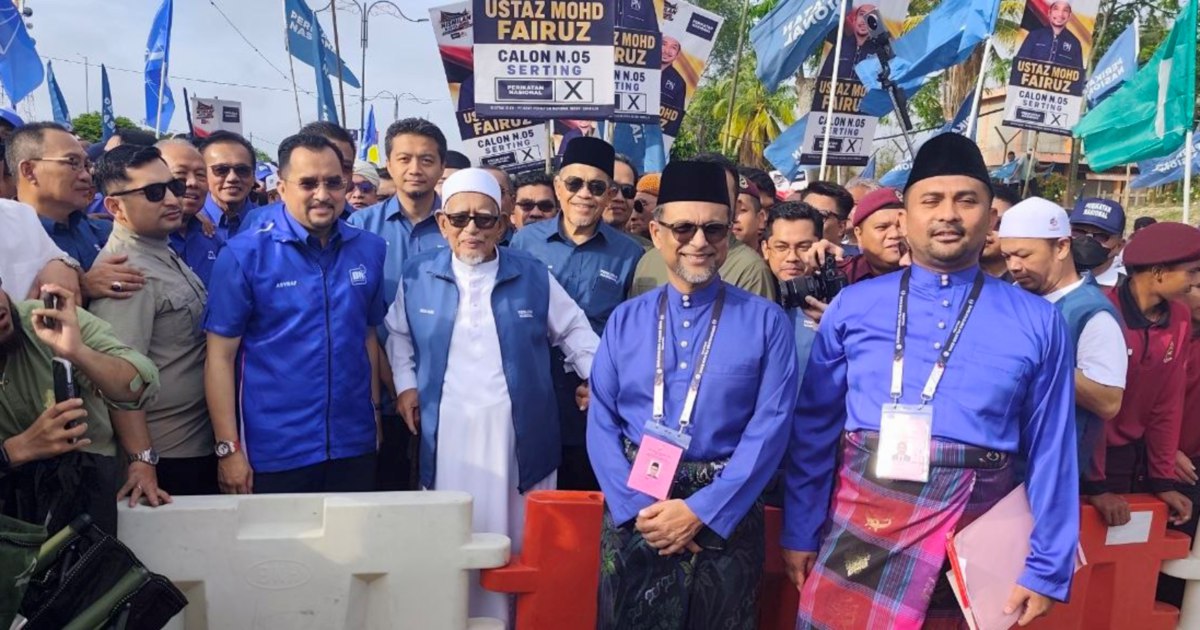
The Perikatan Nasional coalition has committed to backing Barisan Nasional's election campaign in Negri Sembilan, a move that signals deepening coordination between Malaysia's major political blocs ahead of the state polls. Tan Sri Abdul Hadi Awang, president of PAS and a key figure in PN's leadership, made the announcement at an event in Jempol, underlining the willingness of both coalitions to pool resources and support during the crucial electoral battle for control of the state assembly.
This development carries significant implications for Malaysian politics, particularly as Negri Sembilan holds strategic importance in the broader landscape of coalition dynamics. The state has traditionally been a BN stronghold, but the commitment of additional campaign support from PN suggests that both coalitions are treating the election with considerable seriousness. Such cooperation reflects the complex web of political alliances that have evolved since the 2018 general election fundamentally reshaped Malaysia's political terrain, forcing traditional rivals into unprecedented working relationships.
The pledge of PN assistance represents a tangible manifestation of the ongoing political realignment at the national level. Rather than viewing state elections as opportunities to challenge incumbent coalitions, PN has opted for a collaborative approach with BN in Negri Sembilan, demonstrating the pragmatic calculations that now dominate Malaysian politics. This cooperation contrasts sharply with the confrontational dynamics that characterised electoral contests before the pandemic and the subsequent political upheavals that followed the collapse of the Pakatan Harapan government.
For BN, securing PN support in campaign activities provides a substantial electoral advantage. The combined mobilisation machinery of both coalitions can reach significantly larger segments of the voting population, coordinate messaging more effectively, and concentrate their organisational resources where they matter most. In states where electoral margins are traditionally narrow, such coordinated efforts can prove decisive. The assistance from PN essentially grants BN access to an expanded network of party activists, media capabilities, and grassroots organisational strength.
Within the context of Negri Sembilan specifically, the state has a population that is geographically dispersed across nine districts, requiring intensive campaign efforts to reach voters effectively. Urban areas like Seremban and Petaling Jaya present different electoral challenges compared to rural constituencies, where traditional community networks and informal influence channels remain potent factors in voter mobilisation. The combined resources of both BN and PN can address these diverse electoral environments more comprehensively than either coalition operating independently.
The timing of this announcement also warrants attention, as state elections serve as important barometers for national political sentiment. Negri Sembilan's electoral outcome will likely be interpreted as a referendum on the competence and effectiveness of the BN-led state government, but also on the viability of the broader national political arrangement that has bound PN and BN together in varying capacities. A strong performance by BN in Negri Sembilan would vindicate the coalition's governance record and suggest that voters remain confident in its stewardship of the state's affairs.
The collaboration underscores how Malaysian politics has become increasingly about managing complex coalition arrangements rather than pursuing polarised ideological contests. PAS, as part of PN, has positioned itself as a serious participant in governance at both state and national levels, willing to subordinate its own political ambitions in certain contexts to ensure broader coalition success. This approach differs markedly from the party's historical practice of using state elections to expand its own representation and influence within coalitions.
Such cooperation also reflects the electoral mathematics of contemporary Malaysian politics, where no single coalition commands overwhelming majorities across all states. States like Negri Sembilan thus become important prizes in the broader competition for control of parliament and the ability to influence national direction. A loss in any significant state would weaken BN's position nationally, potentially embolening opposition forces and creating perceptions of electoral momentum shifting away from the government.
For ordinary Negri Sembilan voters, this coordinated campaign effort will likely translate into visible increases in campaign activities during the election period. They can expect more joint rallies, unified messaging on policy platforms, and concentrated deployment of campaign resources across constituencies. The enhanced campaign presence may shape voter perceptions of the respective coalitions' commitment to the state and their confidence in victory, potentially influencing turnout and electoral behaviour.
Looking ahead, the outcome of the Negri Sembilan election will provide crucial insights into the durability of the PN-BN relationship and the extent to which such cooperation can be sustained across multiple electoral contests. Should the joint campaign prove successful, it may establish a template for cooperation in other state elections and reinforce the stability of Malaysia's current political arrangement. Conversely, any electoral setback could prompt both coalitions to reassess their collaborative approach and revert to more competitive postures.
The commitment of PN campaign support also demonstrates how state elections in Malaysia have evolved beyond purely local significance into events with national ramifications. Negri Sembilan's political future will be shaped not merely by the state's own developmental needs and voter preferences, but by the intricate calculations of national coalitions maneuvering for strategic advantage. This reality reflects the centralisation of Malaysian politics around a handful of major political formations engaged in constant tactical repositioning to maintain and expand their influence across the federation's diverse political landscape.

