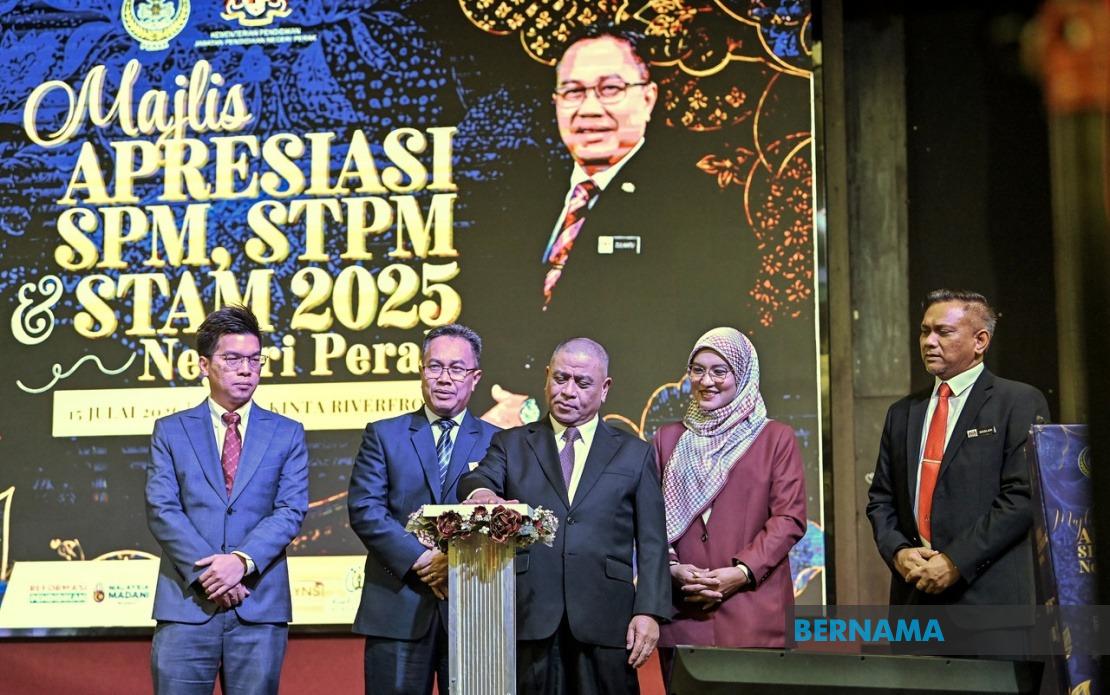
Perak's educational support ecosystem has deepened its reach into financially vulnerable households, with the state government's Menteri Besar Scholarship emerging as a crucial intervention that simultaneously addresses poverty-related barriers to learning and catalyses measurable improvements in student achievement. At a state-level recognition ceremony held in Ipoh on July 15, scholarship recipients and education officials underscored how monthly allocations ranging from RM1,000 to RM1,200 function as far more than symbolic gestures—they represent structural support that permits talented students to focus on academics rather than household economics.
Yoong Lam, a 20-year-old recipient from Sekolah Menengah Kebangsaan Sultan Yussuff, exemplifies the scholarship's dual impact. With an exceptional Sijil Tinggi Persekolahan Malaysia (STPM) Overall Grade Point Average of 4.00, she has leveraged her semester allocation to cover examination fees, acquire essential textbooks, and access supplementary tuition—inputs that directly reinforce academic progression. As the eldest of two children in a self-employed household, Yoong Lam's award simultaneously lifts pressure from her father's income, redirecting parental resources toward younger siblings or household stability rather than tertiary education financing. Her articulation that the scholarship "reduces the burden on parents" reflects a recognition that educational mobility remains structurally constrained by household income in Malaysia's competitive academic environment.
The scholarship's relevance extends across religious educational pathways, indicating Perak's deliberate effort to distribute support equitably across institutional types. Muhammad Haziq Hafit, 19, received RM1,000 upon completing the Sijil Tinggi Agama Malaysia (STAM) at Al-Ulum Al-Syar'Iyyah Religious Secondary School in Bagan Datuk. His stated intention to pursue teacher training at the University of Malaya demonstrates how financial scaffolding at critical junctures—between secondary completion and university entry—shapes career aspirations. Similarly, Muhammad Taufiq Ikwan Mohammad Asri, also 19, framed the identical allocation as enabling his transition toward further study in Egypt, acknowledging that whilst RM1,000 remains modest relative to some scholarship schemes, its targeting toward middle-income families fills a genuine niche in Malaysia's fragmented financial aid landscape.
Perak's educational performance metrics suggest that the scholarship apparatus operates within a broader quality-improvement ecosystem. The state achieved a Grade Point Average of 4.49 for the 2025 Sijil Pelajaran Malaysia (SPM) examination—the highest mark recorded across thirteen years—extending an upward trajectory sustained over three consecutive assessment cycles. This statistical elevation acquired significance partly because it narrowed achievement disparities between urban and rural candidates to merely 0.04 points, signalling that geographical disadvantage, historically a persistent friction point in Malaysian education, has become partially mitigated through targeted intervention. Such convergence speaks to systemic commitment beyond individual scholarships.
The Tuisyen Cikgu Saarani (TCS) Programme represents the strategic architecture underlying these outcomes. Operating as a coordinated initiative between Yayasan Perak and the state's Education Department, it identified supplementary reference materials as a lever for improving mastery of core subjects, particularly among students judged as having genuine potential for examination success but lacking sufficient preparation intensity. The initiative distributed 63,567 copies of custom-designed study guides to daily school students across Perak, targeting nearly 25,000 candidates for the 2026 SPM cycle. Importantly, its expansion to tahfiz schools and religious schools in 2025 broadened its footprint beyond conventional secondary institutions, addressing an underserved cohort.
Perak Education Director Zulkafli Mohamed Mokhtar explained that these reference materials were deliberately authored by experienced educators based on empirical assessment of student needs within Perak's specific demographic context. Rather than distributing generic national resources, the state invested in locally responsive learning materials emphasising conceptual mastery and examination technique—pedagogical priorities identified through direct engagement with schools. This granular approach recognises that standardised interventions frequently miss localised learning gaps, particularly across rural schools where teacher specialisation remains constrained. The partnership between Perak Islamic Religious Department (JAIPk) in extending the programme to religious schools further illustrates institutional coordination that Malaysia's federalised education system sometimes struggles to achieve.
Menteri Besar Datuk Seri Saarani Mohamad's framing of these achievements as validation of "continuous efforts in strengthening education quality" positioned the scholarships and reference materials within a broader development narrative. The emphasis on balancing achievement opportunity throughout the state—not merely urban centres—reflects mounting awareness that regional disparities in educational outcomes translate into geographic inequality in labour market access and income potential. As Malaysia competes for higher-value economic functions, talent development becomes increasingly difficult to sequester within privileged postcodes without incurring broader competitiveness costs.
The implications for Southeast Asian education policy remain instructive. Whilst many regional governments prioritise tertiary institution expansion, Perak's focus on financial scaffolding during secondary completion and reference material quality improvement addresses earlier intervention points—periods when learning foundations are still malleable and when financial stress most acutely threatens continuation. Malaysian states considering educational equity should examine whether their scholarship targeting sufficiently prioritises the middle-income category that Taufiq Ikwan identified as frequently overlooked between poverty-focused assistance and elite merit schemes. The programme's expansion across school types similarly suggests that religious schools, tahfiz institutions, and vocational pathways merit equivalent resource distribution to conventional secondary tracks.
Scholarship recipients' consistent messaging about reduced parental financial stress illuminates an often-underappreciated function of targeted aid: it functions not merely as personal enrichment but as household stabilisation. For self-employed or wage-earning parents, predictable education costs become plannable rather than crisis-inducing, potentially improving family economic decision-making across multiple domains. This stabilisation effect merits serious consideration in cost-benefit analyses of scholarship programmes, which frequently focus only on recipient academic trajectories.
The ceremonial recognition of scholarship recipients by Menteri Besar Saarani, Education Department leadership, and foundation officials underscores political investment in these programmes as achievements worth public celebration. In Malaysian governance contexts where education competes for resources against infrastructure, healthcare, and subsidies, such high-level visibility matters for programme sustainability across electoral cycles. Scholarship recipients themselves become ambassadors for continued state investment, and their articulated plans for higher study and professional contribution validate public expenditure as developmental rather than consumptive.
Looking forward, Perak's approach suggests that educational equity in Malaysia cannot rely solely on individual scholarships without accompanying investments in learning quality, reference material customisation, and institutional coordination. The convergence of financial support, targeted pedagogical resources, and performance monitoring has produced measurable results—not merely in recipient career trajectories but in state-wide examination outcomes that compress historically stubborn urban-rural gaps. Other Malaysian states grappling with educational disparities might profitably examine whether their interventions combine these three elements with equivalent rigour, or whether they remain fragmentary in ways that limit systemic impact.

