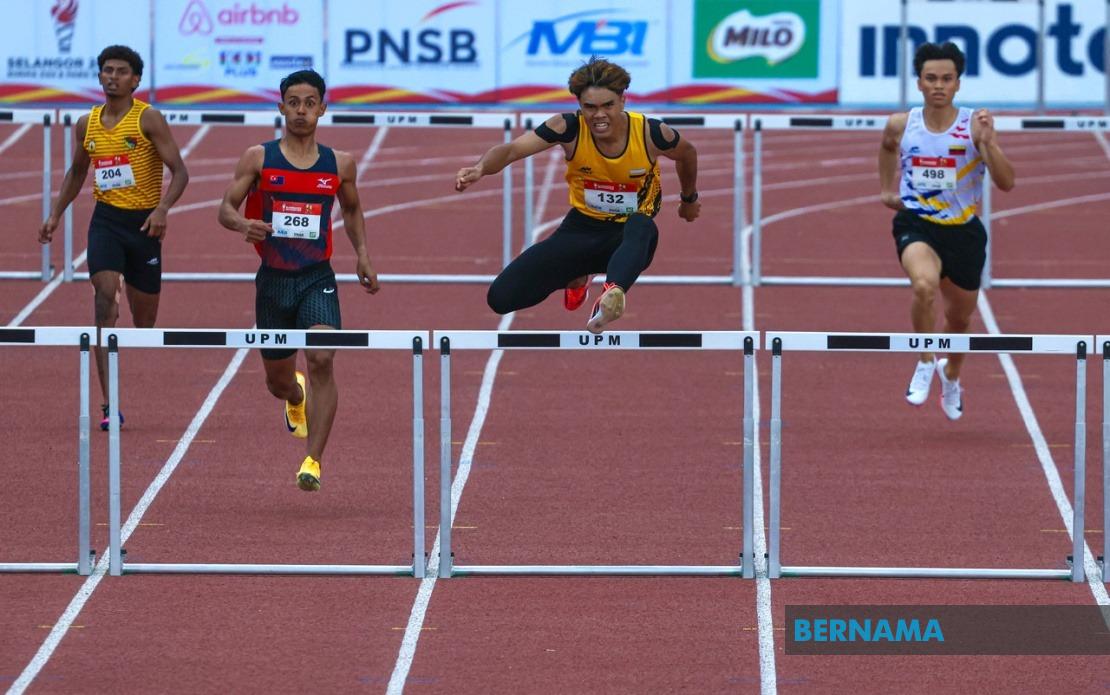
Muhammad Adib Irfan has handed Perak its maiden athletics gold medal at the SUKMA 2026 Games after claiming victory in the men's 400-meter hurdles competition held at Universiti Putra Malaysia Stadium in Serdang. The 20-year-old sprinter demonstrated impressive form throughout the race, crossing the finish line in 52 seconds—a new personal best that underscores his rapid development as one of the emerging talents in Malaysian athletics. His commanding performance on the track represents a significant milestone not only for his individual career but also as the launching point for Perak's track and field medal haul at this year's Games.
The gap between Adib Irfan and his nearest challenger proved decisive, with Johor's Muhammad Danish Nabil Kamarudin securing the silver medal despite trailing by just 0.625 seconds. Terengganu's Shazril Ashraff Shamsurbahry rounded out the podium with a bronze-medal finish in a time of 52.8 seconds. The competitive nature of the men's 400-meter hurdles underscores the quality of middle-distance sprinting talent across Malaysia's states, with several athletes demonstrating the technical capability required for this demanding event that combines speed with the precise coordination needed to clear ten hurdles along the 400-meter track.
In comments to media following his victory, Adib Irfan expressed gratitude for achieving his competitive objective, attributing success to his systematic preparation and mental focus leading into the race. The young athlete's achievement represents validation of the coaching methods employed by his support team, who have guided his progression through the ranks of Malaysian athletics over the past several years. His willingness to credit those around him reflects the collaborative nature of athletic development, particularly within university-based sports programs that combine academic pursuits with elite training.
Adib Irfan currently studies sports science and coaching at Universiti Pendidikan Sultan Idris, an institution with a strong track record of developing athletic talent across multiple disciplines. His academic background positions him advantageously for a potential future in sports education or coaching, should he choose to transition from competitive athletics. The combination of practical competition experience and theoretical knowledge acquired through university coursework provides a solid foundation for sustained involvement in Malaysian athletics beyond his own competitive years.
The pathway that led Adib Irfan to specialise in the 400-meter hurdles reveals an important dimension of talent development within Malaysian schools and universities. The athlete initially pursued football, a sport that offers greater mass participation and visibility at grassroots level. However, his coaches recognised physical attributes and movement patterns that suggested superior potential in track athletics. This identification process—coaches spotting latent talent and redirecting athletes toward disciplines where they can maximise their capabilities—remains critical for ensuring Malaysian sports does not lose talented individuals to less suitable sporting pathways.
Personal motivation from his mother also influenced Adib Irfan's decision to transition from football to athletics. The athlete acknowledges that team-oriented sports presented inherent limitations, as individual performance could be negated by collective underperformance. Athletics, by contrast, places success and failure directly within the individual's sphere of control, a philosophical distinction that resonates with many competitors who prefer personal accountability over team dynamics. This perspective reflects broader patterns in how Southeast Asian athletes evaluate career choices within sport.
Femininity in the hurdles events was also prominently featured at SUKMA 2026, with Kelantan's Fatin Mashira Mohd Fadzil establishing herself as a standout performer across multiple sprinting events. Mashira secured her second gold medal by winning the women's 400-meter hurdles in a time of 1 minute 2.08 seconds, adding to her earlier triumph in the 100-meter hurdles. Her back-to-back medals demonstrate the consistency required to perform at elite level across different distances, particularly when technical demands increase significantly in events requiring hurdle negotiation at varying stages of fatigue.
The women's 400-meter hurdles saw strong competition throughout the field, with Terengganu's Nur Farisha Ardeana Ardy Abdullah claiming the silver medal in 1 minute 2.44 seconds, just 0.36 seconds behind the champion. Kedah's Siti Rokiah Hashim completed the podium with a bronze-medal performance, clocking 1 minute 4.89 seconds. The relatively tight margins at the top of the women's field mirror patterns evident in the men's competition, suggesting that Malaysian female hurdlers are operating at increasingly competitive levels that approach regional benchmarks.
Fatin Mashira's double-gold achievement at SUKMA 2026 positions Kelantan as a significant force within Malaysian athletics during these Games. Two medals from the same athlete across adjacent track events indicates both depth of training and individual excellence. For smaller states seeking to maximise their medal returns from athletics, identifying and developing athletes capable of competing successfully across multiple events becomes strategically important. Multi-event performers reduce reliance on breadth of talent within a state's contingent and allow concentrated resources to support athletes most likely to deliver medal success.
The success of both Adib Irfan and Fatin Mashira in the hurdles events reflects ongoing investment in technical coaching within Malaysian athletics. The 400-meter hurdles and 100-meter hurdles remain technically demanding events requiring specialised instruction in biomechanics, hurdle approach, stride patterns, and injury prevention. Universities and state athletic associations that provide access to qualified technical coaches appear best positioned to develop champions within these disciplines. The performances on display at SUKMA 2026 suggest that Malaysia's hurdles coaching infrastructure has matured sufficiently to produce internationally competitive performers.
For Malaysian athletics enthusiasts monitoring progress in track and field at these Games, the emergence of quality performers in the hurdles events signals positive trends for national team development. These athletes represent potential representatives for Malaysia at regional championships and continental competitions. The combination of personal bests, competitive margins, and technical proficiency suggests that Malaysian middle-distance sprinters are building toward stronger performances that could enhance the nation's standing within Asian athletics over the coming years.

