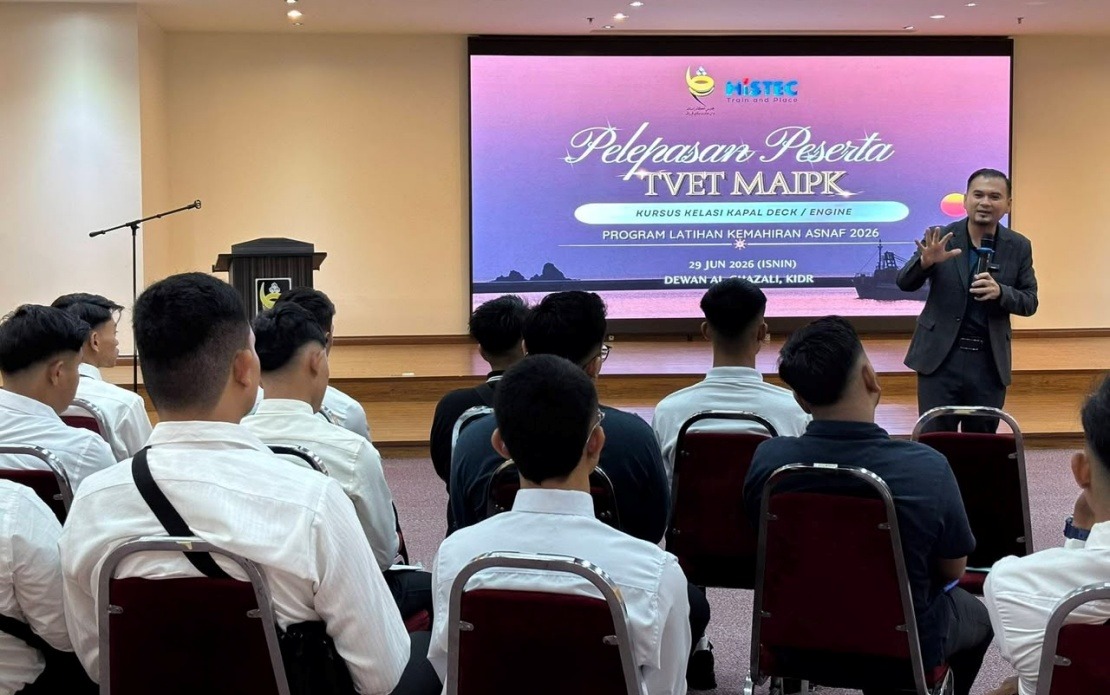
The Perak Islamic Religious and Malay Customs Council (MAIPk) is channelling substantial resources toward maritime workforce development, committing RM470,000 to equip 25 disadvantaged youth with professional seafaring credentials. This financial injection represents a strategic pivot toward technical vocational education as a poverty-alleviation mechanism, addressing both industry labour shortages and community development imperatives in Malaysia's growing maritime sector.
The sponsorship scheme, set at RM18,800 per trainee, reflects MAIPk's assessment that accessible pathways into skilled trades can fundamentally alter life trajectories for asnaf populations—those recognised as economically vulnerable under Islamic social welfare frameworks. Rather than conventional welfare transfers, the council is facilitating genuine employability through structured professional credentials, a distinction that underscores evolving approaches to Islamic social responsibility across Malaysian state institutions.
Participants will complete an intensive three-month curriculum at the Ranaco Education and Training Institute in Chukai, Terengganu, combining classroom instruction with hands-on maritime operations training. The programme encompasses dual pathways: deck crew and engine crew certifications, reflecting the technical specialisation required in commercial shipping. Importantly, completion delivers a seaman's licence—a regulated credential essential for employment on vessels operating under international maritime law, signalling that this is not generic vocational training but sector-specific professional qualification.
For Perak and the broader Malaysian maritime economy, this initiative addresses persistent skills gaps. The shipping and port sectors have long reported difficulty recruiting and retaining competent crew, particularly in engine-room positions where technical knowledge commands premium wages. By creating a pipeline of certified professionals from disadvantaged backgrounds, MAIPk effectively expands the domestic talent pool while simultaneously offering life-changing economic mobility—deck and engine crew positions typically command salaries substantially above Malaysia's median wage.
The employment placement guarantee represents a critical differentiator from many TVET programmes. Rather than leaving graduates to navigate uncertain job markets, MAIPk has pre-arranged maritime industry placements, mitigating the risk that training investments fail to convert into sustainable livelihoods. This embedded employment pathway transforms the scheme from educational subsidy into genuine economic activation, where financial input directly correlates with tangible career outcomes and income generation.
The council's framing of TVET as a "catalyst for socio-economic transformation" reveals institutional recognition that asnaf communities face systemic barriers beyond capital scarcity—including limited awareness of vocational alternatives, restricted access to training networks, and employer hesitation toward unconventional recruitment. By absorbing direct training costs and guaranteeing placement, MAIPk removes these friction points, enabling qualified candidates to compete on merit rather than starting from disadvantage.
The send-off ceremony at Kompleks Islam Darul Ridzuan, officiated by MAIPk's Asnaf Empowerment Division General Manager Amirudin Osman, signals institutional commitment to transparency and community witness. Such public endorsement reinforces that maritime careers are legitimate pathways to prosperity—a cultural messaging function as valuable as the financial investment, particularly in communities where vocational work has historically carried lower social prestige than white-collar alternatives.
This initiative arrives amid broader Southeast Asian focus on maritime skills development. Singapore and South Korea have invested heavily in seafarer training, recognising that crew quality directly impacts vessel safety, operational efficiency, and competitiveness in global shipping markets. Malaysia's maritime sector—encompassing ports at Port Klang, Johor Port, and Penang Port, plus offshore oil and gas operations—requires sustained crew supply. MAIPk's sponsorship model suggests that Islamic-aligned institutional actors can address structural labour gaps while advancing equity objectives.
The three-month intensive format balances cost-efficiency with comprehensive competency development. Industry standards typically require extended practicum periods; compressing this into a focused programme demands high instructional quality and motivated participants. The selection of Ranaco Education and Training Institute indicates MAIPk's confidence in that facility's capacity to deliver internationally recognised maritime certifications within an accelerated timeline.
For wider Malaysia, this spending pattern reflects how state Islamic councils are evolving beyond traditional religious administrative functions toward active economic development roles. MAIPk's allocation demonstrates that zakat-funded institutions and Islamic social welfare bodies increasingly deploy resources strategically—not merely distributing aid, but engineering structural economic transitions for vulnerable populations.
Looking forward, the success of this cohort will likely inform whether MAIPk expands the programme beyond the initial 25 participants. If employment outcomes and wage trajectories validate the model, replication across other Perak districts and potentially other states could create a meaningful alternative pathway for youth currently disconnected from formal education. The scheme's transparency and measurable outputs—completion rates, employment placement rates, earnings trajectories—provide benchmarks for assessing whether institutional investment in specialised TVET genuinely transforms asnaf economic circumstances or merely subsidises training without lasting impact.

