The Perak state government has greenlit a RM500,000 expenditure to construct a permanent concrete bridge in Kampung Ulu Geruntum, Gopeng, restoring critical connectivity to the rural settlement after a catastrophic water surge destroyed its primary crossing on June 19. The decision represents a significant commitment to rehabilitating an isolated community left cut off and economically paralysed by the incident, signalling state authorities' determination to prevent prolonged hardship among affected residents.
Sandrea Ng Shy Ching, the State Housing and Local Government Committee chairman and Teja assemblyman, disclosed the allocation while emphasising the urgency of completing remedial groundwork before main construction begins. Her public acknowledgment of the multi-agency relief operation underscores the complexity of restoring access to remote settlements vulnerable to natural disasters—a perennial challenge across Peninsular Malaysia's hilly interior regions where monsoon-driven flooding and unexpected water surges pose ongoing infrastructure threats.
The bridge collapse triggered a humanitarian crisis that forced more than 50 residents to seek temporary refuge at the Gopeng Town Hall relief centre on June 19, stranding families and severing essential supply routes. The destruction of the main crossing meant residents faced severe mobility restrictions, hindering access to schools, medical facilities, markets, and employment opportunities in surrounding towns. Such isolation, even temporary, inflicts measurable economic and social damage on vulnerable rural populations dependent on stable infrastructure for livelihood continuity.
Recognising the immediacy of the access problem, Sandrea drew upon her constituency allocation to provide RM45,000 for repairing damaged water pipes and restoring the disrupted supply system. This parallel intervention addresses not merely the bridge crisis but the cascading infrastructure failures triggered by the water surge—a reminder that disaster recovery in rural areas requires coordinated, multi-sector responses rather than siloed fixes. Water supply disruption compounds existing vulnerabilities in underserved communities already operating with limited redundancy in essential services.
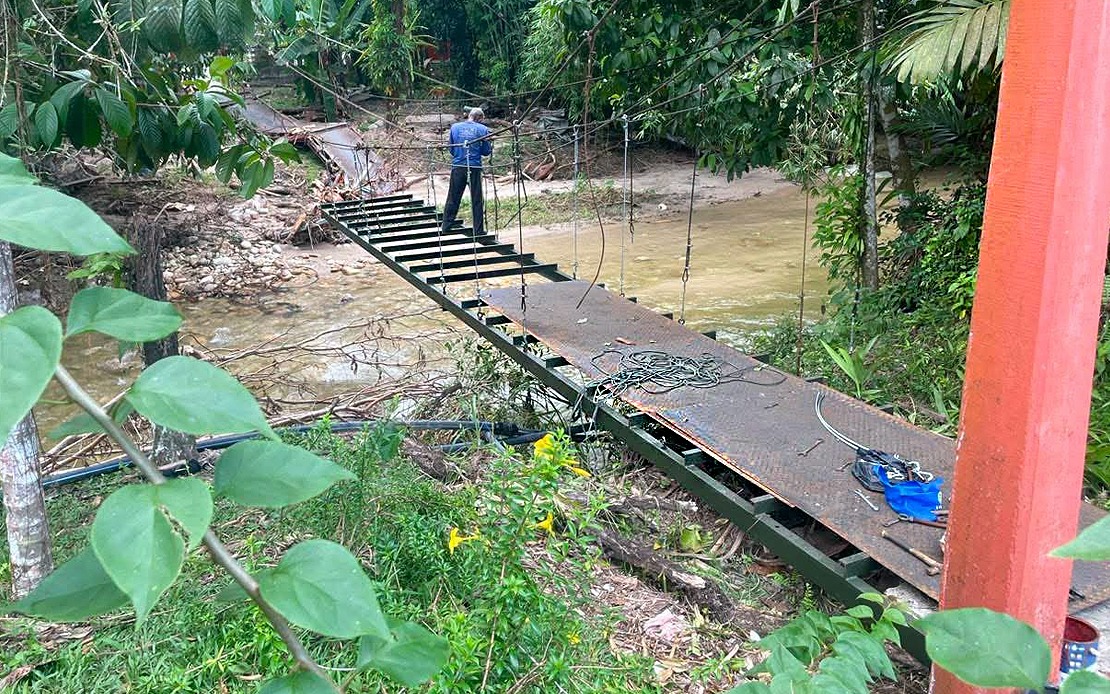
To bridge the gap until the permanent structure stands, the state government has greenlighted an emergency RM150,000 allocation for a temporary suspension bridge currently under construction. Scheduled completion by mid-July provides a crucial intermediate solution, allowing residents to resume normal movement patterns and economic activity within weeks rather than months. This staged approach—emergency access followed by permanent infrastructure—reflects pragmatic disaster response policy balancing immediate need against fiscal prudence.
The June 19 water surge that precipitated the bridge's collapse exemplifies the unpredictable environmental hazards confronting communities in Perak's upland districts. Strong currents overwhelmed the structure's capacity, a failure that prompts wider questions about the adequacy of existing rural bridge designs and maintenance standards across the state. Engineering assessments of the destroyed bridge's construction quality and age will likely inform future specifications for replacements in similarly vulnerable locations.
For Kampung Ulu Geruntum residents, the approvals represent tangible government responsiveness following their evacuation crisis. However, the experience also underscores the fragility of rural connectivity across peninsular Malaysia, where single-crossing dependencies create acute vulnerability to environmental shocks. Communities relying on solitary bridge crossings face disproportionate risk when disasters strike, a systemic vulnerability that state planners should address through redundancy considerations in future infrastructure projects.
The timeline for the permanent bridge construction remains undisclosed, though completion could reasonably extend into late 2024 or beyond depending on detailed design, tendering, and execution phases. Construction quality and material durability will become paramount given the site's susceptibility to water surge events. Future-proofing the bridge against the specific hydrological conditions that destroyed its predecessor should inform engineering specifications to prevent recurrence.
Sandrea's public engagement with the recovery process—visible through social media updates and resource mobilisation across multiple funding sources—demonstrates the administrative machinery's capacity for rapid response to localised crises. Her coordination across housing, local government, and constituency channels illustrates how Malaysia's multi-tiered governance structure can aggregate resources when political will aligns with genuine need, though such effectiveness remains inconsistently distributed across different communities and regions.
The broader implications for Perak and similar states involve long-term infrastructure resilience planning in disaster-prone zones. Rural communities throughout Peninsular Malaysia face comparable exposure to seasonal flooding, water surges, and landslides. The Kampung Ulu Geruntum incident, while dramatic, forms part of an extended pattern of rural infrastructure vulnerabilities that demand systematic evaluation and investment prioritisation. State governments must move beyond reactive crisis responses toward proactive identification and reinforcement of critical connectors serving isolated populations.
Regional development policy increasingly recognises that rural connectivity directly determines economic opportunity and quality of life in remote settlements. When bridges fail, economic multiplier effects ripple through local commerce, agricultural marketing, and service delivery. The RM500,000 investment in Kampung Ulu Geruntum's permanent bridge therefore represents not mere infrastructure replacement but strategic investment in maintaining viable rural economies across Perak.

